
Miyazaki Airport Guide: Kyushu’s Bougainvillea Gateway
Miyazaki Airport links southern Kyushu with Tokyo, Osaka, Seoul and Taipei, and has its own rail line. See its history, runway, airlines and access.
 By The Aviation Hub
5 min read
Updated October 20, 2026
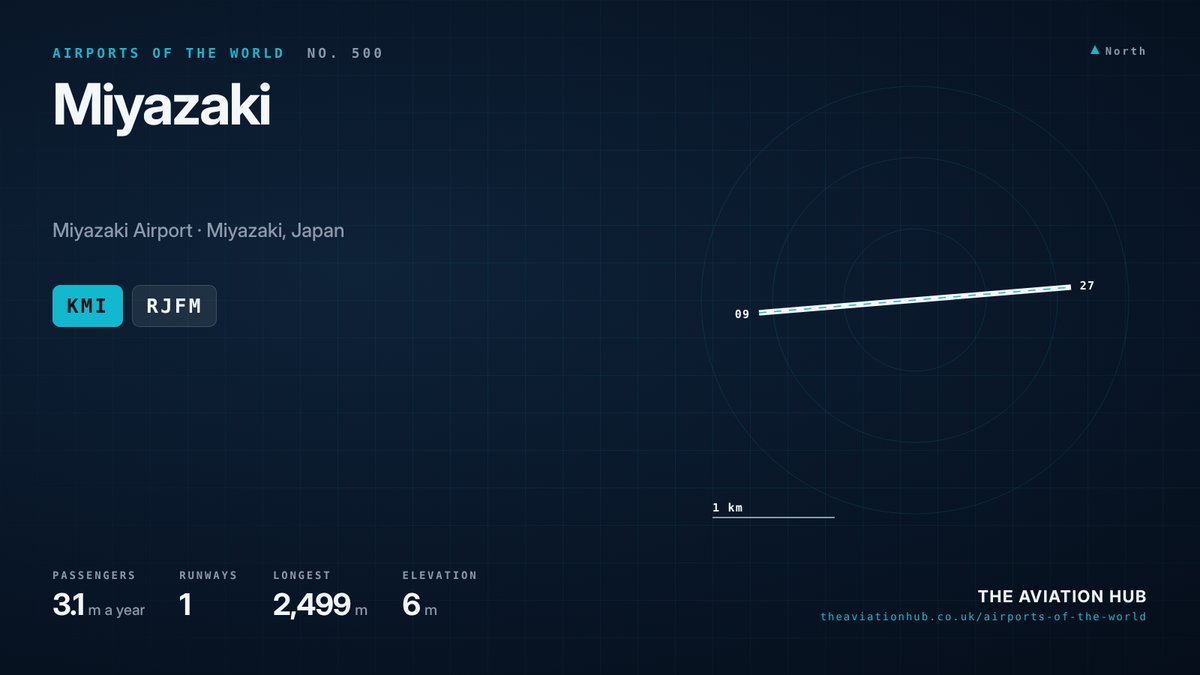
On the warm Pacific coast of southern Kyushu, Miyazaki has long sold itself as Japan’s subtropical escape, with palm lined avenues, surf beaches and baseball spring camps. Miyazaki Airport handles around 3.1 million passengers a year and sits just 2 miles (3.2 km) from the city centre. Locals call it Miyazaki Bougainvillea Airport. A short rail spur links it to the city, and it is the home of the regional airline Solaseed Air.
Miyazaki Airport at a Glance
The codes are KMI and RJFM. The airport lies about 2 miles (3.2 km) south south east of central Miyazaki, right on the coast, at an elevation of just 20 ft (6 m). It has one runway and a single terminal building handling domestic and international flights.
Traffic reached 3,116,019 passengers in 2024, with 18,422 aircraft movements and around 5,800 tonnes of cargo. Solaseed Air uses Miyazaki Airport as its hub, and its head office is in the terminal building. ANA, JAL and the low cost carriers Peach and Jetstar Japan also fly here. The national Ministry of Land, Infrastructure, Transport and Tourism runs the field. Flight information is on the airport’s official website.
A Short History of Miyazaki’s Airport
The airfield opened in 1943 as an Imperial Japanese Navy air base. From February 1945 it became a major base for kamikaze units, and 47 aircraft left Miyazaki on suicide missions, many of them during the Battle of Okinawa. The base was a target for American bombers in the final months of the war.
After the war the field was converted to civil use. Tourism made Miyazaki a famous honeymoon destination in the 1960s and 1970s, and traffic grew as jets replaced propeller aircraft. In October 1969 All Nippon Airways Flight 104 overran the runway, but all 53 people on board survived.
The war returned in October 2024. An American bomb of around 500 lb, buried since 1945, exploded beneath a taxiway at Miyazaki Airport, leaving a large crater. Nobody was hurt, but more than 80 flights were cancelled while the damage was repaired.
Runways at Miyazaki Airport
Runway 09/27 is 2,499 m (8,200 ft) long and 46 m (151 ft) wide, with an asphalt surface. It runs east to west, with the eastern end close to the Pacific shore and the city to the north west.
The length suits the Boeing 737, Airbus A320 family and occasional Boeing 767 jets used on the trunk routes to Tokyo and Osaka. Approaches from the east come in low over the sea, which makes for a scenic arrival.
Weather is the main challenge. Typhoons can close the airport in late summer and autumn, and the rainy season in June and July brings heavy downpours. The rest of the year is generally mild and sunny, which helped earn Miyazaki its reputation as a resort.
Terminals and Airlines
The terminal at Miyazaki Airport is a compact, modern building with domestic and international sections, shops selling local specialities such as mangoes, and an observation deck on the upper level. Solaseed Air’s head office occupies the second floor.
ANA flies to Tokyo Haneda and Osaka Itami, with its regional partners ANA Wings and Oriental Air Bridge adding Nagoya and Fukuoka. JAL serves Haneda, and its subsidiary J-Air flies Embraer jets to Fukuoka and Itami. Solaseed Air flies Boeing 737-800s to Haneda, Nagoya Centrair and Naha in Okinawa.
Low cost carriers have grown their share. Peach flies to Osaka Kansai and Tokyo Narita, and Jetstar Japan also links Narita. International flights are limited to Asiana Airlines from Seoul Incheon and Tigerair Taiwan from Taipei Taoyuan.
Routes and Destinations
Tokyo is the dominant market by far, with ANA, JAL and Solaseed sharing the Haneda route and low cost flights to Narita. Osaka comes second, split between Itami and Kansai. Fukuoka, Nagoya and Naha complete the domestic network.
The Fukuoka route competes with the train and highway bus, but the flight is far quicker across Kyushu’s mountains. Seoul and Taipei bring inbound tourists to Miyazaki’s beaches, golf courses and hot springs, and the region’s mild winters make it popular for sports training camps.
Demand peaks during Golden Week, the summer Obon holidays and the New Year. Cargo at Miyazaki Airport is modest at around 5,800 tonnes a year, most of it carried in passenger aircraft holds.
Getting to and from Miyazaki Airport
The JR Kyushu Miyazaki Airport Line, opened in 1996, runs from a station beside the terminal to the Nichinan Line at Tayoshi. At about 1.4 km it is one of the shortest lines in Japan. Trains reach Miyazaki Station in around 10 minutes, and some limited express services run through to northern Miyazaki Prefecture.
The train is the cheapest and quickest option for the city centre. Buses run to central Miyazaki and to the coast at Aoshima, about 20 minutes south. Taxis wait outside arrivals and take around 15 minutes to the centre.
Rental cars are popular for exploring the Nichinan coast or heading inland to the Takachiho gorge, around three hours away. Parking is available next to the terminal.
Spotting and Photography
Miyazaki Airport is a pleasant spotting venue. The observation deck overlooks the apron and runway, and the mix of ANA, JAL, Solaseed, Peach and Jetstar liveries keeps things colourful. Arrivals over the sea from the east are a highlight.
The coastline near the runway’s eastern end offers views of aircraft on final approach over the water. Clear winter days give the sharpest light. Air enthusiasts in the region also visit the Japan Air Self Defense Force base at Nyutabaru, about 25 km to the north.
Respect the rules on the deck, stay on public land outside and keep clear of the perimeter fence. Japanese police and airport staff are polite but firm about restricted areas.
What Comes Next
There is no major expansion plan, and the airport’s challenge is demand rather than capacity. Growth depends on inbound tourism from Asia, new low cost routes and a steady recovery in domestic travel.
The 2024 explosion was a reminder that history still shapes the site, as buried ordnance remains a concern at former military airfields across Japan. The verdict is a stable regional airport with upside from Korea and Taiwan. See Kyushu’s airports on the Airports of the World map.
Continue to follow The Aviation Hub for more analysis and insight.
Advertise with us Your brand, in front of an aviation audience Home page and in-article placements, sold directly, one advertiser per slot. From £250 a year. See the rates

