
Monterrey Airport serves Mexico’s industrial capital, a city of more than five million people in the state of Nuevo Leon and a few hours by road from the Texas border. Formally General Mariano Escobedo International Airport, it sits in the municipality of Apodaca about 17 miles (28 km) northeast of the city centre. It handled 15.6 million passengers in 2025, making it the fourth busiest airport in Mexico. Viva, one of the country’s two big ultra low cost carriers, calls it home, and its US route network is one of the deepest in northern Mexico.
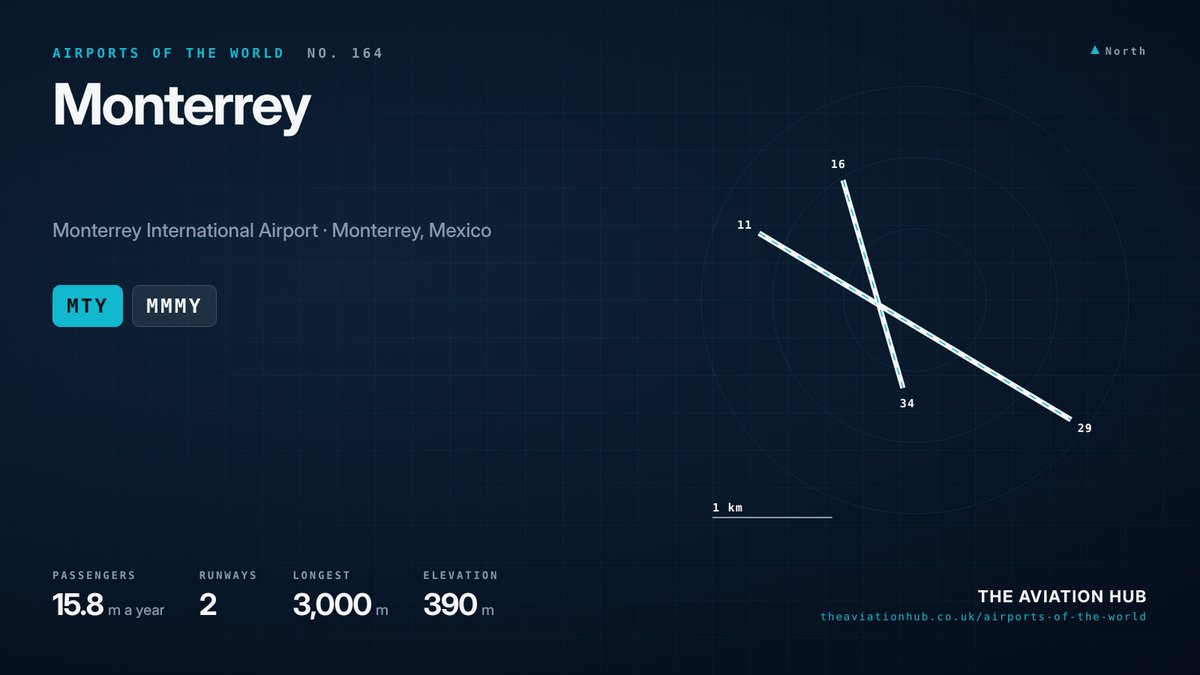
Monterrey Airport at a Glance
The codes are MTY and MMMY. The field lies 390 m (1,278 ft) above sea level on the plain north of the Sierra Madre Oriental, with the saddle shaped Cerro de la Silla dominating the view to the south. There are two runways and three passenger terminals, lettered A, B and C. Passenger numbers rose from 13.6 million in 2024 to 15.6 million in 2025, a jump of around 15 per cent and a record.
Viva operates its main hub here and Magnicharters and the regional carrier Aerus are also based at the field. Aeromexico runs a large operation from its own terminal and Volaris calls it a focus city. Grupo Aeroportuario Centro Norte, known as OMA, operates Monterrey Airport under a federal concession, and Vinci Airports bought a 30 per cent stake in OMA in 2022. Parking and flight information are on the airport’s official website.
How Monterrey’s Airport Came to Be
Monterrey’s first airport, Del Norte, on the northern edge of the city, still exists as a general aviation field. By the 1960s it was boxed in by housing and could not take the jets that Mexicana and Aeromexico were buying. The federal government built a replacement on open land in Apodaca, and the new airport opened on 25 November 1970 when a Mexicana de Aviacion Boeing 727 landed on the fresh runway.
The name honours General Mariano Escobedo, the nineteenth century soldier from Nuevo Leon who led republican forces against the French backed empire of Maximilian. For its first three decades the airport was a single terminal operation serving Mexico City, the border and a handful of American cities.
Growth came with the North American Free Trade Agreement in the 1990s and the arrival of low cost carriers in the 2000s. Terminal C opened in 2006 for the new carrier Viva, Terminal B followed in 2010 for Aeromexico and its SkyTeam partners, and the original building became Terminal A. A modernisation programme launched in 2019 is rebuilding Terminal A once more.
Runways at Monterrey Airport
The main runway is 11/29, an asphalt strip of 3,000 m (9,843 ft) by 45 m equipped with an instrument landing system. It can accept wide body aircraft, and Aeromexico Boeing 787s and the occasional wide body freighter prove the point, but the day to day traffic is narrow body. The runway runs northwest to southeast, with arrivals from the northwest crossing the industrial parks of Apodaca and those from the southeast coming in over farmland.
The second runway, 16/34, is 1,801 m (5,909 ft) long and 30 m wide, also asphalt. It is seldom used, though it offers a crosswind option when strong winds blow from the north. Monterrey Airport effectively runs as a single runway operation, which copes with today’s traffic but will become a constraint later this decade.
An AeroUnion Airbus A300 freighter crashed on approach to the main runway in April 2010, killing the five crew and a person on the ground.
Terminals and Airlines
Terminal A is the original 1970 building. It has gates 1 to 14 and a satellite concourse reached through an underground corridor, and it houses Volaris, Magnicharters and the US carriers American, United and their regional partners, along with Air Canada and Copa. Mexicana, the state owned revival of the old flag carrier, also uses Terminal A. The building is mid way through a reconstruction that adds new check in halls and three piers.
Terminal B, opened in 2010, is the SkyTeam building. Aeromexico, Aeromexico Connect and Delta fly from gates B1 to B16, and the regional operators TAR and Aerus share the space. It was designed for around 2 million passengers a year.
Terminal C, from 2006, belongs to Viva. Gates 21 to 33 handle the carrier’s Airbus A320 and A321 fleet in a basic, functional building built for fast turnarounds. A free shuttle links the three terminals from 05:00 until midnight.
Routes and Destinations
Mexico City is the busiest route by a wide margin, with Aeromexico, Viva and Volaris competing to both the old airport and Felipe Angeles. Cancun, Guadalajara, Chihuahua and Tijuana are the other main domestic markets. Viva uses Monterrey Airport as the centre of a point to point network that reaches most of Mexico’s larger cities with several daily rotations.
The United States is the big international story. Houston, Dallas and Miami are the busiest international links, and American, United, Delta and Viva add more US cities, reflecting the manufacturing supply chains and family ties that bind Nuevo Leon to Texas and beyond. Copa’s Panama City and Air Canada’s Toronto services round out the regional map. Aeromexico has used Monterrey as an outbound stop on its Asian routes since 2014, and the Seoul Incheon sector of roughly 7,100 miles (11,500 km) is the longest flight from the field. Iberia launched a nonstop Madrid service in June 2026, restoring a scheduled link to Europe last flown in 2009.
Getting to and from Monterrey Airport
For now the airport is reached by road only. The Carretera Miguel Aleman and the ring road bring traffic to the terminals in 30 to 60 minutes from the city centre depending on the hour, and the evening rush can push that higher. Licensed taxi companies sell fixed fare tickets at desks in each terminal, and a ride downtown costs around 350 to 450 pesos (£14 to £18). Rideshare pickups work from designated zones.
Bus route R-109 links the terminals to Y Griega station on Metro Line 1 for a few pesos, which is the cheapest sensible option for anyone with light luggage. An express bus runs to the BBVA Stadium on match days. Noreste coaches run hourly to the Central Bus Station in about an hour. The Metro Line 6 extension to an airport station, under construction since April 2024, missed its target of opening for the 2026 World Cup and is now expected around 2027. It will change the picture entirely.
Spotting and Photography
Monterrey Airport gives spotters the Cerro de la Silla as a backdrop, and that mountain makes the field worth a visit. The terminal windows look onto the apron, and Terminal B’s gate area faces the main runway. Outside, the roads of the Apodaca industrial zone under the approach to runway 11 give low shots of arrivals, and the open land beyond the 29 end suits departures.
Afternoon light from the west works best for aircraft on short final to 11 with the mountains behind. The traffic is dominated by Viva and Volaris Airbus A320neo family jets, Aeromexico Boeing 737 MAXs and Embraer E190s, and the US majors, with Aeromexico 787s on the Asian rotations and freighters for variety. Security staff patrol the perimeter and the industrial roads, so stay on public ground, keep away from fences and be ready to explain yourself calmly.
What Comes Next
The Terminal A reconstruction, costed at around 4.2 billion pesos, is the centrepiece of the current plan and should lift total capacity from 11 to 16.5 million passengers once the new piers and baggage halls open. The original 2025 completion date has slipped, and traffic has already overtaken the old capacity figure, which explains the crowding. The metro extension and the profile gained from the 2026 World Cup should push demand higher still.
Monterrey Airport is heading towards 20 million passengers and will need its second runway upgraded before the decade is out. Compare it with Mexico’s other big airports on the Airports of the World map.
Continue to follow The Aviation Hub for more analysis and insight.
Advertise with us Your brand, in front of an aviation audience Home page and in-article placements, sold directly, one advertiser per slot. From £250 a year. See the rates

