
Montreal Airport Guide: Canada’s Transatlantic Gateway
Montreal Airport handles more than 22 million passengers a year and flies Canada's busiest international route. Here is how Trudeau works.
 By The Aviation Hub
7 min read
Updated October 20, 2026
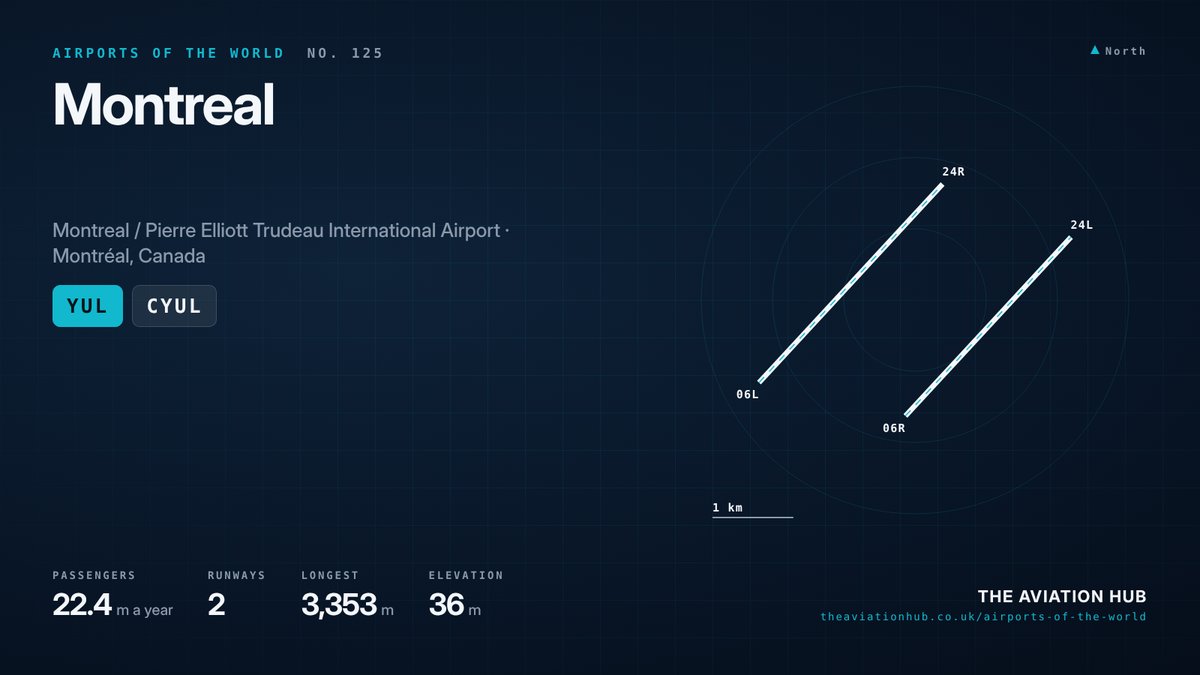
Montreal Pierre Elliott Trudeau International Airport sits in the suburb of Dorval, about 9 miles (15 km) west of downtown Montreal on the island itself. It is the busiest airport in Quebec and the third busiest in Canada after Toronto Pearson and Vancouver. Montreal Airport handled around 22.4 million passengers in 2025, and more than 70 per cent of them were flying internationally or to the United States, the highest share of any Canadian airport. Air Canada, Air Transat and a cluster of regional carriers call it home.
Montreal Airport at a Glance
The codes are YUL and CYUL. The field lies at 36 m (118 ft) above sea level and straddles the boundaries of Dorval, Montreal and Saint Laurent. It has two parallel runways, 06L/24R and 06R/24L, after a third, 10/28, closed in July 2023 and became a taxiway. One terminal with three jetties handles domestic, international and transborder traffic.
Transport Canada owns Montreal Airport and Aeroports de Montreal operates it under a 60 year lease. Air Canada uses it as one of its three hubs and keeps its corporate headquarters on the Saint Laurent side of the field. Air Transat and Air Inuit are headquartered there too, Porter Airlines has an operating base, and WestJet, PAL Airlines and Air Creebec also fly here. In 2025 the airport logged around 206,600 aircraft movements. Live flight data and parking rates are on the airport’s official website.
From Dorval to Trudeau
Dorval Airport opened on 1 September 1941 to replace the Saint Hubert field south of the river, which could not expand. Wartime ferry flights to Britain gave the new field its first transatlantic role. A $30 million terminal opened on 15 December 1960, and the airport was renamed Montreal Dorval International that November.
The federal government then built Mirabel, a vast new airport north of the city that opened in 1975 and was meant to replace Dorval entirely. Travellers hated the distance, international flights drifted back to Dorval by 1997 and Mirabel lost its last passenger flights in 2004. Dorval survived because it was close to the city.
A CAD 716 million expansion from 2000 added the 18 gate transborder jetty in 2003, a new international jetty in 2004 and a parking garage in 2005. On 1 January 2004 the airport was renamed after Pierre Elliott Trudeau, the former prime minister, a choice that drew opposition because his government had built Mirabel to replace Dorval. Many locals still say Dorval.
Runways at Montreal Airport
The main runway, 06L/24R, is 3,353 m (11,000 ft) long and 61 m wide. It carries a Category II instrument landing system on the 06L end and Category I on 24R. The parallel runway, 06R/24L, measures 3,014 m (9,890 ft) by 61 m, with Category I approaches at both ends.
The two runways are staggered and sit roughly a mile apart. Westerly winds dominate, so arrivals on 24R and 24L over the suburbs of Saint Laurent and Ahuntsic are the normal pattern, with departures climbing out over Dorval and Lac Saint Louis. Easterly operations on the 06 runways bring aircraft in over the lake.
Runway 10/28, the old crosswind strip, closed permanently in July 2023 and now serves as a taxiway and the site of a planned remote terminal. Winter is the real test at Montreal Airport. Heavy snow and freezing rain are routine from December to March, and the de icing pads near the runway thresholds work hard through the season.
Terminals and Airlines
A single terminal building splits into three jetties. The domestic jetty, behind security checkpoint A, has a main section with 16 gates and a satellite with 10 gates, most of them bus or walk out stands for Dash 8 turboprops and regional jets. Air Canada, Air Canada Express, Porter, WestJet, Air Inuit, Air Creebec and PAL Airlines all use it.
The international jetty, also reached through checkpoint A, has 18 gates, including Gate 55, designed to take the Airbus A380. Air Canada, Air Transat, Air France, KLM, Lufthansa, British Airways, Swiss, Austrian, Turkish Airlines, Qatar Airways, Royal Air Maroc and Emirates all board here.
The transborder jetty, through checkpoint C, has 18 gates and United States preclearance, so passengers land in America as domestic arrivals. Air Canada, American, Delta and United fill it. A 279 room Marriott hotel sits above the transborder building, and Air Canada’s Maple Leaf lounges serve both the domestic and international jetties.
Routes and Destinations
Toronto Pearson is the busiest domestic route by a wide margin, with Vancouver, Calgary, Ottawa, Quebec City and Halifax behind it. Transborder traffic of around 4.7 million passengers in 2025 flows mostly to New York, Chicago, Boston, Fort Lauderdale, Orlando and Miami, the Florida routes swelling every winter.
Montreal to Paris is the busiest international route in Canada and carries more than 1.5 million passengers a year on Air Canada, Air France, Air Transat and French Bee. French speaking Quebec gives the airport a natural link to France, Belgium, Switzerland, Morocco, Algeria and Lebanon that no other North American airport matches. Montreal Airport offers year round non stop flights to five continents, a distinction it shares in Canada only with Toronto.
The longest route is Air Canada’s seasonal service to Delhi at around 7,000 miles (11,300 km), with Emirates to Dubai, Air Canada to Seoul and Tokyo and Qatar Airways to Doha all above 6,400 miles. Winter sun flying to the Caribbean, Mexico and Cuba on Air Transat, WestJet and Air Canada is a huge seasonal business. Cargo is secondary, though Bombardier’s Global and Challenger business jets are assembled on the field.
Getting to and from Montreal Airport
The STM 747 bus runs around the clock between the terminal and downtown, stopping at Lionel Groulx metro, Central Station and Berri UQAM. The fare is included in a 24 hour transit pass costing around CAD 11, and the ride takes 45 to 70 minutes depending on traffic. It is the cheapest sensible option by far.
Via Rail passengers can take a free shuttle to Dorval station, about 1.2 miles (2 km) away, for trains to Ottawa, Quebec City, Kingston and Toronto. The long promised REM light rail link to downtown has a station under construction beneath the new parking structure, with delivery planned for 2027 before testing and opening.
By road, Highways 20 and 520 pass the airport, and a taxi to downtown costs a flat CAD 49 (about £27) for a journey of 25 to 45 minutes. Uber picks up from a dedicated area. Parking ranges from a multi storey garage next to the terminal to cheaper economy lots served by shuttle.
Spotting and Photography
The best known viewpoint at Montreal Airport is Jacques de Lesseps Park, which looks out over runway 06R/24L and its taxiways, with the light behind the camera from morning to early afternoon. Aircraft on final for 24R pass low over the residential streets of Saint Laurent, and the roads around the Air Canada headquarters give views of the threshold. The Marriott’s airside rooms overlook the transborder apron and the runways beyond.
Westerly operations put arrivals on the 24 runways for most of the year, with afternoon light on the northern side. The fleet is heavy on Air Canada Airbus A220-300s, A320 family and Boeing 737 MAX 8 aircraft, with 787s and Airbus A330-300s on the European routes. Air Transat A321LRs and A330s, Air France Boeing 777-300ERs and the Dash 8s of Air Inuit add variety.
Airport security and the Montreal police keep an eye on the perimeter. Stay on public roads and parks, do not lean cameras over the fence and keep clear of the approach lights. Winter spotting needs serious clothing.
What Comes Next
Aeroports de Montreal announced a CAD 2.5 billion programme in 2018 running to 2030. It includes the rebuilt parking structure with the REM station beneath it, a larger drop off area and a remote terminal on the site of the old Runway 10/28. International jetty extensions in 2012 and 2016 already added gates for the growing wide body operation.
Growth has been steady rather than spectacular, with 2025 fractionally below 2024. Capacity on the two runways is adequate for now, and the main constraints are terminal space and road access, both being addressed. Mirabel, 25 miles (40 km) to the north, remains a cargo and industrial field with no prospect of returning to passenger service.
Montreal Airport will stay Canada’s most international gateway and will gain the rail link it should have had decades ago. See how it compares with other North American hubs on the Airports of the World map.
Continue to follow The Aviation Hub for more analysis and insight.
Advertise with us Your brand, in front of an aviation audience Home page and in-article placements, sold directly, one advertiser per slot. From £250 a year. See the rates

