
Moscow Sheremetyevo Airport Guide: Aeroflot’s Home Base
Moscow Sheremetyevo Airport is Russia's busiest and the home of Aeroflot. Terminals, three runways, routes, Aeroexpress rail access and spotting explained.
 By The Aviation Hub
6 min read
Updated October 20, 2026
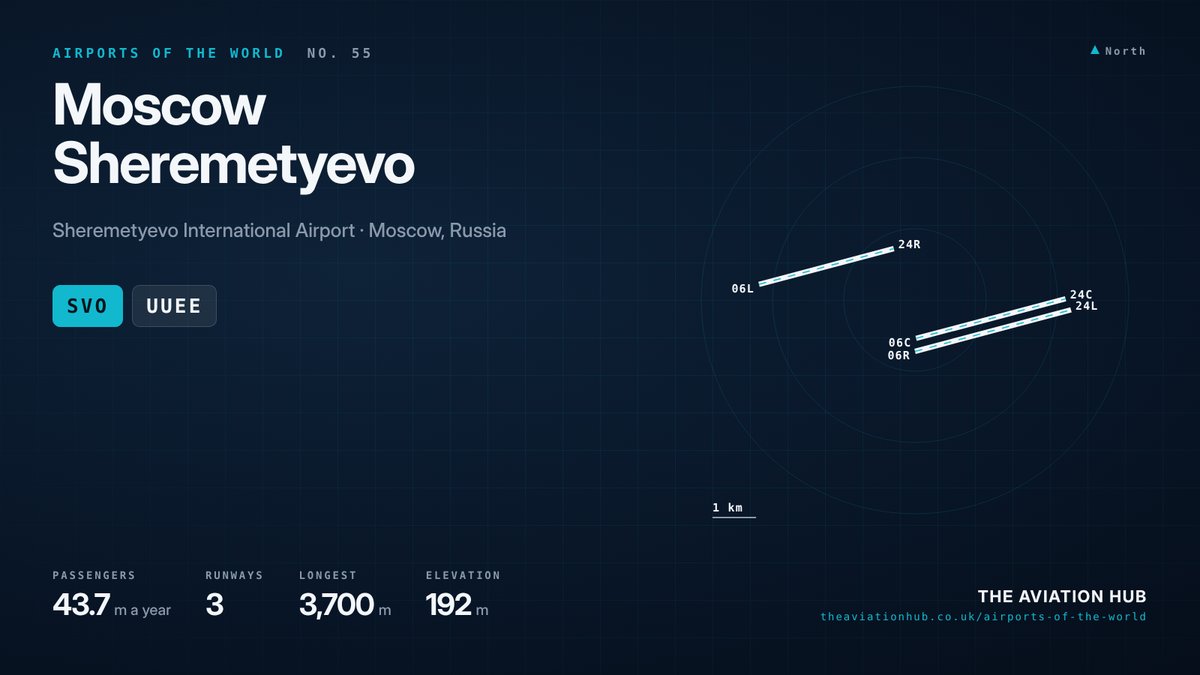
Sheremetyevo International Airport lies in Khimki, about 18 miles (29 km) northwest of the Kremlin, and is the busiest airport in Russia. Moscow Sheremetyevo Airport handled around 43.5 million passengers in 2025, well below its 2019 peak of almost 50 million, after sanctions removed most Western airlines and closed much of the sky to the west. It remains the fortress hub of Aeroflot and the main international gateway to the country, now oriented firmly towards the Gulf, Turkey, China and Central Asia.
Moscow Sheremetyevo Airport at a Glance
The IATA code is SVO and the ICAO code is UUEE. The field sits at 192 metres (630 feet) above sea level on flat, forested land beside the Leningradskoye Highway. Three parallel concrete runways serve a terminal complex split into a northern cluster, Terminals B and C, and a southern cluster, Terminals D, E and F, with an underground people mover between them. Sheremetyevo International Airport JSC operates the field, with private investors holding the majority and the Russian state the remainder.
Aeroflot, its subsidiaries Rossiya and the low cost carrier Pobeda, plus Nordwind and Smartavia, all base aircraft here. The airport was officially named after the poet Alexander Pushkin in 2019 after a public vote, though almost nobody uses the title. Traffic has drifted downwards since 2022 as the Western network vanished and aircraft parts became scarce. Current flight and transport information is on the airport’s official website.
A Short History of Sheremetyevo
The site began as a military airfield that became operational in 1957, named after the nearby village and railway halt of Sheremetyevsky. Civil flights started on 11 August 1959 and the first international service, to Berlin Schonefeld, departed on 1 June 1960. The original Terminal B, with a circular roof the locals nicknamed the shot glass, opened in 1964 and became the face of Soviet aviation.
Sheremetyevo-2, now Terminal F, opened in 1980 for the Moscow Olympics and handled all international flights for three decades. In 2013 Edward Snowden spent more than a month in the airport’s transit zone while seeking asylum. Terminal D opened in 2009 and gave Aeroflot a purpose built hub, with Terminal E following in 2010 to link D and F.
A rebuilt Terminal B opened in May 2018 before the World Cup, and Terminal C1 followed in January 2020. Within two years the pandemic and then the war in Ukraine transformed the airport’s fortunes, removing Western carriers and closing European airspace to Aeroflot.
Runways at Moscow Sheremetyevo Airport
Three concrete runways run northeast to southwest. Runway 06R/24L is the longest at 3,700 metres (12,139 feet), Runway 06C/24C measures 3,550 metres (11,647 feet) and Runway 06L/24R is 3,200 metres (10,499 feet). All are 60 metres wide. The third runway, on a separate airfield to the north of the original pair, was approved in 2011 and entered service in 2019 after years of delay and land disputes.
The original two runways at Moscow Sheremetyevo Airport are close together and were long operated as a dependent pair, which limited capacity. The third strip, far enough away for independent operations, added capacity, though it has been out of use for long periods since traffic fell. The 24 runways are in use in the common southwesterly flow, though the pattern changes with the wind.
Winter is the test. Snow falls often from November to March and the airfield keeps an enormous fleet of ploughs and sweepers to hold the runways open. The 2019 crash of Aeroflot Flight 1492, a Sukhoi Superjet 100 that returned after a lightning strike and burst into flames on landing, killed 41 people and remains the worst accident in the airport’s recent history.
Terminals and Airlines
Terminal D is the heart of the Aeroflot operation and handles both domestic and international flights, including the wide body Airbus A350-900 and Boeing 777-300ER services to the Far East and the long domestic sectors to Vladivostok and Khabarovsk. Rossiya moved its Moscow domestic flights here in 2018. Terminal E alongside links D with F. SkyTeam suspended Aeroflot’s membership in 2022.
In the northern cluster, Terminal B handles most Aeroflot domestic flights with narrow body A320 and 737 aircraft, and Terminal C1 takes international services from Aeroflot and a growing list of foreign operators. Pobeda, Nordwind and Smartavia add their own domestic networks. Terminal F, the old Sheremetyevo-2, has been largely mothballed since traffic fell. Terminal A, opened in 2012, serves business aviation.
Foreign airlines at Moscow Sheremetyevo Airport today include Qatar Airways, Etihad, Air China, China Southern, China Eastern, Hainan Airlines, Vietnam Airlines and Air Serbia. Not one European Union or North American airline remains.
Routes and Destinations
Domestic flying has grown in importance at Moscow Sheremetyevo Airport. St Petersburg is the busiest route, followed by Sochi and Yekaterinburg, with Kazan, Kaliningrad, Novosibirsk and Krasnodar also heavily served. Aeroflot runs a shuttle style schedule on the St Petersburg corridor, and the Far East routes carry wide bodies on flights of eight hours or more within a single country.
Internationally, Dubai, Istanbul, Abu Dhabi and Antalya dominate, serving both leisure traffic and transfer passengers heading on to Europe. Aeroflot flies to Beijing, Guangzhou, Delhi, Bangkok, Phuket and Male. Russian flights to Cuba were suspended in February 2026 because of fuel shortages on the island. Routes to China have expanded fastest since 2022.
Summer brings the Turkish and Egyptian charter peak, and the New Year holidays fill the Dubai, Phuket and Maldives flights. Cargo is modest by global standards.
Getting to and from Moscow Sheremetyevo Airport
The Aeroexpress train is the reliable choice. It runs nonstop to Belorussky station in central Moscow in about 35 minutes, departing every half hour or so, and the fare is around RUB 600 (roughly £5) when booked online. The station sits between Terminals D, E and F, and a free people mover links it to the northern terminals.
Buses 817 and 851 run to Planernaya and Rechnoy Vokzal metro stations in 35 to 55 minutes and cost only a few dozen roubles, which makes them the cheapest sensible option. Night bus N1 serves the city centre when the trains stop. By road, the Leningradskoye Highway is notorious for congestion, and a toll road to the MKAD ring road opened in December 2014 to bypass the worst of it.
Taxis booked through apps such as Yandex Go cost roughly RUB 1,500 to 2,500 (around £13 to £22) to the centre and take 40 to 90 minutes. Multi storey car parks serve both terminal clusters.
Spotting and Photography
Spotting at Moscow Sheremetyevo Airport has become more sensitive since 2022, and enthusiasts should treat the fence with caution. The roads near the eastern thresholds give low arrival shots in the common southwesterly flow. Hotels near the southern terminals, including the Novotel, make convenient bases.
Summer evenings bring long golden light and daylight until late. In winter the sun stays low and snow reflects sharply off the fleet of white Aeroflot aircraft. Photography near airport infrastructure can attract police attention in Russia, so carry identification, keep to public areas and do not photograph security installations. The terminal windows in D and C1 are the safest option.
What Comes Next
Terminal C2 would complete the northern cluster, but its timetable has slipped repeatedly and Terminal F remains mothballed. A 2016 agreement committed around USD 840 million to infrastructure, and the airport has invested in a digital twin to plan operations. Capacity is no longer the problem. Demand, aircraft availability and access to Western spare parts are the real constraints.
Moscow Sheremetyevo Airport will remain the largest in Russia and Aeroflot’s base, but its path back to 50 million passengers depends on politics rather than engineering. See how it compares on our Airports of the World map.
Continue to follow The Aviation Hub for more analysis and insight.
Advertise with us Your brand, in front of an aviation audience Home page and in-article placements, sold directly, one advertiser per slot. From £250 a year. See the rates

