
Moscow Vnukovo Airport Guide: The Capital’s Oldest Gateway
Moscow Vnukovo Airport is the oldest of the Russian capital's three big airports and home to Pobeda and Utair. Runways, routes and access explained.
 By The Aviation Hub
6 min read
Updated October 20, 2026
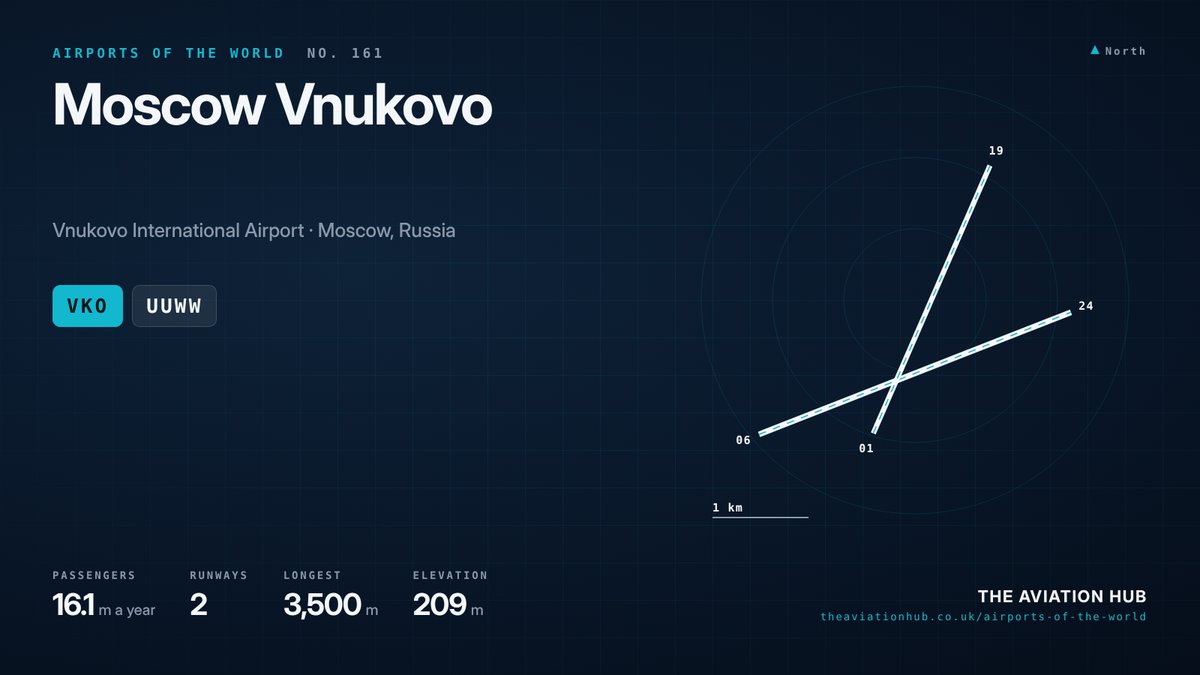
Moscow Vnukovo Airport sits on the southwestern edge of the Russian capital, about 17 miles (28 km) from the Kremlin and inside the city’s own administrative boundary. It is the oldest of Moscow’s three big airports, with around 16 million passengers in 2024. Vnukovo is the home of low cost carrier Pobeda and of Utair, and it hosts the government’s own VIP complex, so presidential aircraft and foreign delegations share the field with holiday charters to Antalya.
Moscow Vnukovo Airport at a Glance
The codes are VKO and UUWW. The field lies 209 m (685 ft) above sea level, which makes it the highest of the three Moscow airports. There are two intersecting runways and one passenger terminal in regular use, Terminal A, after Terminal B lost its flights in 2016. Around 16 million passengers used Moscow Vnukovo Airport in 2024, up roughly 10 per cent on the year before but well short of the 24 million peak of 2019.
Pobeda, Utair, Azur Air, Azimuth, RusLine, I Fly and Gazpromavia all base aircraft here, and Rossiya flies the Saint Petersburg route for the Aeroflot Group. The operator is Vnukovo International Airport JSC. Flight information, parking rates and the terminal map are on the airport’s official website.
A Short History of Vnukovo
The Soviet government approved a new airport in 1937 because Khodynka aerodrome, the capital’s original field close to the centre, had run out of room. Vnukovo opened in 1941 and spent the war as a military base while the front line came within a few dozen miles. Civil flights resumed after 1945 and the field served as the main airport of the Soviet capital through the 1950s.
Aeroflot’s early jets made their debuts here. The Tupolev Tu-104 flew its first scheduled service from Vnukovo in 1956, and the Il-62 and Tu-154 were everyday sights for the next three decades. Sheremetyevo took the international traffic from 1959 and Domodedovo opened in 1964, leaving Vnukovo with domestic routes and government flights.
The modern airport dates from a rebuilding programme that began in the early 2000s. Terminal B opened in 2004, the vast Terminal A followed in December 2010 and both runways were reconstructed in the same decade. The airport took the formal name Vnukovo Andrei Tupolev International Airport in 2019 after a national vote on naming Russia’s airports after notable figures.
Runways at Moscow Vnukovo Airport
Vnukovo has two runways that cross near the middle of the field. Runway 06/24 is the longer at 3,500 m (11,483 ft) and 60 m wide, and runway 01/19 measures 3,060 m (10,039 ft) by 45 m. Both are asphalt surfaced. The intersecting layout rules out true parallel operations, so controllers typically use runway 24 for departures and runway 01 for arrivals when the wind allows, which gives a joint capacity of around 60 movements an hour.
The runways at Moscow Vnukovo Airport have seen two serious accidents in recent memory. A Red Wings Tupolev Tu-204 overran runway 19 in December 2012 and broke up on the M3 motorway embankment, killing five crew. In October 2014 a Dassault Falcon 50 struck a snowplough during its takeoff roll, killing the chief executive of Total and three crew. The Falcon crash in particular exposed failings in ground vehicle control.
Longer term plans have talked of extending one runway to 3,800 m and upgrading the instrument landing system from CAT II to CAT III. Neither appears to have happened yet, and both now look distant.
Terminals and Airlines
Terminal A is the heart of Moscow Vnukovo Airport. It opened in December 2010 and handles both domestic and international flights under one roof, with domestic gates on one side of the building and international gates on the other. Pobeda fills a large share of the stands with its Boeing 737-800 fleet, while Utair, Azimuth, RusLine and Rossiya share the domestic piers. Turkish Airlines, flydubai, Uzbekistan Airways and the other Central Asian carriers use the international side.
Terminal B, which opened in 2004, lost its scheduled flights in 2016 when everything consolidated into Terminal A. A separate general aviation terminal, Vnukovo 3, handles the business jet traffic that makes this field one of Europe’s busiest for large private aircraft. The government’s Vnukovo 2 complex, on the northern perimeter, serves presidential and official flights and is closed to the public.
Routes and Destinations
Domestic flying dominates. Saint Petersburg, Sochi, Kaliningrad and Mineralnye Vody are the thick routes, with Pobeda and Rossiya running shuttles to Pulkovo through the day. Utair connects its Siberian heartland of Surgut, Tyumen and Khanty Mansiysk, and Azimuth feeds Rostov on Don. The Caucasus, the Urals and the Volga cities all see several departures daily.
Since 2022 the international map from Moscow Vnukovo Airport has shrunk to countries that still welcome Russian aircraft. Turkey is the largest market, with Antalya and Istanbul carrying a dense mix of charter and scheduled flights. Dubai, Tashkent, Samarkand, Yerevan, Baku and Minsk are other key markets. Azur Air flies wide body Boeing 767 and 777 charters to Antalya, Phuket, Goa, the Maldives and Sharm el Sheikh, but the longest flight is Conviasa’s service to Caracas, at around 6,200 miles (9,900 km). Cargo is modest, because Sheremetyevo handles most of Moscow’s freight.
Getting to and from Moscow Vnukovo Airport
The Moscow Metro reached the airport in September 2023, when Aeroport Vnukovo station opened at the end of the Solntsevskaya line, and this is the cheapest sensible option. A single fare costs around 70 roubles (under £1) and the ride to the central ring takes about 50 minutes, with the station entrance a short walk from Terminal A. The Aeroexpress train to Kiyevsky station ended in July 2024 and ordinary suburban trains now cover the same line.
Buses 611 and 611k connect the terminal to Yugo Zapadnaya and Salaryevo metro stations in 20 to 35 minutes. By road the Kiyevskoye and Borovskoye highways lead into town, and the M3 passes the end of runway 01. A taxi to the centre takes 40 minutes outside the rush hour and well over an hour inside it, at roughly 1,500 to 2,500 roubles (£13 to £22). A multistorey car park sits opposite Terminal A.
Spotting and Photography
Spotting in Russia requires caution, and Moscow Vnukovo Airport is no exception. The departure hall windows in Terminal A give the safest and best view of the apron, with Pobeda 737s, Rossiya Airbus A320s and the occasional Ilyushin Il-96 of the government’s Special Flight Detachment taxiing past. There is no public viewing terrace.
Outside the fence, the approach to runway 01 crosses the M3 Kiyevskoye highway, and the land around the village of Vnukovo gives low passes. Runway 24 departures climb over the suburbs to the southwest. Morning light favours arrivals on 01 photographed from the east, and westerly winds bring landings on 24 over the forest beyond the field.
Keep cameras away from the government complex, answer politely if police ask what you are doing and never photograph military or VIP aircraft on the ground. Russian law treats airport perimeters as sensitive and the penalties can be real.
What Comes Next
Sanctions have frozen the big ideas. The runway extension and CAT III upgrade remain on paper, Western aircraft deliveries have stopped and foreign investment has dried up. Instead the airport is working within what it has, with Terminal A handling every scheduled flight and Terminal B closed.
The metro link is the one real step forward, and it gives Moscow Vnukovo Airport an advantage its rivals cannot match. Traffic should keep edging back towards the 2019 peak as domestic demand grows and Pobeda expands. The field’s future lies as Russia’s low cost and government gateway rather than as an international hub. See how it compares with Sheremetyevo and Domodedovo on the Airports of the World map.
Continue to follow The Aviation Hub for more analysis and insight.
Advertise with us Your brand, in front of an aviation audience Home page and in-article placements, sold directly, one advertiser per slot. From £250 a year. See the rates

