
Mumbai Airport Guide: India’s Crowded Single Runway Giant
Mumbai Airport explained: crossing runways, Terminal 2 at Sahar, Air India and IndiGo, the Metro Line 3 link and how Navi Mumbai changes the picture.
 By The Aviation Hub
7 min read
Updated October 20, 2026
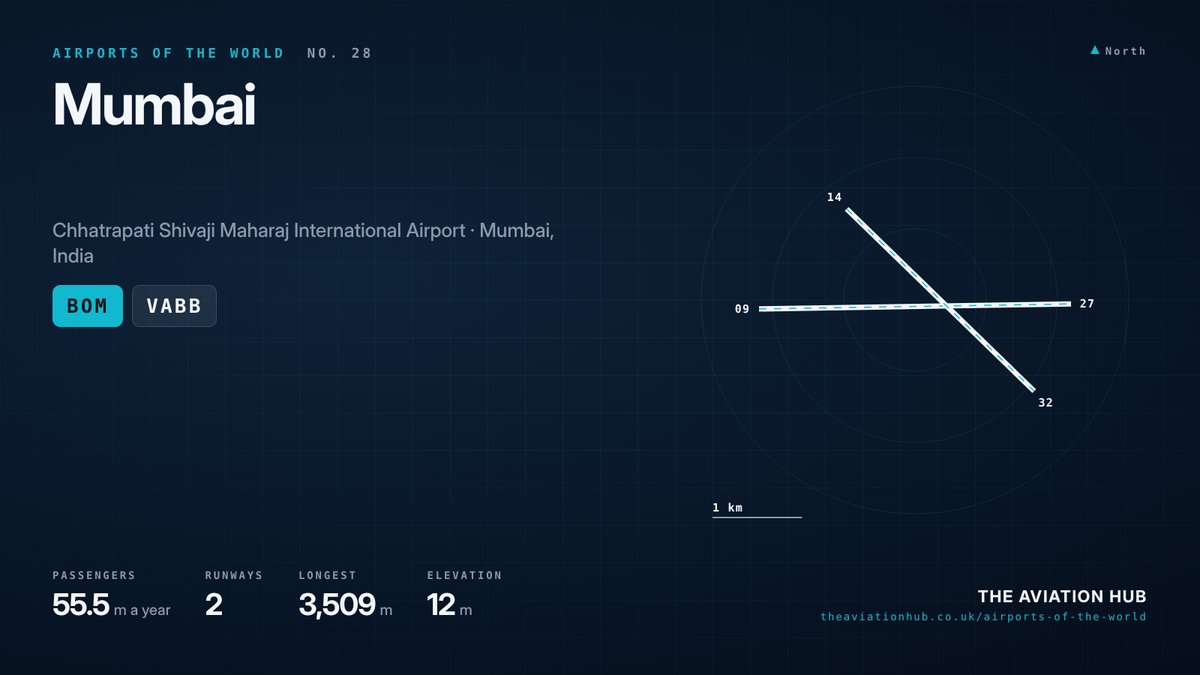
Mumbai Airport is the second busiest airport in India and one of the most congested in the world. It sits in the middle of the city’s northern suburbs, boxed in by housing, slums and the Western Express Highway, with two runways that cross each other and only one in use at a time. More than 55 million passengers squeezed through in the 2024 to 2025 financial year, just above its stated capacity of 55 million. A new airport at Navi Mumbai is finally taking some of the strain.
Mumbai Airport at a Glance
The IATA code is BOM, a relic of the city’s old name of Bombay, and the ICAO code is VABB. The formal name is Chhatrapati Shivaji Maharaj International Airport, after the 17th century founder of the Maratha Empire. The field straddles Santacruz and Sahar in Vile Parle East, about 10 miles (16 km) north of the Fort district, at an elevation of 12 m (39 ft).
Mumbai International Airport Limited operates it, a joint venture in which Adani Enterprises holds 74 per cent and the Airports Authority of India 26 per cent. Two terminals and two crossing runways handle the traffic. Air India, Air India Express, IndiGo, Akasa Air and SpiceJet all have large operations at Mumbai Airport, and Air India uses it as one of its two main hubs. Live flight status and transport details are on the airport’s official website.
How Mumbai’s Airport Came to Be
The Royal Air Force built RAF Santa Cruz in the 1930s and used it heavily between 1942 and 1947. Civil aviation took over the airfield in 1946, and a new passenger terminal at Santacruz opened in 1958. Juhu, the older and smaller aerodrome on the coast, could not take airliners, so Santacruz became the city’s airport by default.
The international terminal at Sahar opened at the end of 1980, splitting the operation into a domestic side and an international side that remained physically separate for decades. The airport was renamed from Sahar Airport to Chhatrapati Shivaji International Airport in 1999, and the word Maharaj was added in 2018. Privatisation in 2006 brought the GVK group in, and Adani took control in 2021.
The main runway was rebuilt and widened to 60 m in 2010 and 2011, and the new Terminal 2 opened in 2014 with its distinctive lotus columns. Simultaneous operations on the crossing runways ended in mid 2013. In 2017 the field overtook Gatwick as the busiest airport in the world with a single operational runway.
Runways at Mumbai Airport
Mumbai Airport has two asphalt runways that cross near the centre of the field. Runway 09/27 is the main strip at 3,509 m (11,511 ft) long and 60 m wide. It handles almost every movement, with departures and arrivals mixed on the same runway at intervals of about a minute at peak times. Runway 14/32 is 2,871 m (9,419 ft) long and 45 m wide, running between Terminal 1 and Terminal 2.
The secondary runway is used only when 09/27 is unavailable, for maintenance or during the monsoon when crosswinds become too strong. It is less suitable in wet conditions, and an Air India Boeing 747 skidded on it after hydroplaning in 2005. Simultaneous crossing operations were tried and dropped in 2013 because single runway working proved more efficient.
The BARC nuclear research complex at Trombay, a no fly zone, lies about 8 km beyond the 32 end of the secondary runway, which further limits its use. The monsoon from June to September brings torrential rain and regular go arounds. Slot control is strict, and the record stands at 51 movements in a single hour, set in 2014.
Terminals and Airlines
Terminal 2 at Sahar is the main building at Mumbai Airport, a four level structure with a long X shaped pier that handles all international flights and a large share of domestic traffic. Air India, Air India Express and part of the IndiGo operation use it, along with every foreign carrier. Emirates, Qatar Airways, Etihad, British Airways, Virgin Atlantic, Lufthansa, Singapore Airlines and United are among the long haul tenants. The eastern pier remains truncated because the adjoining slum colony has never been cleared, which gives the building a lopsided look from the air.
Terminal 1 at Santacruz is domestic only and the home of the low cost carriers. Akasa Air, SpiceJet, Star Air, Alliance Air and the rest of IndiGo’s flights use it. The two terminals sit on opposite sides of the runways, and transferring between them means a road journey of 15 to 20 minutes. A separate general aviation terminal at Kalina handles business jets and charters.
Routes and Destinations
Delhi is the busiest route from Mumbai Airport and one of the busiest city pairs in the world, with IndiGo, Air India, Akasa and SpiceJet running dozens of flights a day. Bengaluru, Hyderabad, Chennai, Kolkata, Goa and Ahmedabad fill out the domestic trunk network. The Gulf dominates the international side, with Dubai, Abu Dhabi, Doha, Muscat, Sharjah and the Saudi cities carrying the enormous flow of workers and families between western India and the Middle East.
Long haul service reaches London Heathrow, Frankfurt, Paris, Amsterdam, New York, Newark, San Francisco and Singapore. Air India flies Boeing 777s across the Atlantic, and IndiGo has entered the European market with Boeing 787s wet leased from Norse Atlantic to Amsterdam, Manchester, London and Copenhagen. Cargo is significant, with a large freight complex on the Sahar side handling pharmaceuticals and textiles. Traffic peaks around Diwali and the winter wedding season.
Getting to and from Mumbai Airport
Metro Line 3, the underground Aqua Line, opened its airport stations in October 2024 with stops at Terminal 1, Terminal 2 and the SkyCity complex, giving a direct link to Bandra Kurla Complex and south Mumbai for the first time. Fares are low, a matter of tens of rupees, and journey times to the business district are about 15 minutes. Metro Line 1 stops at Airport Road and Marol Naka close to Terminal 2.
Suburban trains on the Western line stop at Vile Parle, a short auto rickshaw ride from either terminal, and remain the cheapest option. The six lane Sahar Elevated Access Road links Terminal 2 to the Western Express Highway, and the drive to south Mumbai takes 45 minutes to well over an hour depending on traffic. Prepaid taxis and app based rides are available at both terminals, with a trip to Colaba costing roughly 600 to 800 rupees (around £6 to £8). BEST air conditioned buses run to points across the city and can be booked on the Chalo app.
Spotting and Photography
Mumbai Airport is a difficult but rewarding place to spot. The elevated Sahar road and the flyovers around the airport give brief views of the Terminal 2 apron. The Runway 27 approach over Kurla and the Mithi river is the classic view, with aircraft crossing low over the rooftops, and the Western Express Highway flyover near the 09 threshold puts you close to departures.
Hotels along the Sahar side, including those in the Andheri East cluster, have upper floor rooms facing the field and offer the safest vantage point. Early morning light is best in winter when the haze is lighter. Security forces take photography near the perimeter seriously, so avoid standing at the fence, do not use tripods on public roads and be ready to explain yourself. A hotel room is the sensible choice.
What Comes Next
The operator proposed in 2025 to raise capacity from 55 to 65 million passengers a year. Terminal 1 is to be rebuilt as a larger facility for 15 to 20 million passengers at a cost of about 2,500 crore rupees, although the old building will remain in use until at least 2029. Terminal 2 will grow from 40 to 45 million, and a three lane tunnel will finally link the two terminals under the runways.
The bigger story is Navi Mumbai International Airport across the harbour, which opened in late 2025 and will absorb a growing share of the city’s traffic. Metro Line 8 is planned to link the two airports. The crossing runways will not change, and the single runway operation will remain the limit. Mumbai Airport is heading for a future as the premium half of a two airport system rather than the only gateway to the city. See both on the Airports of the World map.
Continue to follow The Aviation Hub for more analysis and insight.
Advertise with us Your brand, in front of an aviation audience Home page and in-article placements, sold directly, one advertiser per slot. From £250 a year. See the rates

