
Munich Airport Guide: Lufthansa’s Bavarian Hub Explained
Munich Airport is Lufthansa's second hub and Germany's second busiest. Two 4,000 metre runways, terminals, routes, rail access and spotting explained.
 By The Aviation Hub
7 min read
Updated October 20, 2026
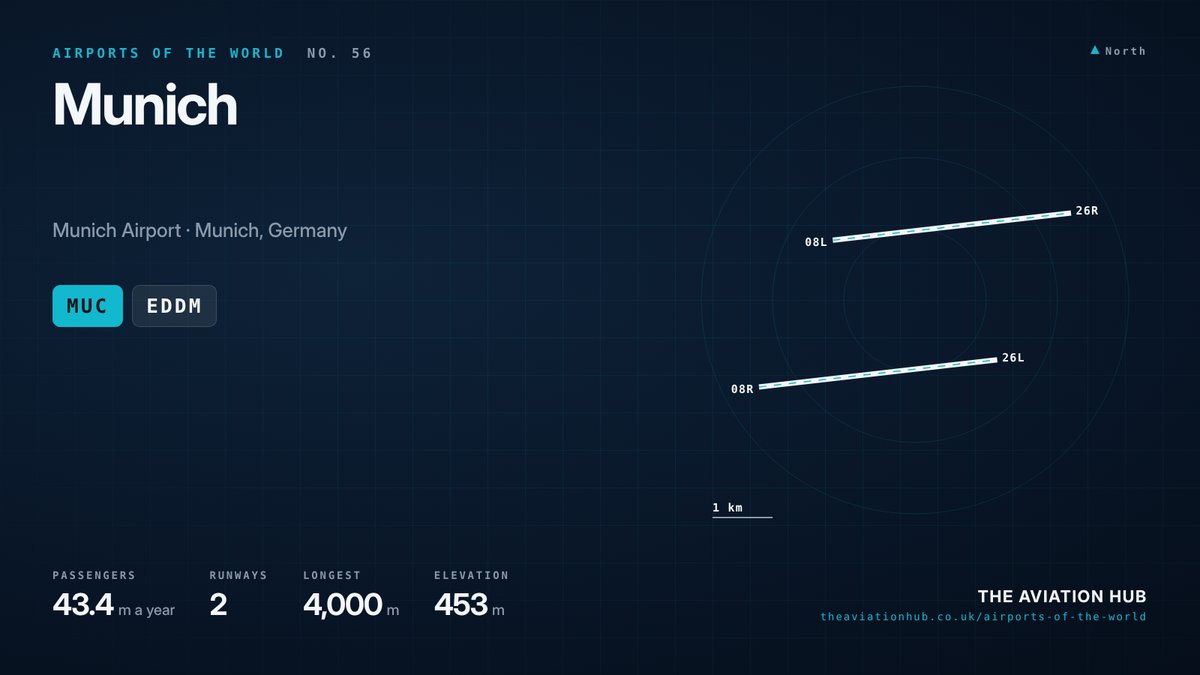
Franz Josef Strauss International Airport lies on the Erdinger Moos, a drained marsh about 18 miles (29 km) northeast of the centre of Munich. Munich Airport opened in 1992 and has grown into the second busiest in Germany and the second hub of Lufthansa. It handled around 43.4 million passengers in 2025, up more than 4 per cent on the previous year. Its two long parallel runways, the airline operated Terminal 2 and a famous visitor park make it one of the most admired airports in Europe among passengers and enthusiasts alike.
Munich Airport at a Glance
The IATA code is MUC and the ICAO code is EDDM. The field sits at 453 metres (1,487 feet) above sea level on flat farmland between Freising and Erding. Two parallel concrete runways, each 4,000 metres long, serve two terminals and a large satellite building. Flughafen Munchen GmbH operates the airport, owned by the Free State of Bavaria with 51 per cent, the Federal Republic with 26 per cent and the City of Munich with 23 per cent.
Lufthansa runs its second hub here together with Lufthansa CityLine, Lufthansa City Airlines and Air Dolomiti. Condor, Discover Airlines, Eurowings and TUI fly Deutschland also base aircraft at Munich Airport. The 2025 figure is still a little short of the 47.9 million recorded in 2019, but the gap is closing. Flight information and parking bookings are on the airport’s official website.
How Munich’s Airport Came to Be
Munich’s first airport opened at Oberwiesenfeld in 1931 and moved to Riem, east of the city, in 1939. Riem served the city for more than 50 years but was hemmed in by suburbs and had a single runway. The 1958 air disaster that killed much of the Manchester United team, when an Airspeed Ambassador failed to get airborne in slush, happened there. Planning for a replacement on the Erdinger Moos began in the 1960s and faced decades of legal challenge from farmers and environmentalists.
The new airport opened on 17 May 1992, the day after Riem closed, in an overnight move that shifted the entire operation across the city. It inherited the MUC and EDDM codes. The airport is named after Franz Josef Strauss, the Bavarian minister president from 1978 to 1988, who championed the project and chaired the first Airbus supervisory board.
Terminal 2 opened in 2003 as a joint venture in which Lufthansa holds 40 per cent, the first terminal in Germany co operated by an airline. Its satellite building followed in April 2016 with 52 gates and the ability to handle the Airbus A380. Munich Airport has since collected a long run of awards as the best airport in Europe.
Runways at Munich Airport
Two parallel concrete runways run east to west and are identical in size. Runway 08R/26L and Runway 08L/26R each measure 4,000 metres (13,123 feet) by 60 metres. They sit 2,300 metres apart, which permits fully independent parallel operations with arrivals and departures on both at once. Capacity is around 90 movements an hour.
The prevailing westerly wind means the 26 runways are in use for most of the year, bringing arrivals in over the farmland to the east. Easterly operations on 08 bring approaches in from the west. The length is generous enough for a fully loaded Airbus A350-900 to reach the west coast of North America without payload penalty.
Fog is the weather problem. The Erdinger Moos is a low lying marsh and autumn and winter mornings can bring CAT III conditions for hours at a time. Night flights are restricted between 22:00 and 06:00, with scheduled movements banned for most of that period and only delayed flights permitted on the edges.
Terminals and Airlines
Terminal 1 is the original 1992 building, arranged as a row of modules lettered A to E along a central road. It handles almost every airline outside Star Alliance, including American, Delta, Emirates, Etihad, Qatar Airways, Cathay Pacific, easyJet, Eurowings, Condor and TUI fly Deutschland. A new pier for non Schengen flights entered service in April 2026 after a long build, adding capacity for six million passengers a year.
Terminal 2 and its satellite are the Lufthansa and Star Alliance house. Lufthansa, Lufthansa City Airlines, Air Dolomiti, Discover Airlines, Austrian, Swiss, United, Air Canada, ANA, Singapore Airlines, Thai Airways and Turkish Airlines all use it, along with Luxair. An underground people mover links the main building to the satellite in about a minute. Lufthansa’s First Class Lounge and Senator Lounges in Terminal 2 are among the best in its network.
The Munich Airport Center, a huge covered plaza between the terminals, holds shops, restaurants and the suburban railway station. In winter it hosts a Christmas market with an ice rink, a feature few airports can match.
Routes and Destinations
Domestically, Hamburg, Berlin, Dusseldorf, Frankfurt and Cologne Bonn lead, though rail competition has thinned the shorter routes. Within Europe, London Heathrow has long been the busiest destination, and Amsterdam, Paris, Madrid and Athens are also heavily served. Lufthansa feeds its intercontinental network with dozens of short haul rotations a day from Italy, Eastern Europe and the Balkans in particular.
Long haul traffic is led by Dubai, with Doha, Abu Dhabi, Bangkok and Newark also busy. Lufthansa flies long haul to Los Angeles, San Francisco, Chicago, Tokyo, Seoul, Shanghai, Delhi, Mumbai and Cape Town, and the Munich fleet of A380s returned after the pandemic. The longest sector is Singapore Airlines’ nonstop to Singapore at about 6,250 miles (10,060 km).
Summer brings heavy leisure traffic to the Mediterranean on Condor, Eurowings and TUI fly, while winter weekends fill with skiers heading for the Alps. Cargo is modest but growing, with Lufthansa Cargo using belly capacity on the wide body fleet.
Getting to and from Munich Airport
The suburban railway lines S1 and S8 are the cheapest sensible option. The S8 runs east of the city to Ostbahnhof, Marienplatz and the Hauptbahnhof in about 40 minutes, and the S1 loops west through Neufahrn. Both run roughly every 20 minutes for 20 hours a day with a break in the small hours. A single ticket costs around EUR 14 (roughly £12), and the airport day ticket is better value for a return.
The Lufthansa Airport Bus runs to the Hauptbahnhof and Nordfriedhof in about 45 minutes, and regional bus 635 reaches Freising station in 20 minutes. Since December 2018 a regional express train has linked the airport to Regensburg via the Neufahrn curve. There is still no long distance rail link.
By road, the A92 motorway and the eastern airport tangent connect to the city and the A9. Taxis cost roughly EUR 80 to 100 (around £70 to £85) to the centre and take 35 to 60 minutes. Parking is plentiful but expensive at the terminals, with cheaper long stay options served by shuttle.
Spotting and Photography
Munich Airport is one of the best spotting locations in Europe. The Besucherpark, the visitor park between the two runways west of the terminals, has a tall viewing hill overlooking the western apron and Terminal 1, plus a preserved Lockheed Super Constellation, Douglas DC-3 and Junkers Ju 52. It has its own suburban railway station and a small admission charge for the hill. Terminal 2 has a free viewing terrace, and the Hilton beside the airport centre is a convenient base.
Outside the fence, the roads near the 26L and 26R thresholds to the east give classic approach shots in the usual westerly flow. Light favours the southern side for most of the day. The airport welcomes spotters, but stay on public paths, keep clear of the service roads and respect the farmers’ fields.
What Comes Next
The third runway dominates every discussion of the future. Planning approval arrived in 2011 and the courts upheld it in 2015, but Munich voters rejected the project in a 2012 referendum and construction needs all three shareholders to agree. In September 2020 the Bavarian government suspended the project until at least 2028, and environmental groups remain firmly opposed.
Terminal expansion is more certain. In March 2026 Lufthansa and the airport announced a new pier extending east from the Terminal 2 satellite, due to open in 2035 and adding up to 10 million passengers of annual capacity. Munich Airport will keep growing on two runways for the foreseeable future, held back by politics rather than demand. See how it ranks on our Airports of the World map.
Continue to follow The Aviation Hub for more analysis and insight.
Advertise with us Your brand, in front of an aviation audience Home page and in-article placements, sold directly, one advertiser per slot. From £250 a year. See the rates

