Munich Boeing 787 Takeoff Accident: BFU Interim Report Released
 By The Aviation Hub
5 min read
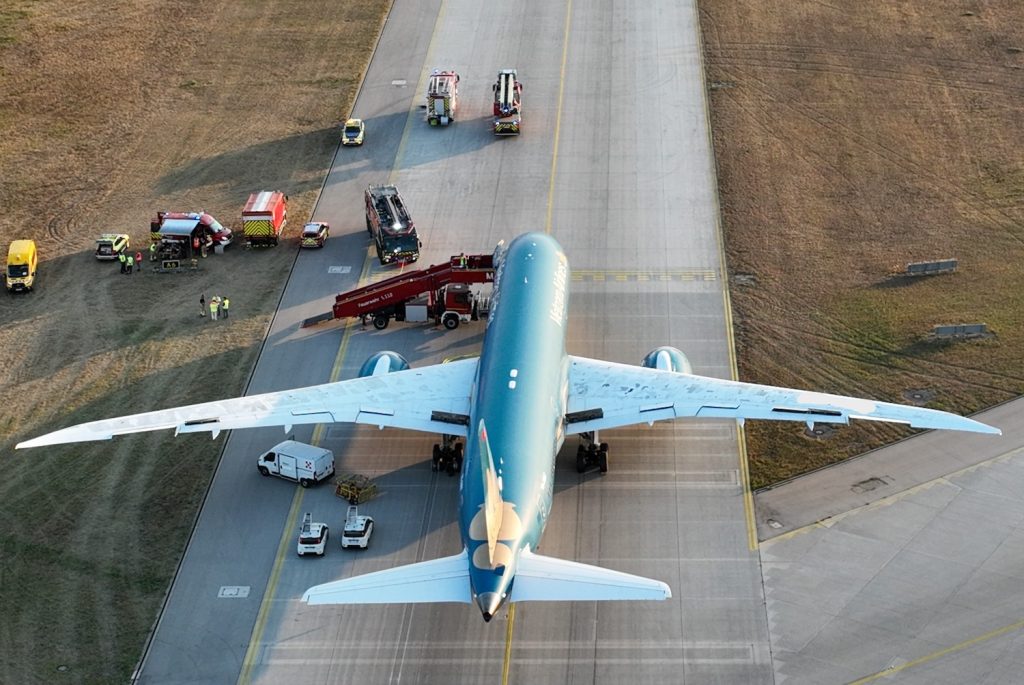
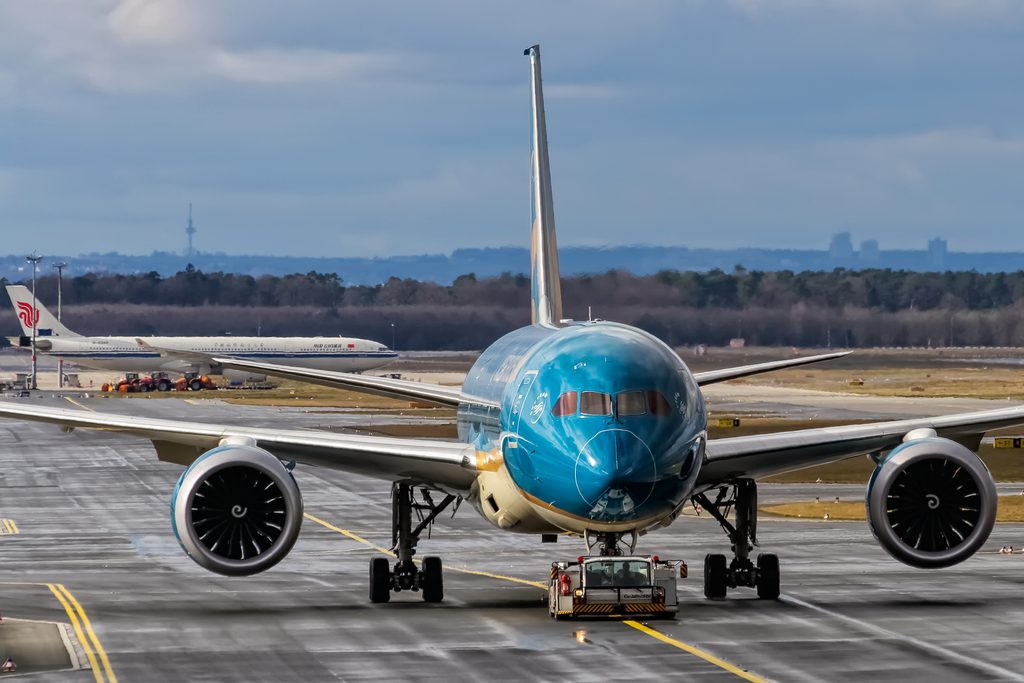
A Boeing 787-9 bound for Hanoi lifted off from the grass beyond the end of the runway at Munich Airport on 15 August 2026.
The widebody struck approach lights and suffered a tail strike before returning to Munich around two hours later. Nobody was hurt.
However, the aircraft sustained substantial damage.
Germany’s Federal Bureau of Aircraft Accident Investigation (BFU) has now published its interim report into the accident.
It does not yet state a cause. Even so, the flight recorder data paints a remarkable picture of a takeoff that used every metre of runway and more.
The Flight From Munich to Hanoi
The aircraft was operating a scheduled passenger service from Munich to Noi Bai International Airport in Vietnam.
On board were 271 passengers, 12 cabin crew and four pilots. The report identifies the operator only as a Vietnamese airline.
The 787-9 left its stand at Terminal 1 at 11:35 UTC. It then taxied to holding point B14 for runway 26L.
The crew received takeoff clearance at 11:55:47 UTC.
Conditions were clear but hot.
The Munich weather report showed visibility above 10 km, light and variable winds, and a temperature of 33°C.
The airport sits at an elevation of 1,487 ft, so the high temperature would have reduced aircraft performance.
The takeoff mass was 240,857 kg, close to the maximum takeoff mass of 247,207 kg.
The crew had calculated a decision speed (V1) of 169 kt, a rotation speed (Vr) of 175 kt and a takeoff safety speed (V2) of 180 kt.
Brake Inputs During the Takeoff Roll
The most striking finding concerns the brakes.
Just three seconds after takeoff thrust was set, the recorders captured rudder and brake pedal movement from the left seat.
Investigators later found main gear tyre marks near taxiway B4.
At that stage, the brake control units registered 15% braking on the left side and 6% on the right.
Further brake pedal activity followed during the roll.
By 11:57:12 UTC, left braking peaked at around 27% and right braking at around 17%.
Meanwhile, the indicated airspeed hovered at about 168 kt for roughly 18 seconds. For a jet accelerating down a runway, that is highly unusual.
The report does not explain why, and the BFU has not linked it to the braking.
Rotation Beyond the Runway End at Munich
At 11:57:13 UTC, the pilot monitoring increased thrust manually from 100% to 101% N1.
One second later, the aircraft rotated at 163 kt. By then, it was already level with the far threshold of the 4,000 m runway at Munich.
Notably, that speed was below both the planned rotation speed and the decision speed.
The aircraft rolled across the 60 m clearway and onto the grass. Its tyre tracks ended around 240 m beyond the threshold of runway 08R.
As the jet rotated, its tail and main landing gear hit parts of the approach lighting.
In total, 20 lamps belonging to the runway lighting at Munich were damaged.
Stall Protection and Tail Strike
The recorders show just how marginal the departure became.
The aircraft only reached V1 at 11:57:19 UTC, when it was already 11 ft above the ground.
One second later, the pitch angle reached 12.2° and the angle of attack reached 14°.
As a result, the automatic stall protection system extended the leading edge slats to their fully extended position.
The crew then activated takeoff and go around mode.
The aircraft reached V2 at 76 ft, and the crew retracted the landing gear.
Shortly afterwards, the recorders logged a tail strike.
A Pan Call and a Return to Munich
At 12:00:49 UTC, the crew declared a pan pan and requested radar vectors to dump fuel.
They later told controllers they suspected a flat tyre and asked for full assistance on the ground in Munich.
When the aircraft reached 9,000 ft, the pilot in command took over the controls.
He had been seated in the left jumpseat for the departure, as nominated by the operator.
Fuel dumping began at 12:22 UTC and ended at 13:07 UTC.
In total, the crew jettisoned 62 tonnes of fuel.
The crew then flew two approaches to runway 26R with the main gear extended.
This allowed ground personnel to inspect the landing gear visually. Both approaches ended in a go around.
Finally, the 787 touched down on runway 26R at 13:56 UTC with flaps 30. It landed at 143 kt with a mass of 176.5 tonnes.
Afterwards, four tyres on the left main landing gear were found damaged.
Passengers left the aircraft by mobile stairs on taxiway A6, assisted by rescue personnel.
An Experienced Crew on the Flight Deck
The pilot flying for the takeoff was a 64 year old captain with 27,182 flying hours, including 7,795 hours as a 787 captain.
The pilot monitoring had 12,375 hours.
The nominated pilot in command had 22,900 hours, while the fourth pilot had 1,444 hours on the 787-9.
All four held licences issued by the Civil Aviation Authority of Vietnam.
What Investigators Know So Far
The BFU recovered both Enhanced Airborne Flight Recorders.
Together, they had recorded more than 2,200 flight parameters.
However, the cockpit voice recordings of the takeoff were lost. Each recorder holds two hours of audio, and power was not switched off at Munich until more than two hours after departure.
Consequently, the takeoff conversation was overwritten.
The aircraft itself was built in 2016 and powered by two GE Aerospace GEnx-1B engines.
It had flown 41,421 hours and completed 8,189 landings.
Crucially, the BFU has seized the Brake System Control Units and the Electric Brake Actuator Controllers.
These components will now be examined in detail.
Overall…
This interim report raises more questions than it answers.
Why were the brakes applied during the takeoff roll? Why did the airspeed hold at around 168 kt?
And why did the rotation begin below V1, beyond the end of the runway at Munich?
Only the final report will provide those answers.
Until then, the Munich accident stands as a stark reminder of how thin the safety margins can become on a hot day with a heavy aircraft.
That 287 people walked away unhurt is a testament to the robustness of the aircraft and the response of the crew and emergency services at Munich.
For more incident coverage, visit our Emergency and Accident Hub.
Advertise with us Your brand, in front of an aviation audience Home page and in-article placements, sold directly, one advertiser per slot. From £250 a year. See the rates