
Myrtle Beach Airport Guide: Grand Strand Holiday Gateway
Myrtle Beach Airport is the holiday gateway to the Grand Strand. Discover its air base past, runway, airlines, busiest routes and spotting tips.
 By The Aviation Hub
6 min read
Updated October 20, 2026
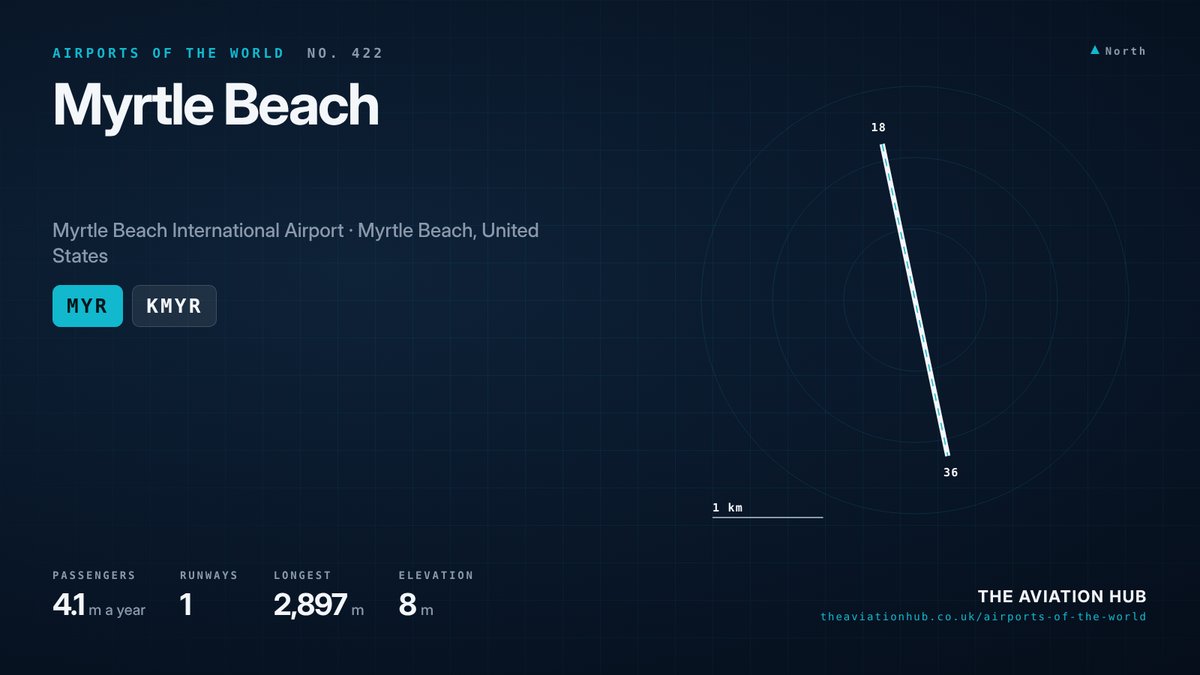
The Grand Strand stretches for around 60 miles of sand along the South Carolina coast, and most of its flying visitors arrive through one field. Myrtle Beach Airport sits on part of a former Air Force base, a short drive from the oceanfront hotels. Traffic is overwhelmingly leisure, with low cost carriers bringing holidaymakers from the Northeast and Midwest. Around 3.5 million passengers passed through in 2025, a big total for a metropolitan area of roughly half a million people.
Myrtle Beach Airport at a Glance
The IATA code is MYR and the ICAO code is KMYR. The airport lies about 3 miles (5 km) southwest of downtown Myrtle Beach, close to the coast. Its elevation is just 25 feet (8 metres). There is one runway and one passenger terminal, which carries the name of the city’s first mayor, Dr Wilford Leroy Harrelson.
Myrtle Beach Airport handled about 3.5 million passengers in 2025, down from roughly 3.8 million in 2024. Spirit Airlines was the largest carrier in the year to April 2026, with around a fifth of the total, but it ceased operations on 2 May 2026. Southwest, Delta, Allegiant and American followed, each with between 11 and 15 per cent. Horry County owns and runs the field through its Department of Airports. Schedules and parking details are on the airport’s official website.
How Myrtle Beach’s Airport Came to Be
The site began as a military airfield. During the Second World War the Army used it for training, and in 1948 the federal government transferred land from the former base to local hands. The deal carried a condition that proceeds had to go towards an airport. That money supported the Horry County Jetport at Crescent Beach from 1958 to 1976.
The Air Force returned in the 1950s, and Myrtle Beach Air Force Base became a busy fighter station. Its A-10 Thunderbolt II wing deployed to the Gulf War in 1990. Civil flights moved onto the northeast part of the base, trading as Myrtle Beach Jetport from 1974 to 1989. The city annexed the area in 1977.
The base closed in 1993, handing the civil operation room to grow. International status followed on 1 April 1996. Hooters Air made Myrtle Beach Airport its main hub from 2003 to 2006, and low cost carrier Direct Air was a major presence until its collapse in 2012. Spirit and Allegiant then built the modern leisure network.
Runways at Myrtle Beach Airport
A single asphalt runway, 18/36, measures 2,897 metres (9,503 feet) long and 46 metres (150 feet) wide. It is a legacy of the air base years, when it handled heavy jet fighters and transports. The length comfortably suits narrow body jets such as the Airbus A321neo and Boeing 737 MAX 8. It was even long enough for NASA to list the field as a Space Shuttle abort landing site. No shuttle ever needed it.
The runway runs roughly north to south, at an angle to the shoreline. Summer sea breezes from the south and southwest often put runway 18 in use, with arrivals passing over the city. Runway 36 takes over in northerly winds and many winter weather patterns. Thunderstorms on summer afternoons can stack up arrivals for short periods.
A helipad near the base of runway 36 handles sightseeing tours over the beaches. General aviation and training flights add variety, especially since the LIFT Academy announced flight training operations in 2022.
Terminals and Airlines
All airline flights use the single terminal. A $93.5 million expansion built six more gates, taking the total to 18 and adding a new security checkpoint, extra fuel storage, and more restaurant and retail space. Construction ran from June 2024 to December 2025. South Carolina’s aeronautics commission put in $8 million.
The airline line up leans heavily towards low cost and ultra low cost carriers. Allegiant, Frontier, Breeze, Sun Country and Avelo sell point to point leisure seats. Southwest has a large presence. The network carriers connect through their hubs: Delta through Atlanta, American through Charlotte and United through its northern hubs. All three major alliances are therefore represented, though few passengers choose Myrtle Beach Airport for loyalty perks.
Contour provides regional links. Canadian carriers have also tested seasonal Toronto flying, and Horry County paid WestJet around $570,000 under a revenue guarantee when demand fell short.
Routes and Destinations
Charlotte is the busiest route, with roughly 215,000 passengers in the twelve months to April 2026, all on American. Atlanta follows with about 153,000 on Delta. Baltimore, served by Southwest, runs third at around 114,000. Newark and New York LaGuardia complete the top five, each with more than 90,000 passengers.
Seasonality defines the schedule. Summer brings a long list of extra routes to cities across the Northeast and Midwest, many flown only a few times a week. Golf breaks support some spring and autumn demand. Winter is much quieter, and several airlines trim frequencies or suspend routes until the following spring.
Cargo is minor. The old air cargo building now serves mainly as maintenance storage, and Air Cargo Carriers flies a small feeder service to Columbia.
Getting to and from Myrtle Beach Airport
The entrance sits on Harrelson Boulevard, a short hop from the US 17 Bypass. Most hotels on the central oceanfront are 10 to 20 minutes away by car, longer in summer traffic. Taxis and ride hailing services wait outside arrivals, and fares to central hotels are modest. All the major car hire brands operate from the terminal.
Public transport to Myrtle Beach Airport is limited. Coast RTA local buses cover parts of the Grand Strand, but services are infrequent, so most visitors rely on cars. There is no passenger rail in the city. The nearest Amtrak station is at Florence, around 70 miles (113 km) inland.
For short stays near the beach, a ride hailing trip is usually the cheapest sensible option. Week long visitors exploring the coast will find a hire car better value.
Spotting and Photography
The Market Common district, built on the old base, sits right beside the field. Its Warbird Park displays retired military jets that once flew from the base, a fitting stop before a session on the fence line. Public roads around Myrtle Beach Airport give views of the approaches, and the flat coastal ground keeps sightlines open.
Afternoon light favours positions on the west side, while mornings suit the east. Runway 18 is the summer norm, so arrivals over the city make the most reliable targets. Summer brings the best variety, with brightly painted low cost fleets and occasional charter visitors.
Stay on public land, never climb or lean on fences, and keep well clear of the runway safety areas. Police and airport staff will ask spotters to move if they block roads or private entrances.
What Comes Next
The new gates give the terminal room to grow for years. The 2021 master plan set out long term concepts rather than any near term runway project, and the single strip has plenty of spare capacity outside summer peaks. Myrtle Beach Airport’s main risk is commercial rather than physical. Spirit’s shutdown in May 2026 removed the largest carrier, and other airlines must now fill the gaps.
Competition from Charleston and Wilmington also shapes airline decisions. Even so, the Grand Strand’s appeal to drive market holidaymakers keeps carriers interested. Compare the field with other leisure gateways on our Airports of the World map. The verdict: Myrtle Beach Airport is a well equipped leisure field with fresh terminal space, and its future depends on keeping low cost airlines committed beyond the summer.
Continue to follow The Aviation Hub for more analysis and insight.
Advertise with us Your brand, in front of an aviation audience Home page and in-article placements, sold directly, one advertiser per slot. From £250 a year. See the rates

