
Nairobi Airport Guide: East Africa’s Hub at 5,330 Feet
Nairobi Airport is the home of Kenya Airways and a major hub for East Africa. Our guide covers its long runway, terminals, routes, transport and spotting.
 By The Aviation Hub
5 min read
Updated October 20, 2026
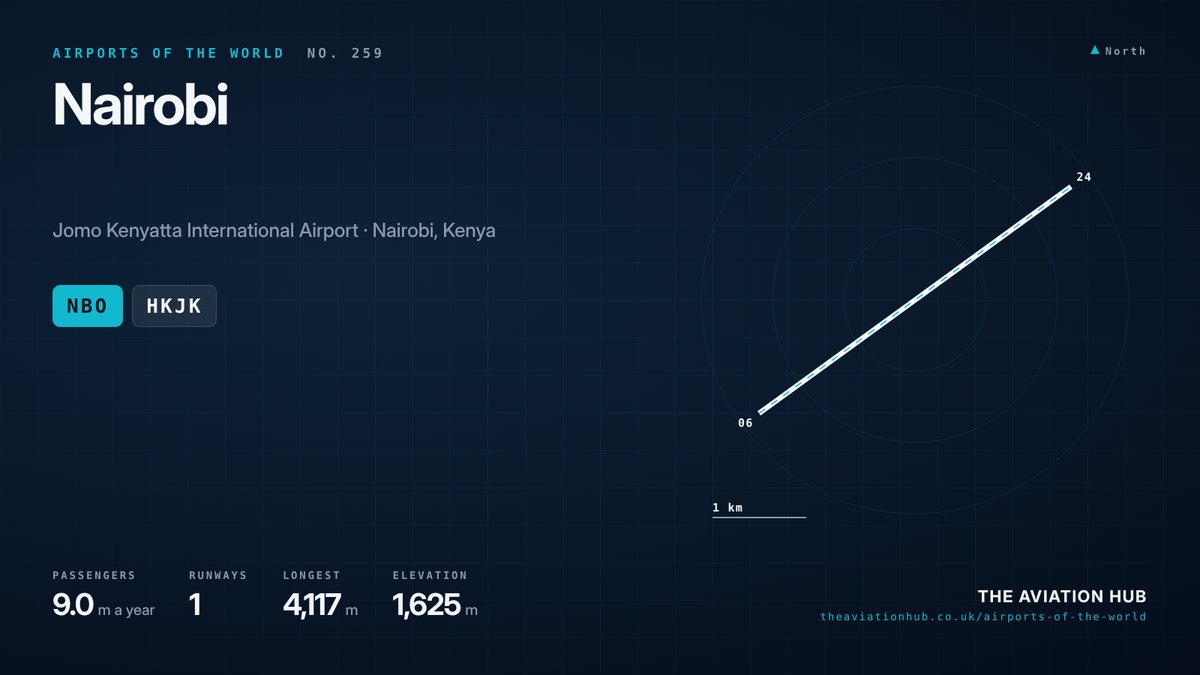
Jomo Kenyatta International Airport sits on the Embakasi plains southeast of the Kenyan capital, with Nairobi National Park on its doorstep. Nairobi Airport handled about 9 million passengers in 2024, ranking as the sixth busiest airport in Africa. It is the home of Kenya Airways, a key cargo gateway for the country’s flower and fresh produce exports and the main entry point for safari visitors to East Africa.
Nairobi Airport at a Glance
The IATA code is NBO and the ICAO code is HKJK. Nairobi Airport lies about 11 miles (18 km) southeast of the city centre at an elevation of 1,625 metres (5,330 feet). It has a single runway and a terminal complex made up of Units 1A to 1E and a separate Terminal 2.
Traffic reached about 9.07 million passengers in 2024, along with roughly 365,000 tonnes of freight. Kenya Airways is the dominant airline, with its low cost subsidiary Jambojet and African Express Airways also based here. The Kenya Airports Authority runs the airport, and terminal and flight information is on the airport’s official website.
How Nairobi’s Airport Came to Be
The airport opened on 9 March 1958 as Embakasi Airport, inaugurated by Sir Evelyn Baring, then the colonial governor. Accounts of its construction say much of the labour came from detainees held during the Mau Mau emergency, many of whom suffered badly. It took over from Eastleigh as the main gateway for international flights to Nairobi.
In 1978 the airport was renamed after Jomo Kenyatta, Kenya’s first president, who died that year. On 20 November 1974 a Lufthansa Boeing 747 crashed on takeoff, killing 59 people. Through the following decades Kenya Airways built its network around the airport, joining SkyTeam in 2010.
On 7 August 2013 a fire destroyed the international arrivals and departures area. An electrical fault was later blamed. Unit 1A opened in 2014 to replace the damaged buildings, and Terminal 2 followed in 2015 for low cost and regional carriers.
Runways at Nairobi Airport
Nairobi Airport has one runway, 06/24, which is 4,117 metres (13,507 feet) long with an asphalt surface. It is long enough for the Airbus A380 and Boeing 747-8, and that length matters here.
At 1,625 metres above sea level, the thin air reduces engine and wing performance, especially on warm afternoons. The long runway allows Kenya Airways’ Boeing 787-8 to depart for New York and Europe with useful payloads, and lets heavy freighters leave fully loaded with flowers and produce.
Easterly winds are common, so runway 06 is often in use, with arrivals approaching from the southwest over Nairobi National Park. A second runway was approved in 2017 but later put on hold, leaving the airport dependent on a single strip.
Terminals and Airlines
Unit 1A, opened in 2014, handles most Kenya Airways international flights and other SkyTeam carriers. Units 1B and 1C serve international departures for airlines not based in 1A, while Unit 1D handles domestic flights for Kenya Airways and Jambojet. Terminal 2 serves low cost and some regional airlines. Airline assignments change, so passengers should check before travelling.
Kenya Airways flies 787s on long haul and Boeing 737-800 and Embraer E190 jets on regional routes. Its network reaches London Heathrow, Paris, Amsterdam, Dubai, Mumbai and dozens of African cities. Jambojet flies De Havilland Canada Dash 8 turboprops and other aircraft on domestic and regional routes.
Foreign carriers at Nairobi Airport include Emirates, Qatar Airways, Ethiopian Airlines, Turkish Airlines, KLM, British Airways, EgyptAir and Saudia. Regional airlines such as Air Tanzania, Airlink and ASKY link Nairobi with other African cities.
Routes and Destinations
Nairobi Airport has scheduled flights to more than 50 countries. Domestic routes to Mombasa, Kisumu and Eldoret are busy, and Mombasa is the leading domestic market. Regional routes to Entebbe, Kigali, Dar es Salaam, Addis Ababa and Johannesburg carry heavy traffic.
Internationally, the Gulf hubs of Dubai and Doha attract strong demand, along with London, Amsterdam and Istanbul. Kenya Airways’ nonstop service to New York JFK is the longest route, at roughly 7,350 miles (11,800 km). Tourism peaks during the safari seasons, especially from July to October.
Cargo is vital to the Kenyan economy. Cut flowers, vegetables and fruit fly nightly to Europe, much of it to the Netherlands for auction. Kenya Airways Cargo, the Nairobi based Astral Aviation and international freighter operators all serve the airport.
Getting to and from Nairobi Airport
The main entrance is on Airport South Road, reached from Mombasa Road. The elevated Nairobi Expressway, opened in 2022, offers a direct toll route to the city and Westlands, cutting the journey to around 20 to 30 minutes. Without it, traffic on Mombasa Road can stretch the trip past an hour.
Taxis and ride hailing apps such as Uber and Bolt operate from the terminals, with fares to the city centre of roughly KES 2,000 to KES 3,000 (about £12 to £18). Bus route 34 serves the airport, and it is the cheapest sensible option for travellers with light luggage.
A commuter rail service linking the airport area with central Nairobi began in December 2020, though departures are infrequent. The Standard Gauge Railway terminus at Syokimau, a short drive away, offers trains to Mombasa.
Spotting and Photography
The setting at Nairobi Airport is unique. Nairobi National Park borders the airfield, and safari visitors sometimes capture giraffes, zebras or buffalo with aircraft on approach in the background. Within the park, rangers and guides decide where vehicles may stop.
The aircraft mix is rich, with Kenya Airways 787s, Emirates and Qatar wide bodies, African regional carriers and a steady stream of freighters. Morning light is clear before afternoon heat haze builds.
Kenya treats airports as security sensitive sites, and photographing near the perimeter can lead to arrest. Keep cameras out of sight near the fences, follow police instructions and never fly drones near the airport.
What Comes Next
Expansion has a troubled history. The Greenfield Terminal was cancelled in 2016, and an Adani concession proposal in 2024 triggered protests and strikes before President Ruto cancelled it in November 2024. In June 2026 the government signed a KES 154.2 billion contract with China Road and Bridge Corporation for runway rehabilitation, terminal renovation and a new terminal, targeting about 22 million passengers a year.
If the new terminal is delivered, Nairobi Airport will have the capacity to compete with Addis Ababa as the main hub for East Africa. The verdict is an airport with huge potential that now needs to turn plans into concrete. Compare it with other African hubs on the Airports of the World map.
Continue to follow The Aviation Hub for more analysis and insight.
Advertise with us Your brand, in front of an aviation audience Home page and in-article placements, sold directly, one advertiser per slot. From £250 a year. See the rates

