
Najaf Airport Guide: The Pilgrim Gateway to Southern Iraq
Najaf Airport carries millions of pilgrims to the Imam Ali Shrine. Read about its history, runway, airlines, routes and travel to Najaf and Karbala.
 By The Aviation Hub
5 min read
Updated October 20, 2026
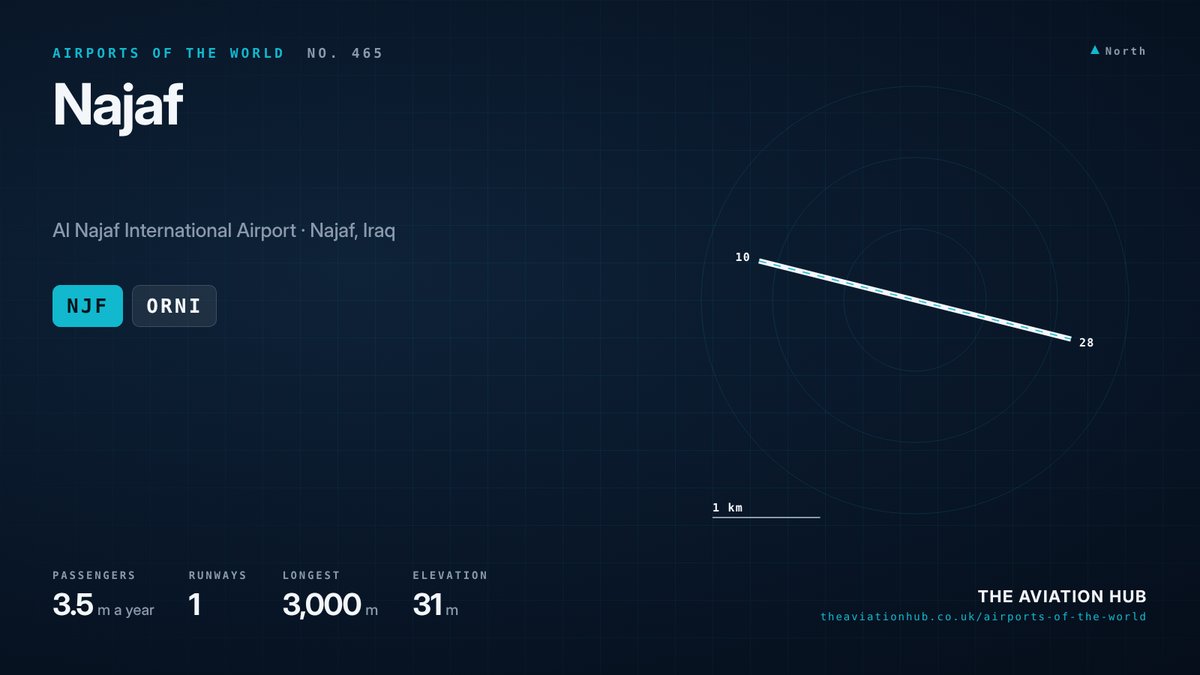
Najaf Airport serves one of the holiest cities in Shia Islam, home to the shrine of Imam Ali. It opened as a civil airport only in 2008, yet it quickly became a major gateway to Iraq for pilgrims from Iran, the Gulf, South Asia and Lebanon. Traffic peaked at more than 3.4 million passengers in 2016. Its runway and terminal are built around one purpose: moving large crowds of visitors in and out during the great religious seasons.
Najaf Airport at a Glance
The codes are NJF for IATA and ORNI for ICAO. The airport sits on the eastern side of the city, about 5 miles (8.5 km) east of the Imam Ali Shrine and a few miles south of Kufa. Elevation is 31 metres (103 feet). There is one runway and a single passenger terminal.
The latest published annual figure is 2,686,074 passengers in 2022, roughly triple the previous year, with about 23,300 aircraft movements and more than 24,000 tonnes of cargo. That ranks Najaf Airport second in Iraq behind Baghdad, but first in the country for international passengers. Iraqi Airways and UR Airlines treat it as a hub. Aqeeq Aviation Holding manages the site, and flight details are on the airport’s official website.
How Najaf’s Airport Came to Be
The site began life as a military airbase. After 2003, local leaders pushed for a civil airport that could cope with the surge of pilgrims now able to visit Najaf freely. On 24 June 2008 the Najaf Governorate signed a memorandum with Al Aqeelah Holding, which agreed to finish construction and manage the airport.
A ceremonial opening followed on 20 July 2008. Prime Minister Nouri al Maliki stepped off the first official flight. The airport grew fast, and Najaf Airport was the busiest in Iraq in both 2015 and 2016. It reached its record of about 3.44 million passengers in the second of those years.
Then came a sharp fall. Traffic dropped almost 29 per cent in 2019 and collapsed by 86 per cent in 2020 to around 273,000 when the pandemic halted pilgrimages. The recovery since has been strong but not yet complete.
Runways at Najaf Airport
There is a single asphalt runway, 10/28, measuring 3,000 metres (9,842 feet) long and 45 metres wide. That is enough for the Airbus A320 and Boeing 737 families that carry most pilgrims, and for wide body jets such as the Airbus A330 and Boeing 777. Summer heat in southern Iraq regularly passes 45°C, so the length matters on departure.
The runway runs roughly east to west across flat desert. Prevailing winds in this part of Iraq come from the north west, which usually favours landings on runway 28 from the east. There are no hills nearby, and the approaches are simple, though dust storms can close the field or cause diversions to Baghdad and Basra.
Terminals and Airlines
All passenger flights use the single terminal, which includes arrival and departure halls, a VIP lounge and cargo facilities. Capacity comes under heavy strain during religious holidays, when charter and extra flights pile on top of the normal schedule. Security is tight, with several checkpoints between the main road and the terminal. Allow extra time on departure, since bags and vehicles are screened well before check in. British and many other Western passport holders can usually obtain a visa on arrival at Iraqi airports, though the rules should be checked before travel.
Iraqi Airways has the largest network, serving 16 destinations from Najaf, including Baghdad, Istanbul, Kuwait City, Mumbai and Tehran. UR Airlines adds regional services. Iranian airlines run the busiest foreign links, while flydubai, Qatar Airways and other Gulf carriers connect Najaf Airport to their hubs. Turkish Airlines has suspended its Istanbul service.
Routes and Destinations
Iran is the most important market. Flights to Tehran and Mashhad appear on more airline schedules than any other destination, reflecting heavy pilgrim traffic between the shrine cities. Iraqi Airways and several Iranian carriers compete on these routes.
Elsewhere the network follows the Shia diaspora and the Gulf. Dubai, Doha, Bahrain, Kuwait City, Beirut and Amman all have links, as does Kabul. Mumbai serves pilgrims from India, and Istanbul offers wider European connections. Domestic flying is limited, because Baghdad is only around a two hour drive away.
Demand peaks around Muharram and Arbaeen, when millions of pilgrims gather in Najaf and nearby Karbala. Many walk the roughly 50 miles (80 km) between the two cities during Arbaeen. Ramadan and the Eid holidays bring further peaks. Cargo is significant, at about 24,000 tonnes in 2022.
Getting to and from Najaf Airport
There is no rail link. Taxis are the standard way into the city, taking around 20 to 30 minutes to the old town and the shrine, depending on checkpoints. Agree the fare before departure, as meters are uncommon. Many pilgrim groups travel on pre booked coaches arranged by their tour operators, which is usually the cheapest sensible option.
Karbala lies about 50 miles (80 km) to the north west, roughly an hour or more by road, and shared taxis and minibuses run between the two cities. Baghdad is about 100 miles (160 km) to the north. Hotels close to the shrine often arrange airport transfers, and during the busiest festivals roads around the old city can close to vehicles.
Spotting and Photography
Najaf Airport is not a place for traditional spotting. Iraqi security forces control the approaches closely, and long lenses near the perimeter will attract immediate attention. Photography of checkpoints, soldiers and security installations is forbidden and can lead to detention.
Travellers can still enjoy the variety from the terminal. Iraqi Airways Boeing 737s and Airbus A320s mix with Iranian MD-80s, Fokker 100s and Airbus A300s, as well as flydubai 737 MAX 8s and Qatar Airways A320s. Any photographs should be taken discreetly from inside the building or the aircraft, and only where staff allow it.
What Comes Next
Expansion is under way to add four departure gates, two arrival gates and more immigration capacity, which should ease the worst of the festival queues. The management agreement with Aqeeq Aviation Holding runs in renewable five year terms, giving the operator a stake in continued growth.
Najaf Airport depends on pilgrimage, so its fortunes track regional security and relations between Iraq and Iran. If stability holds, traffic should return to and pass the 2016 record. See how it compares with Baghdad and other Middle Eastern airports on our Airports of the World map.
Continue to follow The Aviation Hub for more analysis and insight.
Advertise with us Your brand, in front of an aviation audience Home page and in-article placements, sold directly, one advertiser per slot. From £250 a year. See the rates

