
Nanchang Airport Guide: Jiangxi’s Gateway in Profile
Nanchang Airport is the main gateway to Jiangxi and home to Jiangxi Air. Explore its history, single runway, airlines, routes and how to reach the city.
 By The Aviation Hub
6 min read
Updated October 20, 2026
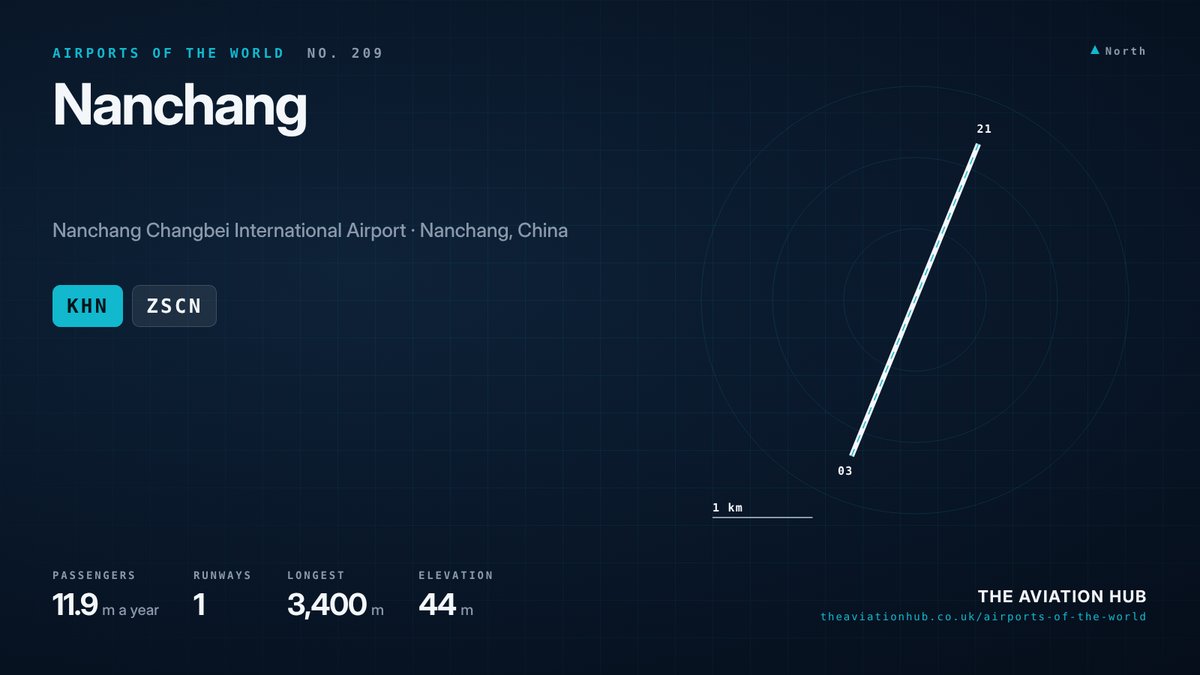
Nanchang Changbei International Airport serves the capital of Jiangxi Province in south east China, a city of more than six million people on the Gan River. Nanchang Airport handled close to 12 million passengers in 2025, after growth of around 6 per cent on the year before. It is the main air gateway for a province of some 45 million people and the home base of the provincial carrier, Jiangxi Air. A single long runway carries a mostly domestic network that has been shaped by fierce competition from high speed rail.
Nanchang Airport at a Glance
The IATA code is KHN and the ICAO code is ZSCN. The airport lies about 17 miles (28 km) north of central Nanchang on flat, low ground. Elevation is a modest 143 ft (44 m). One runway and a terminal area built in stages handle every flight, passenger and cargo alike.
In 2025 the field recorded roughly 11.9 million passengers, about 92,000 aircraft movements and some 42,000 tonnes of cargo. China Eastern Airlines keeps a large Jiangxi branch here, and Jiangxi Air flies its whole network from the base. Capital Airport Holding has run the airport since 2003, when it took over from the Jiangxi provincial government. Flight times and terminal information are on the airport’s official website.
How Nanchang’s Airport Came to Be
For decades Nanchang relied on Xiangtang Airport, a shared civil and military field south of the city. By the 1990s it was overcrowded and had little room to grow. Work on a replacement began in October 1996 on a greenfield site north of the urban area.
The new airport opened on 10 September 1999, and Xiangtang reverted to military use only. The name is simple geography. Chang is a common shorthand for Nanchang and bei means north, so Changbei marks the site’s position relative to the city. International status followed in 2004, opening the way for scheduled flights abroad.
A major expansion between 2008 and 2011 lifted the airport to Class 4E standard, able to handle wide body jets, and raised capacity to around 12 million passengers a year. Growth then stalled as high speed rail reached Jiangxi and took short domestic trips. Local governments answered with route subsidies, and traffic jumped by about 39 per cent in 2017. On 4 March 2018 strong winds tore away part of the terminal’s exterior roof, a reminder of the violent spring storms in the region.
Runways at Nanchang Airport
Everything happens on Runway 03/21, a concrete strip of 3,400 m (11,155 ft) by 45 m. That length gives ample margin for the Airbus A320neo and Boeing 737-800 fleets that dominate the schedule. It also accommodates wide body types such as the Airbus A330 on heavier sectors and charter work.
With one runway, Nanchang Airport cannot run parallel or crosswind operations. Every arrival and departure shares the same strip, and direction follows the wind. Northerly winds are common in the cooler months, which favours landings on Runway 03. Summer brings more southerly flows and more use of Runway 21.
Weather is the main operational challenge. Heavy summer thunderstorms build quickly over the Yangtze basin, and winter fog can slow arrivals in the early morning. Instrument landing systems support approaches in poor visibility, but storms still cause delays and diversions during the wet season.
Terminals and Airlines
The terminal area has grown in step with traffic. The 2008 to 2011 expansion added a much larger passenger hall alongside the original 1999 building. Domestic flights make up the great majority of departures, while a smaller international area handles immigration and customs for the regional schedule abroad.
China Eastern, a SkyTeam member, is the largest carrier at Nanchang Airport, with its Jiangxi branch basing aircraft overnight. Jiangxi Air is the home airline, a joint venture in which Xiamen Airlines holds a majority stake alongside provincial investors. It flies Boeing 737-800s and Comac C909 regional jets on routes across China.
The other big state groups are well represented. Air China, China Southern, Hainan Airlines, Sichuan Airlines, Shandong Airlines and Shenzhen Airlines all serve the field. Low cost operators add capacity on leisure routes, especially to the south and south west.
Routes and Destinations
The trunk routes from Nanchang Airport run to Beijing Daxing, Shanghai Hongqiao and Pudong, Guangzhou and Shenzhen. China Eastern carries the largest share of these, with Jiangxi Air competing on several. Fast trains now reach Shanghai in around three hours, which keeps pressure on air fares eastwards.
Air holds its ground on longer domestic sectors where rail journeys still take most of a day. Chengdu Tianfu, Chongqing, Kunming and Haikou are typical examples, along with cities in the north east and the far west. Hainan routes peak in winter, when Jiangxi residents head south for the sun.
International flying is modest and mainly regional, focused on East and Southeast Asia. Demand rises around the Spring Festival and the summer holidays, when students and family visitors fill the schedule. Cargo volumes are small, built mostly on express parcels and belly freight.
Getting to and from Nanchang Airport
Since June 2025 the northern extension of Nanchang Metro Line 1 has run to the airport, giving a direct rail link into the city. The airport also sits beside the expressway towards Jiujiang, which gives a direct run into the north of Nanchang. A taxi to the city centre takes around 40 to 50 minutes in normal traffic and costs roughly 100 yuan (about £11).
Airport buses remain a cheap option. Several lines run to central Nanchang and key transport hubs for a fare of around 15 to 20 yuan, with a journey of about an hour. Coaches also link the airport with other cities in Jiangxi. Ride hailing apps work well, and there is parking for both short and long stays in front of the terminals.
Rail travellers arriving from elsewhere in China will usually use Nanchang West station. The airport’s third phase expansion will go further by connecting Nanchang Airport to the Nanchang to Jiujiang high speed railway.
Spotting and Photography
Nanchang is an aircraft city as well as an airline one. The Hongdu aviation group builds military jet trainers in the city, and its factory traces its history to one of the earliest aircraft plants in the People’s Republic. Those types fly from their own airfield, however, not from Changbei.
At Nanchang Airport the best views come from the terminal glass, which looks out over the apron and the single runway. The schedule is dominated by China Eastern and Jiangxi Air narrow bodies, with a sprinkling of other carriers through the day. Haze is common, so clear days after rain or a northerly wind give the sharpest pictures.
Photography around Chinese airports is closely controlled. Stay away from perimeter fences, avoid long lenses near security posts and follow any instruction from police or airport staff.
What Comes Next
The third phase expansion is the big story. It has already brought the metro to the airport, and the high speed rail connection comes next. Growth well beyond the current capacity of around 12 million passengers a year will also need more terminal and runway space.
Competition from rail will not go away, and fast trains will continue to cap growth on short routes. The opportunity lies in longer domestic sectors, Jiangxi Air’s expansion and a gradual rebuild of regional international flying.
Nanchang Airport is heading for steady, infrastructure led growth as a provincial hub. See where it sits among China’s regional gateways on the Airports of the World map.
Continue to follow The Aviation Hub for more analysis and insight.
Advertise with us Your brand, in front of an aviation audience Home page and in-article placements, sold directly, one advertiser per slot. From £250 a year. See the rates

