
Nanjing Airport Guide: Jiangsu’s Gateway on the Yangtze
Nanjing Airport at Lukou serves one of China's great historic cities and the Yangtze delta. Read about its runways, terminals, routes and spotting.
 By The Aviation Hub
6 min read
Updated October 20, 2026
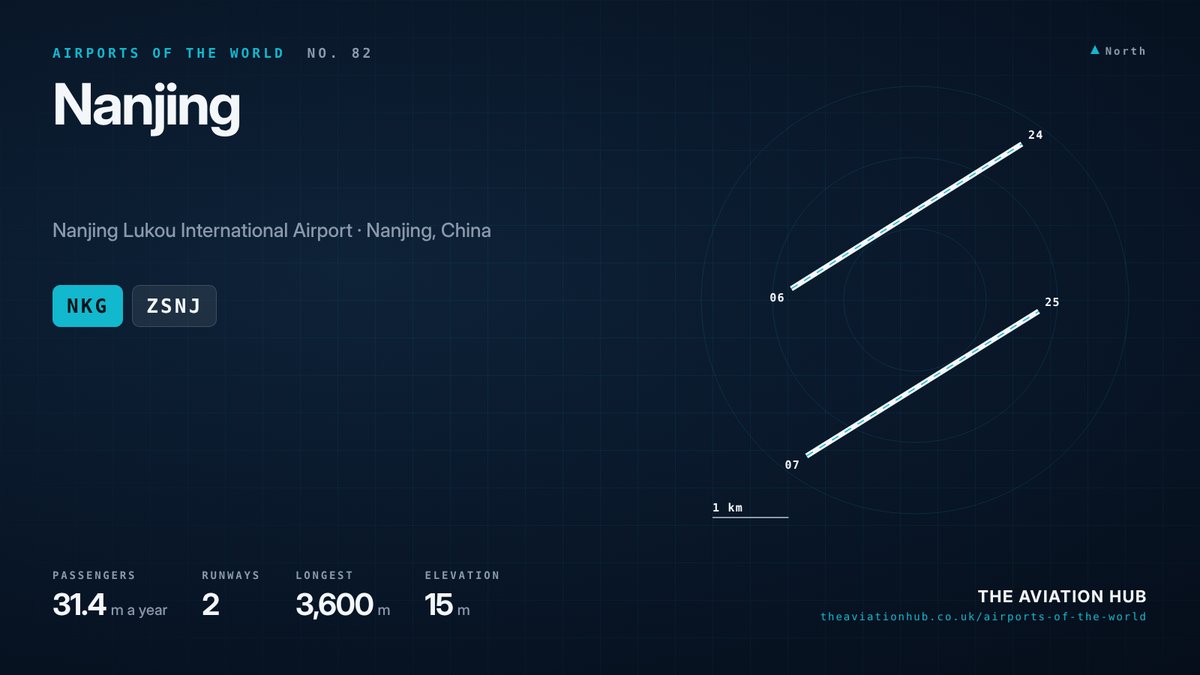
Nanjing Lukou International Airport is the main airport for Jiangsu Province and the former capital of China. It lies in Jiangning District, some 22 miles (35 km) south of the city centre, on flat farmland near the town of Lukou. Around 31 million passengers used Nanjing Airport in 2025, which places it in the top 15 in China and ahead of several European capitals. Two parallel runways, two terminals and a large China Postal Airlines cargo base make it one of the main secondary hubs of the Yangtze River Delta, in the shadow of Shanghai but busy in its own right.
Nanjing Airport at a Glance
The codes are NKG and ZSNJ. The IATA code preserves the old Nanking spelling. The field sits at just 49 ft (15 m) above sea level, 22 miles (35 km) south of the city on the Airport Expressway. Nanjing South railway station, the city’s high speed rail hub, is about 35 minutes away by metro.
Nanjing Airport has two runways and two terminals. Passenger traffic reached about 31.4 million in 2025, up slightly on the year before, alongside more than 476,000 tonnes of cargo. China Eastern’s Jiangsu company is the largest operator, with Juneyao Air, Shenzhen Airlines, China Southern and Beijing Capital Airlines all basing aircraft here. China Postal Airlines runs its main freighter base from the field. The operator is Eastern Airport Group, a provincial state owned company. Flight information is on the airport’s official website.
How Nanjing’s Airport Came to Be
Nanjing had an airport long before Lukou. Dajiaochang, a military field inside the city, carried civilian flights from the 1930s until the 1990s and became hopelessly hemmed in by housing. The provincial government chose a greenfield site at Lukou in the early 1990s. Construction began in 1995 and the new airport opened on 1 July 1997 with a single runway and a terminal designed for 12 million passengers.
Growth was slow at first, as Shanghai swallowed most of the region’s international demand. Traffic passed 10 million in 2009 and then accelerated. By 2013 the terminal was handling around 3 million more passengers than it was designed for. The answer was Phase 2, timed for the 2014 Summer Youth Olympics that Nanjing hosted.
Phase 2 added Terminal 2, a second runway, a 107 m control tower and a ground transport centre. Terminal 1 then closed for a six year rebuild and reopened on 29 July 2020. The pandemic cut traffic by more than a third in 2020, but the airport recovered quickly and set new records in 2024 and 2025.
Runways at Nanjing Airport
Runway 06/24 is the original strip, 3,600 m (11,811 ft) long and 45 m (148 ft) wide, with an asphalt surface. Runway 07/25, added in 2014 on the south side of the terminal area, is also 3,600 m (11,811 ft) long but 60 m (197 ft) wide and surfaced in concrete. The two are parallel, and the different numbers simply tell them apart.
The lengths give plenty of margin for the Airbus A330-300 and Boeing 787 types that fly the Australian routes, and for the Boeing 737 and 757 freighters of China Postal. Fog and low cloud in winter bring the main delays, and the summer typhoon season occasionally shuts the field for a few hours.
Peak hour capacity rose from 28 to 38 movements when the second runway came into full use in late 2014. The airport remains comfortably within its limits, which is one reason airlines find it easier to add flights at Nanjing Airport than at the two crowded Shanghai fields.
Terminals and Airlines
Terminal 2 opened in 2014 and is the larger of the pair, with around 263,000 square metres of floor space, 35 air bridges and a design capacity of 18 million passengers. China Eastern and Juneyao Air use it exclusively, and the terminal also handles international flights. Check in, security and the departure halls sit on the upper level, with the ground transport centre below.
Terminal 1 reopened in 2020 after a complete rebuild and now handles every other domestic airline. China Southern, Shenzhen Airlines, Xiamen Airlines, Air China, Hainan Airlines and the low cost operators such as Spring and Lucky Air all fly from here. The two buildings are joined by the ground transport centre, so passengers can walk between them.
China Post’s express logistics centre sits beside the airport. China Postal Airlines sorts express mail here through the night, and a large express logistics centre has grown around its apron.
Routes and Destinations
Domestic traffic dominates. Beijing, Guangzhou, Shenzhen, Chengdu, Chongqing, Xi’an, Kunming and Xiamen all have double digit daily frequencies. Shanghai is a short train ride away, so there are no flights, but the surrounding provinces generate heavy traffic through Nanjing Airport for their own connections.
International service has rebuilt steadily since 2023. Regular links run to Hong Kong, Macau, Taichung, Seoul Incheon, Busan, Osaka Kansai, Bangkok, Singapore and Kuala Lumpur. Longer routes reach Sydney and Melbourne. Finnair’s Helsinki route, suspended in 2020, has not returned. The longest regular route at the time of writing is Melbourne at around 5,100 miles (8,200 km).
Getting to and from Nanjing Airport
Metro Line S1, the Airport Line, is the cheapest and simplest option. It runs from a station beneath the ground transport centre to Nanjing South in about 35 minutes for 7 yuan (around £0.80), with trains from 6am to around 10.40pm. Nanjing South connects to the city’s metro network and to high speed trains for Shanghai, Hangzhou and Beijing.
Airport buses run to Nanjing South every 20 minutes in about 40 minutes, to the main Nanjing Railway Station in around 80 minutes and to several points downtown. The Airport Expressway, part of the S55, takes a taxi to the centre in 40 to 60 minutes for roughly 120 yuan (£13).
Car parks sit beside both terminals. Online ride hailing apps work well from a dedicated pick up area on the lower level.
Spotting and Photography
Nanjing Airport is a workmanlike spot rather than a classic one, but the variety rewards a visit. The glass walls of Terminal 2’s departure piers give good views of the China Eastern and Juneyao fleets, which include Airbus A350-900s and Boeing 787-9s on the premium domestic trunk routes. Terminal 1 looks across to the China Southern and Shenzhen Airlines stands.
Outside the fence, the farm roads around the field give open views, though there is no official viewing area. The sun sits to the south for most of the day, so the south side gives the best light. The China Postal freighters arrive and depart mostly after dark, so bring a tripod for night shots of the apron from the terminal.
Chinese airports are sensitive about photography near the perimeter. Stay on public roads, keep away from the fence line and put the camera away if security staff ask. Airside photography from the terminal windows is generally tolerated.
What Comes Next
The third phase of expansion, centred on a new Terminal 3, was due to begin in 2025 under the city’s transport hub plan to 2035, and the terminal is now taking shape. The aim is more intercontinental flights, while cargo keeps growing on the back of e commerce freight.
The strategic question is how Nanjing fits beside Shanghai. The airport pitches itself as a cheaper, less congested alternative for airlines and as a convenient hub for the western half of the Yangtze delta. New international routes such as Hanoi and Ho Chi Minh City suggest the plan is working.
Nanjing Airport is a solid regional hub with room to grow and a province of 85 million people behind it. See how it compares with the other Chinese gateways on the Airports of the World map.
Continue to follow The Aviation Hub for more analysis and insight.
Advertise with us Your brand, in front of an aviation audience Home page and in-article placements, sold directly, one advertiser per slot. From £250 a year. See the rates

