
Nantes Airport Guide: The Field That Refused to Move
Nantes Airport survived plans to replace it and now handles about seven million passengers. Codes, runway, airlines, routes, transport and spotting tips.
 By The Aviation Hub
5 min read
Updated October 20, 2026
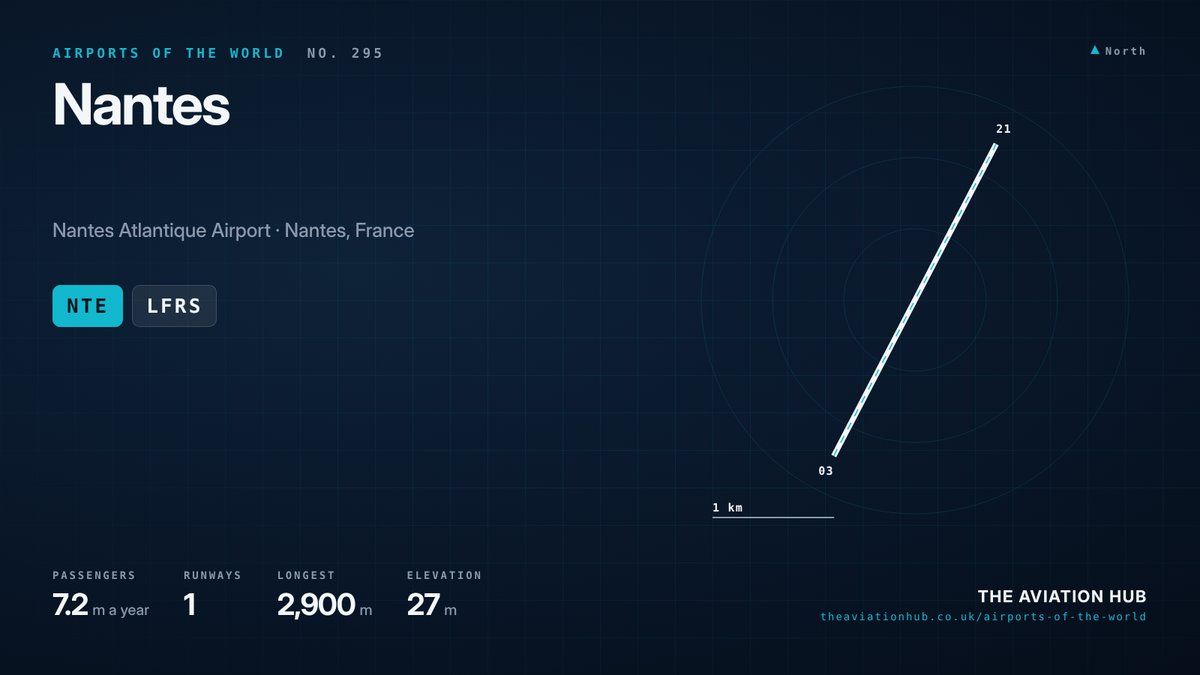
Nantes Atlantique sits in Bouguenais, just south west of Nantes, the capital of the Pays de la Loire region. Nantes Airport handles around seven million passengers a year on a single runway and a compact terminal. For four decades it was meant to close, replaced by a new airport north of the city at Notre Dame des Landes. That project was cancelled in 2018, and the old field now has to be upgraded for the long term. Few regional airports carry so much political baggage.
Nantes Airport at a Glance
The IATA code is NTE and the ICAO code is LFRS. The airport lies about 5 miles (8 km) south west of central Nantes, at an elevation of 27 metres (90 ft). It has one runway and one L shaped passenger terminal divided into four halls. An Airbus factory sits beside the terminal.
Traffic reached about 7.2 million passengers in 2019, fell sharply in the pandemic and was back to about seven million by 2024. easyJet, Transavia France and Volotea all base aircraft here and carry most of the traffic. The airport has been run by Aéroports du Grand Ouest, a subsidiary of Vinci Airports, under a state concession. Flight times, parking and shuttle details are on the airport’s official website.
How Nantes Got Its Airport
The site was planned as a military airfield in 1928, on farmland south of the Loire. An aircraft factory grew up beside it, and on 4 July 1943 an Allied air raid damaged the field and destroyed the plant. Commercial flights began in 1951, and a new terminal was built between 1954 and 1960. The field was long known as Château Bougon, after a local estate, before taking the Nantes Atlantique name.
The idea of a replacement dates back to the late 1960s, when planners expected traffic to outgrow the site. A new airport at Notre Dame des Landes, about 19 miles (30 km) north west of the city, was finally approved in February 2008 at a cost of €580 million, with opening planned for 2017. Farmers, environmental campaigners and occupiers of the site fought it for years. The government cancelled the project on 17 January 2018.
The cancellation left Nantes Airport with no successor and a terminal never designed for its current traffic. Hall 4, a single storey extension, was added to cope with growth.
Runways at Nantes Airport
Nantes Airport has a single asphalt runway, 03/21, which is 2,900 metres (9,514 ft) long and 45 metres wide. It handles everything from turboprops to the occasional wide body charter and Airbus transport flights. There is no parallel taxiway along its full length, which limits capacity at busy times.
The alignment is the airport’s main problem. Arrivals on runway 21 pass low over central Nantes, bringing noise to tens of thousands of residents. To the south, the approach to runway 03 passes close to the Lac de Grand Lieu, a protected nature reserve. Westerly and south westerly winds off the Atlantic mean runway 21 is often in use, which keeps the noise issue in the headlines.
Terminals and Airlines
The terminal at Nantes Airport has an L shaped plan. Halls 1, 2 and 3 form one two storey building, with check in and baggage reclaim below and departure lounges above. Hall 4 is a later single storey building connected by a lobby. Facilities are simple, and queues build quickly at summer peaks, when the low cost carriers run their heaviest schedules.
easyJet, Transavia France and Volotea dominate, flying Airbus A320 family jets and Boeing 737-800s. Air France connects with Paris Charles de Gaulle and other French cities. KLM, Lufthansa and Iberia link the airport with their hubs, giving access to all three global alliances. Ryanair, Vueling, Royal Air Maroc, Air Algérie, Air Canada, Air Transat and Corsair are among the others.
Routes and Destinations
Leisure and visiting friends traffic drives the network. easyJet flies to London Gatwick, Lisbon, Madrid, Marrakesh and many other cities. Transavia covers North Africa, Portugal and Greece. Volotea specialises in Spain, Italy and the Canaries, often on routes no other airline serves from western France.
Ryanair flies to Dublin, Edinburgh, Manchester and London Stansted. North Africa is a strong market, with Algiers, Oran, Casablanca and Marrakesh all well served. Air Canada and Air Transat fly to Montreal, but the longest route from Nantes Airport is Corsair’s seasonal service to Fort de France in Martinique, at about 4,050 miles (6,520 km). Summer adds Corsica, the Greek islands and a long list of Mediterranean resorts.
Getting to and from Nantes Airport
The Tan Air express shuttle links the terminal with Nantes railway station and the city centre in around 20 to 30 minutes. It costs more than a standard ticket but is the fastest public option. The cheapest route is TAN bus 38 to Pirmil, or bus 98 to Neustrie for tram line 3 into town.
By road, the terminal is a short drive from the Nantes ring road. A taxi to the centre takes about 20 minutes outside rush hour. Parking is available in several car parks, from short stay areas by the terminal to cheaper long stay lots. Rail connections at Nantes station reach Paris in around two hours by TGV.
Spotting and Photography
Nantes Airport has no dedicated viewing terrace, but the countryside around it offers options. Minor roads near the southern end of the runway give views of arrivals on 03 and departures from 21, with Lac de Grand Lieu beyond. The Airbus plant brings occasional Beluga flights carrying the centre wing boxes it builds for Airbus airliners.
Traffic is mainly easyJet, Volotea and Transavia narrow bodies, plus Air France regional jets. Afternoon light favours the western side. Stay on public land, respect the fences and avoid lingering near the Airbus site, which has its own security.
What Comes Next
After the cancellation of Notre Dame des Landes, the state committed to upgrading the existing airport. Plans have covered a larger terminal, a full parallel taxiway, new aprons and measures to cut noise over the city, and a curfew from midnight to 6am has applied since 2022. Each step faces scrutiny from residents and environmental groups. A first tender for a new concession failed in 2023, so the 2010 contract with the Vinci subsidiary still applied in late 2025.
Nantes Airport is staying put, and that is now the settled position. The challenge is fitting a growing regional airport into a site hemmed in by a city and a nature reserve. Explore other French regional airports on the Airports of the World map.
Continue to follow The Aviation Hub for more analysis and insight.
Advertise with us Your brand, in front of an aviation audience Home page and in-article placements, sold directly, one advertiser per slot. From £250 a year. See the rates

