
LaGuardia sits on the East River shoreline of Queens, about 8 miles (13 km) from Midtown Manhattan and closer to the city than JFK or Newark. It is the smallest of New York’s three big airports by land, yet it handles more than 32 million passengers a year on two runways that are each barely 7,000 ft long. New York LaGuardia Airport spent decades as a national punchline for cramped terminals and delays, and then spent the 2020s being rebuilt almost entirely while staying open.
New York LaGuardia Airport at a Glance
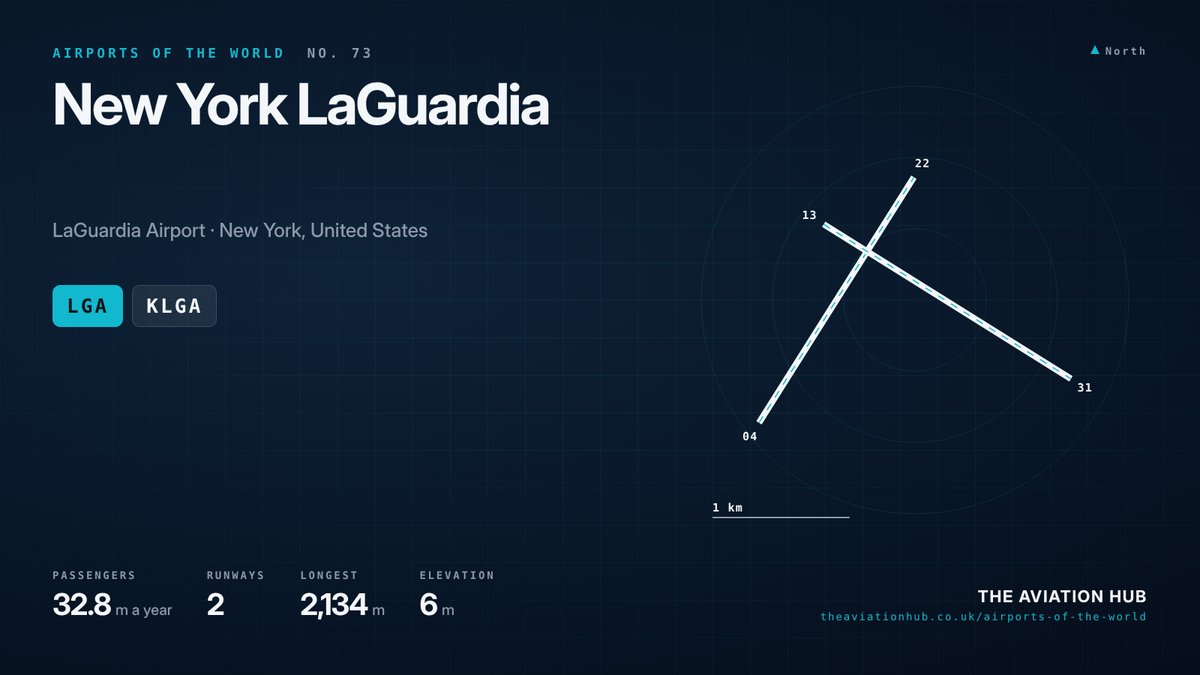
The codes are LGA and KLGA. The field lies in East Elmhurst, bounded by Flushing Bay and Bowery Bay on three sides and the Grand Central Parkway on the fourth. It sits only 21 ft (6 m) above sea level. Two crossing runways and three terminals, A, B and C, make up the whole operation. The City of New York owns it and the Port Authority of New York and New Jersey has run it since 1947.
New York LaGuardia Airport handled around 32.6 million passengers in 2025, a little below the previous year. Delta Air Lines carries roughly 43 per cent of them and American Airlines about a quarter, with Southwest and United the next largest. Most flights stay within a 1,500 mile (2,400 km) perimeter, so this is a domestic and Canadian airport rather than an intercontinental one. Terminal maps and transport details are on the airport’s official website.
How New York’s City Airport Came to Be
The site began as North Beach, a seaside amusement park that became a private seaplane base. New York Air Terminals opened an airfield there in June 1929, later named Glenn H. Curtiss Airport. Mayor Fiorello La Guardia took up the cause of a city owned airport after a 1934 flight ticketed to New York landed him in Newark. He refused to get off until the aircraft flew him across the river.
Construction started in 1937 with Works Progress Administration labour and landfill moved from Rikers Island. The airport opened for business on 2 December 1939. Pan American’s flying boats used the Marine Air Terminal, an Art Deco building that still stands as Terminal A. The Port Authority took control in June 1947 and the name LaGuardia Airport became official.
The central terminal of 1964 served for more than half a century and was widely derided by the 2010s. A plan announced in 2015 replaced almost every building on the site. The new Terminal B opened in stages from 2018 to 2022, Delta’s Terminal C followed in June 2022 and the programme was declared complete in January 2025.
Runways at New York LaGuardia Airport
New York LaGuardia Airport has two runways of identical length. Runway 04/22 and Runway 13/31 are each 2,134 m (7,002 ft) long and 46 m wide, with asphalt surfaces and extensions built on piers out over the water. They cross near the middle of the field, so one serves departures and the other arrivals at any time. The usual pattern is arrivals on 22 or 31 with departures on 13 or 4, chosen to keep traffic clear of JFK a few miles south.
The short runways rule out wide body aircraft in normal service, so the field is a narrow body airport of Airbus A321s, Boeing 737s and Embraer E175s. Arrestor beds sit at the runway ends to stop an overrun going into Flushing Bay. The Expressway Visual approach to Runway 31 follows the Long Island Expressway past Flushing Meadows, then makes a tight left turn over Flushing Bay.
The airport is slot controlled under FAA rules and has a seasonal overnight curfew from midnight to six in the morning. In March 2026 an Air Canada Express regional jet collided with a fire vehicle on Runway 04/22, killing both pilots.
Terminals and Airlines
Terminal B is the largest building, with 35 gates on an eastern and a western concourse joined to the headhouse by two pedestrian bridges that aircraft taxi beneath. American Airlines runs a hub here, and United, Southwest, JetBlue, Air Canada and Frontier share the building. The headhouse opened in 2020 and won a string of design awards.
Terminal C belongs to Delta and Delta Connection. It has four concourses, with gates numbered 61 to 98, and a Delta Sky Club that ranks among the carrier’s largest. Delta made LaGuardia a hub in 2011, and the terminal replaced the old Terminals C and D in 2022.
Terminal A, the Marine Air Terminal, is a protected landmark with a famous mural in its rotunda. Spirit Airlines used it until the airline ceased flying in May 2026, and it is now home only to a general aviation terminal. Free shuttle buses link the three terminals on the landside, since they are not connected airside.
Routes and Destinations
Chicago O’Hare is the busiest route from New York LaGuardia Airport with around 1.36 million passengers in the year to May 2026. Atlanta follows at 1.09 million, then Miami, Dallas Fort Worth, Orlando, Fort Lauderdale and Denver. Charlotte, Houston and Detroit complete the top ten.
International flying is almost entirely Canadian. Toronto Pearson carries just over a million passengers a year and Montreal nearly 400,000, with Halifax and Nassau far behind. Denver is the main exception to the perimeter rule, which otherwise bars nonstop flights beyond 1,500 miles except on Saturdays, so there are no transcontinental services and no flights to Europe. The longest regular route is Denver at about 1,620 miles (2,610 km).
Seasonal demand peaks in winter towards Florida and in summer towards the Carolinas and New England. Cargo is negligible, with freight handled at JFK and Newark instead.
Getting to and from New York LaGuardia Airport
There is no rail link, and every plan for a subway extension or an AirTrain has failed, the last in 2023. The cheapest sensible option is the Q70 LaGuardia Link bus, which runs free of charge to the subway at Jackson Heights and Woodside in about ten minutes, connecting to the 7, E, F, M and R trains and the Long Island Rail Road. The M60 bus crosses to Harlem and Columbia University. The M60 serves every terminal, the Q70 and Q72 serve Terminals B and C, and the Q33 serves Terminal A.
A yellow taxi to Midtown takes 25 to 45 minutes and costs around $40 to 50 (£30 to 40) plus tolls and tip, more at rush hour. Ride hailing cars collect from dedicated areas and carry an airport surcharge. Drivers reach New York LaGuardia Airport from the Grand Central Parkway, and multi storey garages sit opposite Terminals B and C. Road congestion on the parkway and the Brooklyn Queens Expressway makes journey times unpredictable.
Spotting and Photography
Planeview Park is the classic spot. The small city park sits on the Grand Central Parkway at the approach end of Runway 04, and arriving aircraft pass a few hundred feet overhead. It works when the wind favours landings on 04, and the afternoon light is behind the camera. When arrivals use Runway 31, the promenade at Flushing Bay and the Marina near Citi Field put the final approach over the water in front of you.
The Terminal B pedestrian bridges give a view of taxiing aircraft from above. Variety is limited to narrow bodies, but the mix of Delta A220s and A321neos, American 737-800s and the regional fleets is dense all day. Do not stop on the parkway hard shoulder, and expect Port Authority police to ask questions if you linger by the fence.
What Comes Next
With the rebuild finished, the airport’s task is to keep its new buildings full. The perimeter rule and the slot cap mean traffic cannot grow much, and the collapse of Spirit in 2026 took away one of its low cost carriers. Airlines will swap regional jets for A220s and A321s to grow seats without adding movements.
New York LaGuardia Airport has gone from the worst terminals in America to some of the best in less than a decade, and it will remain the city’s favourite airport for short domestic trips. See how it compares with its neighbours at JFK and Newark on the Airports of the World map.
Continue to follow The Aviation Hub for more analysis and insight.
Advertise with us Your brand, in front of an aviation audience Home page and in-article placements, sold directly, one advertiser per slot. From £250 a year. See the rates

