
Newark Airport Guide: United’s Fortress Across the Hudson
Newark Airport is United's transatlantic fortress and New York's oldest major airfield. Terminals, three runways, routes, AirTrain access and spotting.
 By The Aviation Hub
6 min read
Updated October 20, 2026
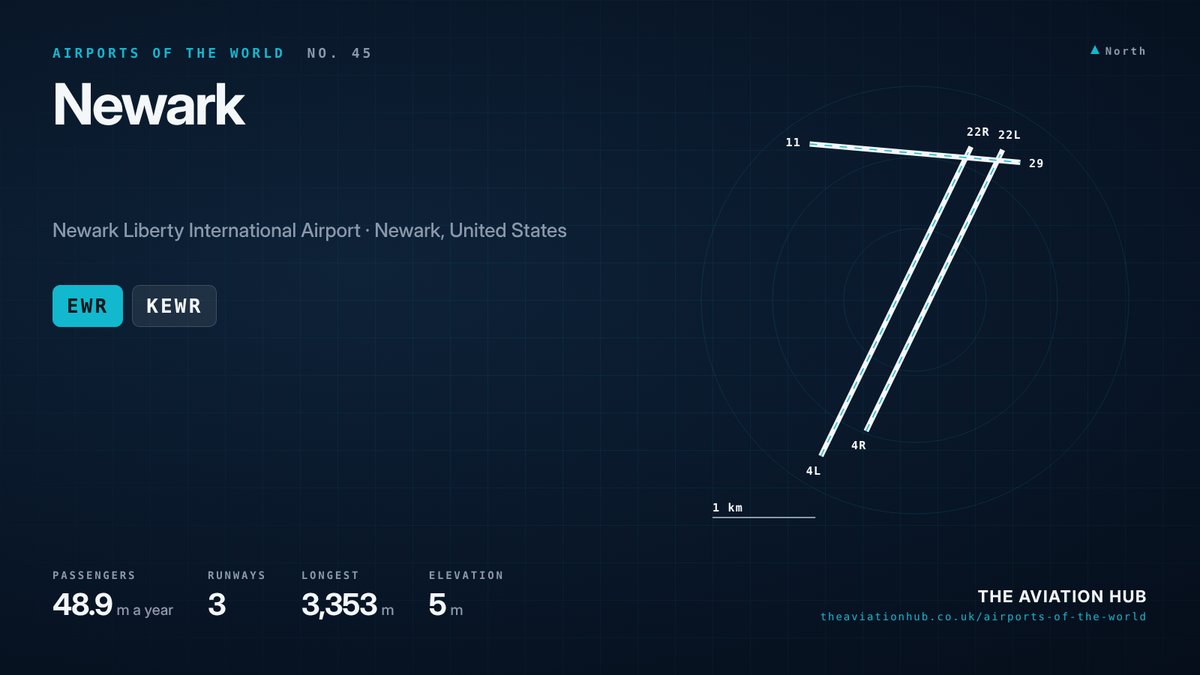
Newark Liberty International Airport lies in New Jersey, about 9 miles (15 km) southwest of Midtown Manhattan across the Hudson River. It handled around 47 million passengers in 2025 and is one of the three major airports run by the Port Authority of New York and New Jersey. Newark Airport is United Airlines’ transatlantic fortress and carries roughly two thirds of its traffic on that one airline. It is also the oldest of the New York region’s big three fields, with a history reaching back to 1928.
Newark Airport at a Glance
The airport’s IATA code is EWR, because NEW had already been assigned to Lakefront Airport in New Orleans. The ICAO code is KEWR. The field sits at just 5 metres (18 feet) above sea level on reclaimed marshland straddling the cities of Newark and Elizabeth, which own it and lease it to the Port Authority. Three runways and three terminals handle the traffic.
Passenger numbers reached a record of just over 49 million in 2023 and settled at around 47 million in 2025 after a difficult year of runway work and air traffic control disruption. United Airlines accounts for roughly 67 per cent of passengers and runs its largest international hub here. FedEx Express is the second largest tenant. Live flight status and parking rates are on the airport’s official website.
How Newark’s Airport Came to Be
The City of Newark opened Newark Metropolitan Airport on reclaimed marshland in October 1928. It was the first major airport serving the New York area and quickly became the busiest in the world. A 1929 crash that killed 14 of 15 people aboard was then the deadliest in United States aviation history.
LaGuardia’s opening in 1939 stole the limelight, and the field closed to civilian traffic during the Second World War. The Port Authority took over in 1948 and rebuilt the airport around new runways and terminals. Three crashes in nearby Elizabeth between December 1951 and February 1952 killed more than 100 people and forced a temporary closure that reshaped approach paths. The current terminal layout dates from the 1970s, when Terminals A, B and C opened as three horseshoe shaped buildings.
People Express made Newark its low fare base in the 1980s, and Continental Airlines inherited that hub and built it into a global operation. The Continental merger with United in 2010 brought the current dominant carrier. On 11 September 2001, United Flight 93 departed from the old Terminal A. The airport was renamed Newark Liberty International in 2002 to honour the victims and reference the Statue of Liberty, about 7 miles to the east.
Runways at Newark Airport
Newark operates two parallel runways plus a crosswind strip, all asphalt and all 46 metres wide. Runway 4L/22R is the longest at 3,353 metres (11,000 feet) and handles most departures. Runway 4R/22L measures 3,048 metres (9,999 feet) and takes most arrivals. Runway 11/29 is the crosswind runway at 2,050 metres (6,725 feet), used by smaller aircraft and when strong westerlies make the parallels unusable.
The two parallels are only about 950 feet apart, far too close for independent simultaneous approaches. That constraint is the root of the airport’s reputation for delays, as it effectively operates as a single runway airport in poor weather. Southwesterly operations on the 22s are most common, with northeasterly flow on the 4s during winter high pressure.
Runway 4L/22R was rebuilt in the spring of 2025, which coincided with staffing and equipment problems at the Philadelphia radar facility that handles Newark approach. The resulting delays made international headlines and prompted the Federal Aviation Administration to cap hourly movements. Newark Airport remains slot controlled under those limits.
Terminals and Airlines
Terminal A is the newest building, opened in stages from January 2023 at a cost of about 2.7 billion dollars. Its 33 gates host Air Canada, American, Delta, JetBlue and a portion of United’s domestic flying. The bright, spacious design replaced the cramped 1973 original and quickly won awards.
Terminal B has 24 gates and handles Alaska Airlines plus most foreign carriers, including British Airways, Lufthansa, Emirates, Singapore Airlines, Air India and TAP. It also receives some United international arrivals. The building is the next in line for replacement under the Port Authority’s long term plan.
Terminal C belongs to United. Its 68 gates host most of the carrier’s mainline and United Express operation, making it one of the biggest single airline terminals in the country. United’s Polaris lounge here is among the best in its network. SkyTeam and Oneworld have a much smaller presence.
Routes and Destinations
The busiest domestic routes are Orlando, Los Angeles and Atlanta, each with many daily departures. San Francisco, Chicago, Fort Lauderdale, Miami and Houston follow. United uses Newark Airport as its main East Coast connecting point, so flights fan out to every corner of the country.
Internationally, London Heathrow, Santo Domingo and Toronto Pearson lead by passenger numbers. United flies nonstop to dozens of European cities, from the obvious capitals to secondary points such as Palma, Porto and Tenerife. The longest routes reach Singapore, flown by Singapore Airlines, and Johannesburg, Cape Town, Delhi and Tokyo, flown by United’s Boeing 787 and 777 fleets. Transatlantic flying peaks from June to September, while winter brings extra Caribbean and Florida capacity.
Cargo is substantial. FedEx operates a large regional hub across three buildings, and the field handles a significant share of the region’s international freight.
Getting to and from Newark Airport
AirTrain Newark, a monorail, links all three terminals with Newark Liberty International Airport station on the Northeast Corridor. NJ Transit trains reach New York Penn Station in about 30 minutes, the quickest option for Manhattan. Amtrak also stops at the station. The monorail is ageing and unreliable, and a 2 billion dollar replacement cable car system is due to open in 2029.
Coach services run from each terminal to Port Authority Bus Terminal, Bryant Park and Grand Central, taking 45 to 60 minutes depending on tunnel traffic. NJ Transit local buses serve downtown Newark and the Ironbound district cheaply. By road, US Routes 1 and 9 border the field and the Newark Airport Interchange connects to Interstates 95 and 78. A taxi to Midtown costs around 90 to 110 dollars including tolls. Parking ranges from economy lots to the daily garages beside each terminal.
Spotting and Photography
Newark Airport has no official viewing area, but the Terminal C concourses offer broad views across the United apron and Runway 4L/22R. The Marriott hotel inside the airport loop has rooms overlooking the runways, which is the easiest way to watch operations in comfort. The AirTrain itself gives moving views over the whole field.
For approach shots, the Elizabeth Center car park by IKEA, east of the field, is the best spot for 4R arrivals, and the rideshare hold lot on Earhart Drive also catches them. With the 22s in use, the industrial streets around Delancy Street to the north offer views of arrivals on 22L. Afternoon light suits the west side of the field. Police attention is routine, so carry identification, stay on public ground and avoid lingering near fences.
Expansion Plans
The Port Authority’s EWR Vision plan runs through 2065. The next phase replaces Terminal B with a larger building, consolidates roadways and delivers the new AirTrain. There is no room for a fourth runway, so capacity gains must come from better air traffic procedures and larger aircraft.
The 2025 delay crisis forced the FAA to modernise the facility handling Newark approach and to hold movement caps in place. That will stabilise reliability at the cost of growth. United’s response is to upgauge, replacing regional jets with Airbus A321neos and Boeing 737 MAX aircraft. Newark Airport will remain United’s gateway to the world, slightly smaller but more dependable. Compare it with JFK and LaGuardia on our Airports of the World map.
Continue to follow The Aviation Hub for more analysis and insight.
Advertise with us Your brand, in front of an aviation audience Home page and in-article placements, sold directly, one advertiser per slot. From £250 a year. See the rates

