
Nice Airport Guide: The Riviera’s Seaside Runways
Nice Airport sits on reclaimed land at the end of the Promenade des Anglais. Runways, terminals, routes, the Monaco helicopters and access all explained.
 By The Aviation Hub
7 min read
Updated October 20, 2026
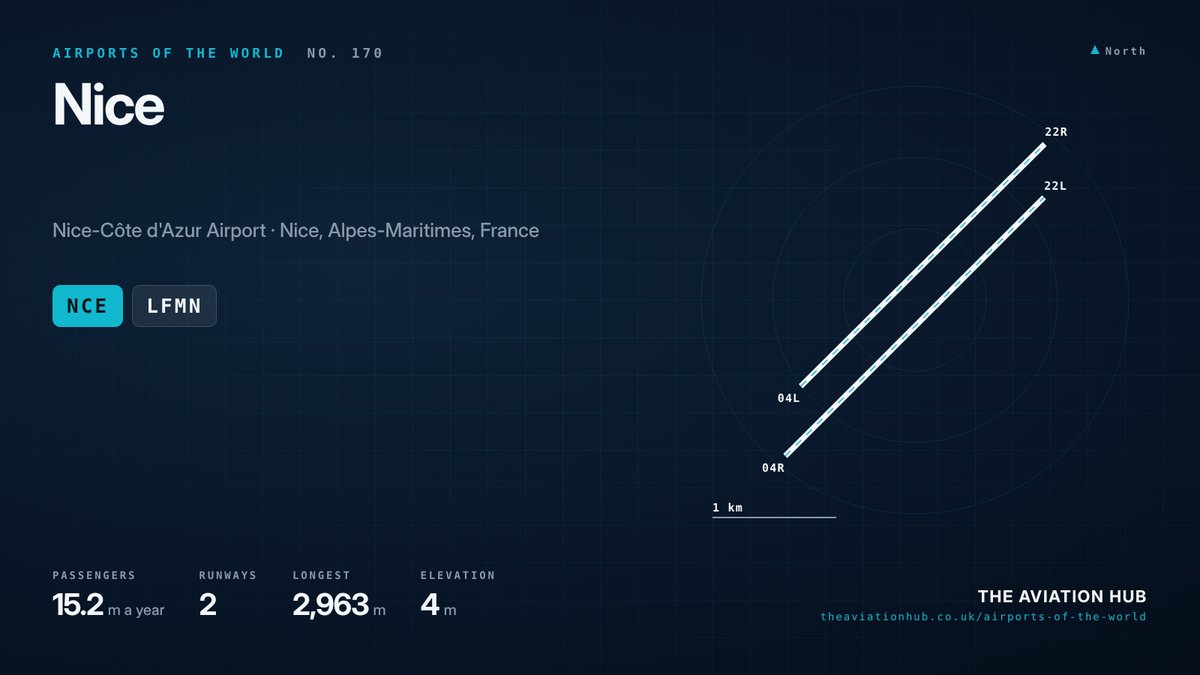
Nice Airport occupies a wedge of reclaimed land at the western end of the Promenade des Anglais, where the River Var meets the Mediterranean about 4 miles (7 km) from the old town. Formally Nice Cote d’Azur Airport, it is the third busiest airport in France and the gateway to the Riviera, Monaco and the ski resorts of the southern Alps. It handled 15.2 million passengers in 2025. The approach along the coast, with the Alps on one side and the sea on the other, is among the most celebrated in Europe.
Nice Airport at a Glance
The codes are NCE and LFMN. The airport sits just 4 m (12 ft) above sea level on land pushed out into the bay, with the Var valley to the west and the city pressing against the eastern boundary. There are two parallel runways, two passenger terminals and a business aviation terminal, plus two helipads for the Monaco shuttle. Around 15.2 million passengers and 173,000 aircraft movements were recorded in 2025, up about 3 and 2 per cent respectively, and the passenger total was a record.
Air France treats Nice Airport as a focus city and easyJet runs one of its largest French bases here, with the two carrying a large share of the traffic. Aeroports de la Cote d’Azur, a company majority owned by the Azzurra consortium of Mundys and EDF Invest since 2016, operates the field along with the smaller airports at Cannes Mandelieu and Saint Tropez. Terminal and parking information sits on the airport’s official website.
How the Riviera Got Its Airport
Flying in Nice began on the Californie fields west of the city before the First World War, and a grass aerodrome served the interwar tourist trade. The modern airport dates from the aftermath of the Second World War, when the site was rebuilt and given a paved runway and the Cote d’Azur name that tied it to the whole coast rather than one city.
Growth through the 1950s and 1960s brought Caravelles and the first terminal on the eastern side of the field, now Terminal 1. Land was scarce, so the airport grew into the sea. A huge reclamation programme in the late 1970s and early 1980s created the platform for the second runway and for Terminal 2, which opened in 1987 on the western side.
The airport has suffered two notable losses at sea. Air France Flight 1611, a Caravelle from Ajaccio, crashed into the Mediterranean off Nice in September 1968 with the loss of all 95 on board, and a memorial stands near the airport. A Sterling Airways Corvette business jet came down about 1 km south of the field in 1979, killing all 10 on board. In 1969 an experimental hovercraft service even linked the airport with Cannes, Saint Tropez, Monaco and San Remo for a season.
Runways at Nice Airport
Two parallel asphalt runways run northeast to southwest along the shore. Runway 04R/22L is the southern and longer of the pair at 2,963 m (9,721 ft) by 45 m, built on the reclaimed land, and runway 04L/22R measures 2,628 m (8,622 ft) by 45 m on the landward side. The two are close together, so Nice Airport runs them in segregated mode, with 04L/22R mainly for arrivals and 04R/22L for departures, rather than as independent parallels.
Most of the time aircraft land towards the northeast on the 04 runways and the arrival is the reason pilots and passengers love the place. Traffic from the west follows the coast past Cannes and Antibes, turns over the bay and lines up low over the water with the Baie des Anges and the hills behind the city filling the windscreen. Departures to the southwest on the 22s climb out over the sea and turn away from the city to limit noise. When the easterly wind blows, operations reverse and arrivals come in over the Promenade.
The Alps rising behind the airport and the terrain to the north make missed approaches and departures more demanding than at most coastal fields, and Nice Airport has strict noise procedures, especially at night. The two helipads, H1 and H2, handle the seven minute Monaco helicopter shuttle.
Terminals and Airlines
Terminal 1 is the older building on the eastern side, close to the city. It handles the Star Alliance carriers, most of oneworld and the unaligned European airlines, among them Lufthansa, Swiss, British Airways, Aer Lingus, Turkish Airlines, Qatar Airways and Air Transat, along with many of the seasonal operators. The building has been refurbished repeatedly and includes the schengen and non schengen split typical of French airports.
Terminal 2 to the west is the larger and busier of the two and the home of Air France, KLM, Transavia, Delta and Emirates, along with several budget airlines. A new module adding room for 3.5 million passengers was inaugurated in April 2026. The business aviation terminal beside Terminal 2, opened in 2010, serves one of the densest private jet markets in Europe, and in May the Monaco Grand Prix and the Cannes film festival fill its apron. A free shuttle and the tram link the two terminals in minutes.
Routes and Destinations
Paris dominates. Paris Orly carried about 1.66 million passengers in 2023 and Charles de Gaulle a further 1.18 million, with Air France and easyJet fighting over both. Lille, Nantes and Bordeaux complete the domestic top five, and easyJet adds Lyon from October 2026.
London is the biggest international market by a distance, with Heathrow at around 628,000 passengers and Gatwick at 580,000, and Luton, Stansted and the regional British airports behind them. Geneva, Amsterdam, Rome, Zurich, Frankfurt, Munich, Brussels and Dublin follow. Nice Airport also carries real long haul. Emirates flies Dubai and Qatar Airways Doha, Delta, United and American fly seasonally to New York, Atlanta, Boston, Washington and Philadelphia, and Air Canada and Air Transat fly Montreal. The Dubai route at roughly 3,000 miles (4,800 km) is the longest year round service, and Delta’s seasonal Atlanta flight at about 4,700 miles (7,600 km) is the longest of all. Summer brings a wave of seasonal flights from across Europe and the Gulf, while winter traffic falls sharply. Cargo is negligible.
Getting to and from Nice Airport
Tram line 2 is the answer for most visitors. It stops at both terminals and runs through the Grand Arenas interchange into the city centre, reaching Jean Medecin in around 25 minutes and the port in about 35, for a fare of less than 2 euros, which makes it the cheapest sensible option. Trams run every eight minutes through the day. Nice Saint Augustin railway station is a few hundred metres from Terminal 1 at Grand Arenas and connects to the coastal TER trains towards Cannes, Antibes, Monaco and Menton.
Express coaches run along the coast to Monaco and Menton in one direction and Cannes in the other, and winter buses serve the ski resorts. By road the A8 motorway is minutes away. A taxi to central Nice takes 20 to 30 minutes for a regulated fare of around 32 euros (£27), and Monaco costs roughly 90 euros. Parking spans several multistorey car parks beside each terminal.
Spotting and Photography
Few airports offer what Nice Airport does. The Promenade des Anglais by the Ibis hotel and the Parc de Carras, at the eastern end of the runways, suit departures on 04 and arrivals on 22R, while the rocky breakwater by the Club Var Mer boat club at the western end, near the Cap 3000 mall, catches movements on 04. The hills of the Cap de Nice and Mont Boron give the classic shot of aircraft on the curving coastal approach with the city below, and the Cap d’Antibes side shows the same traffic from the west.
Afternoon light from the west suits arrivals on the 04s, and the long summer evenings are superb. The traffic mixes Air France and easyJet Airbus A320 family jets with Emirates Boeing 777s, Qatar A350s, transatlantic 767s and 787s and a constant flow of business jets and helicopters. Stay on the public beach and promenade, keep clear of the airport perimeter and do not use drones, which are banned near the field.
What Comes Next
Expansion is the hard question. The Terminal 2 extension, which lifts theoretical capacity towards 18 million passengers, went ahead after the courts rejected challenges from environmental campaigners in 2022 and opened in 2026. The airport cannot grow outwards without more reclamation, which is politically unthinkable, and the city wants fewer noisy night movements rather than more.
Nice Airport is heading for modest growth within fixed walls, with quieter aircraft and higher yields doing the work. Compare it with the rest of France on the Airports of the World map.
Continue to follow The Aviation Hub for more analysis and insight.
Advertise with us Your brand, in front of an aviation audience Home page and in-article placements, sold directly, one advertiser per slot. From £250 a year. See the rates

