
Ningbo Airport Guide: Zhejiang’s Port City Gateway
Ningbo Airport, formally Ningbo Lishe International, handles around 16 million passengers a year. Terminals, routes, the runway and transport explained.
 By The Aviation Hub
6 min read
Updated October 20, 2026
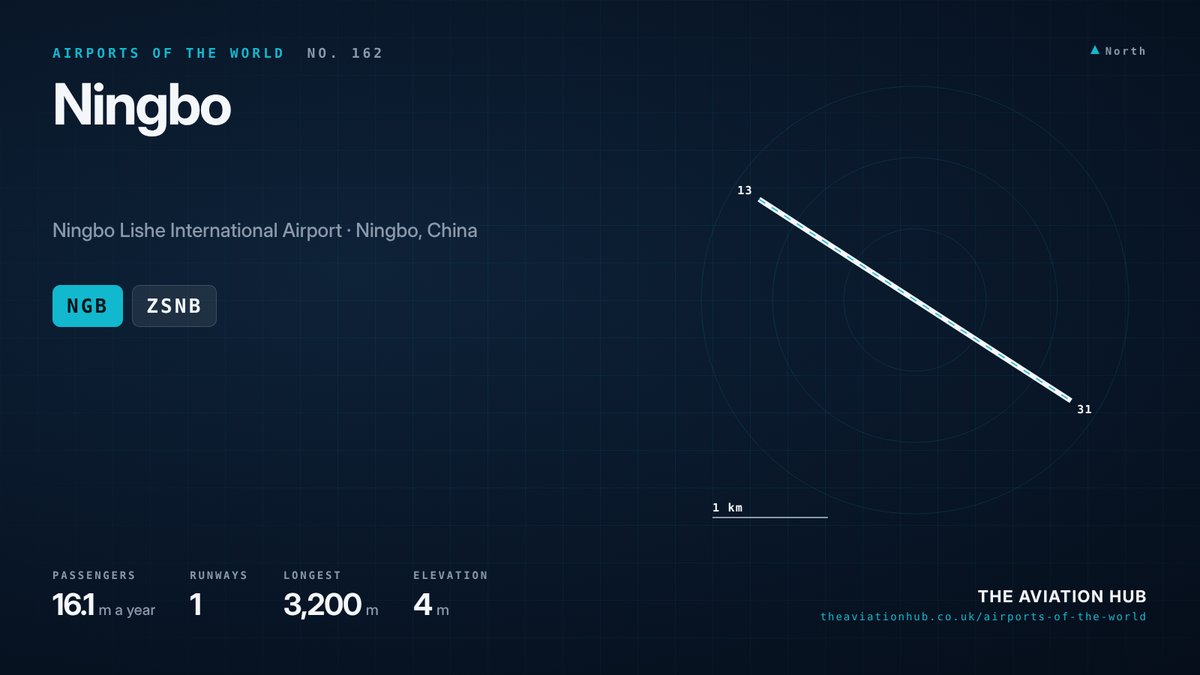
Ningbo Airport serves one of China’s great port cities, a place of ten million people on the southern shore of Hangzhou Bay that ships more container tonnage than almost anywhere on earth. Formally Ningbo Lishe International Airport, it lies about 7 miles (12 km) southwest of the city centre in Haishu District. It handled roughly 16 million passengers in 2025, which places it around 30th among Chinese airports. The field is a focus city for China Eastern Airlines and the main air gateway for a province that otherwise looks to Hangzhou and Shanghai.
Ningbo Airport at a Glance
The codes are NGB and ZSNB. The airport sits just 4 m (13 ft) above sea level on the flat coastal plain between the Yong River and the hills to the west. There is one runway and two passenger terminals, the large T2 opened in 2019 and the refurbished T1 that returned to use at the end of 2023. Around 16.1 million passengers passed through in 2025, up a little over 9 per cent on 2024, and cargo was roughly 160,000 tonnes.
China Eastern runs the biggest operation and bases aircraft here, while Spring Airlines, China Southern, Air China and Xiamen Airlines all keep sizeable schedules. More than 40 airlines use the field. Zhejiang Provincial Airport Group operates Ningbo Airport, and the latest flight information is on the airport’s official website.
From Wartime Bomber Base to Civil Airport
Lishe began as an auxiliary base of the Chinese Nationalist Air Force in the 1930s. Its moment in history came in May 1938, when bombers launched from Lishe to drop leaflets over Nagasaki and other Japanese cities in a propaganda raid that reached the Japanese mainland. The field spent the following decades as a military airfield with no civil role.
The central government approved a civil airport on the site in 1985, and the new Ningbo Lishe Airport opened to the public on 30 June 1990 at a cost of around 126 million yuan. It was the first airport in Zhejiang built purely for civil use. Great Wall Airlines set up a hub in 1997, and a new terminal, now T1, opened in October 2002. The airport took its present name in November 2005, more than a decade after its first international flights to Hong Kong in July 1992.
The third expansion phase began in earnest in December 2015 and delivered T2, which opened on 29 December 2019 with T1 closing the same day. T1 was gutted and rebuilt from April 2022 and reopened on 22 December 2023, giving the field two working terminals for the first time.
Runways at Ningbo Airport
A single concrete runway, 13/31, carries everything. It measures 3,200 m (10,499 ft) long and 45 m wide, which is enough for a fully loaded Boeing 777 freighter or Airbus A330 but leaves the airport in the 4E class rather than the 4F standard needed for regular Airbus A380 and 747-8 operations. The runway runs roughly northwest to southeast, with the city on the 31 side and open farmland and the Fenghua River valley beyond the 13 end.
The sea breeze pattern means landings on runway 13 are common in the afternoon, while mornings and the winter monsoon often favour 31. One runway means no parallel operations, and the field handled around 113,000 movements in 2025, which is close to the sensible limit for a single strip with a mixed fleet.
The runway at Ningbo Airport made the news on 7 August 2023, when a Kalitta Air Boeing 747 freighter arriving from Anchorage ran off the side of the runway on landing. Nobody was hurt, but the airport shut for the rest of the day, arrivals diverted to Hangzhou and Shanghai, and departures were cancelled.
Terminals and Airlines
T2 is the main building at Ningbo Airport, a long curved hall facing the apron with more than 30 contact gates and both domestic and international zones. China Eastern, Spring Airlines, China Southern and most of the domestic carriers board here. International and regional flights to Hong Kong, Macau, Taipei, Singapore, Bangkok and the Japanese and Korean cities use the international wing at the eastern end, where immigration and customs sit.
T1, reopened at the end of 2023, takes overflow domestic traffic and gives the airport room to grow without rebuilding again. The two buildings connect through a ground transport centre that also houses the metro shuttle stop, coach bays and the car parks. A dedicated cargo terminal on the south side handles the freight trade, much of it electronics and clothing from the factories of eastern Zhejiang.
Routes and Destinations
As of early 2026 the airport served 81 domestic and 12 international destinations. Beijing Daxing, Guangzhou, Shenzhen, Chengdu, Chongqing, Xi’an and Kunming are the heavy trunk routes, with multiple daily flights on Boeing 737 and Airbus A320 family aircraft. China Eastern links Beijing Daxing, Guangzhou and Hong Kong, and also flies the Singapore route, which at roughly 2,300 miles (3,700 km) is among the longest scheduled services.
Cross border traffic recovered strongly after the pandemic and reached 1.07 million passengers in 2025, up more than a fifth. Hong Kong, Macau, Taipei, Bangkok, Seoul, Osaka and Singapore are the main international and regional points. Charter flights to Southeast Asian beach resorts peak around Chinese New Year and the October holiday. Cargo matters more here than at most Chinese airports of this size because of the port and the industrial hinterland, and Kalitta, Cargolux and the Chinese freight carriers operate regular wide body services.
Getting to and from Ningbo Airport
Ningbo Metro Line 2 stops at Lishe International Airport station, and a free shuttle bus runs from the terminals to the station every ten minutes. The train takes around 30 minutes to the city centre and 40 to Ningbo railway station for about 4 yuan (under 50p), which makes it the cheapest sensible option. High speed trains from the main station reach Hangzhou in an hour and Shanghai in two.
Airport limousine buses leave for downtown hotels hourly and less frequent coaches serve Shaoxing, Taizhou, Zhoushan and other cities in eastern Zhejiang. The Airport Expressway links the terminals to the ring roads, and a taxi to the city centre takes 20 to 30 minutes for roughly 40 to 60 yuan (£4 to £7). Parking sits in a multistorey structure beside T2.
Spotting and Photography
Ningbo Airport is not a traditional spotting location, but the airside windows in T2 give a clean view of the apron and the runway beyond it. The approach to runway 13 crosses the suburbs to the northwest, and the roads around Lishe town give low views of arrivals. Morning light from the east favours shots of aircraft landing on 13, while afternoon light works for departures from 31.
The traffic is a parade of Chinese narrow bodies with the occasional freighter for variety. Cathay Pacific, Scoot, Korean Air and the Japanese carriers add foreign colour. Photographing from public land is tolerated in China, but staying away from the fence, avoiding anything that looks military and moving on if asked by police is essential. Nearby Lishe still has a military presence and security is taken seriously.
What Comes Next
The two terminal layout gives the airport capacity for more than 20 million passengers, and the master plan allows for a second runway to the east of the present strip to lift the field into the 4F class. No construction date has been set, and the competition from Hangzhou, 90 miles (150 km) to the northwest, and from the two Shanghai airports limits how far long haul ambitions can run.
The realistic path for Ningbo Airport is steady domestic growth, more regional international services and a stronger cargo role tied to the port. It is heading towards 20 million passengers by the end of the decade. Compare it with the other Yangtze Delta airports on the Airports of the World map.
Continue to follow The Aviation Hub for more analysis and insight.
Advertise with us Your brand, in front of an aviation audience Home page and in-article placements, sold directly, one advertiser per slot. From £250 a year. See the rates

