
Nuremberg Airport Guide: Franconia’s Compact Holiday Gateway
Nuremberg Airport is 13 minutes from the city centre by underground train. Our guide covers its runway, airlines, holiday routes and future plans.
 By The Aviation Hub
5 min read
Updated October 20, 2026
Albrecht Dürer Airport sits on the northern edge of Nuremberg, the largest city in the Franconia region of northern Bavaria. Nuremberg Airport handled a record 4.5 million passengers in 2025, making it the second busiest airport in Bavaria after Munich. It is a compact, efficient field with a strong holiday focus. Few German airports are as quick to reach from the city centre, with the city’s underground taking just 13 minutes.
Nuremberg Airport at a Glance
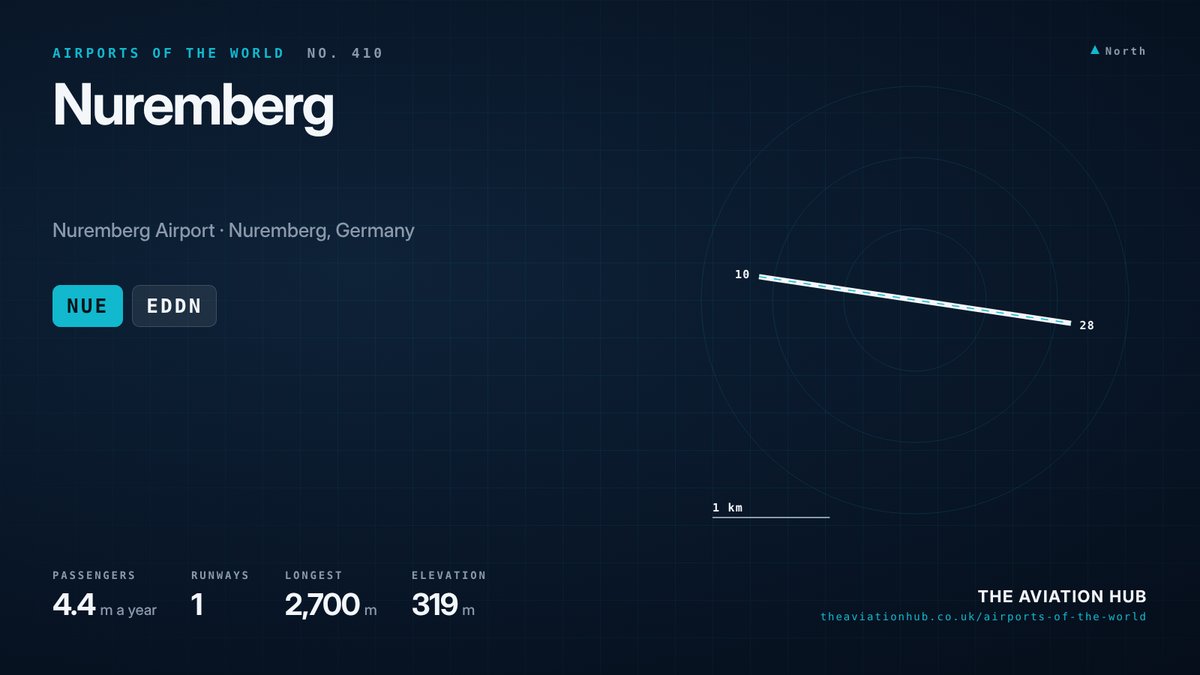
The IATA code is NUE and the ICAO code is EDDN. The airport lies about 3 miles (5 km) north of the city centre, at an elevation of 319 metres (1,046 feet). It has one runway and a single terminal with two linked departure halls. Nuremberg Airport recorded about 4.51 million passengers in 2025, beating its previous record of 4.47 million set in 2018.
Corendon Airlines Europe, Marabu and Ryanair all base aircraft here, and Eurowings returned with a base in 2024. Flughafen Nürnberg GmbH runs the site and is owned jointly by the Free State of Bavaria and the City of Nuremberg. Timetables and parking information are on the airport’s official website.
How Nuremberg’s Airport Came to Be
The city had flown from earlier fields at Atzenhof from 1915 and at Marienberg from the 1930s. War destroyed or superseded them. After 1945 US forces even used part of the main boulevard of the former Nazi Party Rally Grounds as a makeshift runway. Between 1950 and 1955 passenger flights used a private airfield near today’s Fürth Hardhöhe underground station.
The new airport opened on 6 April 1955, the first built in West Germany after the Second World War. Growth came quickly. The runway was lengthened to 2,700 metres in 1968, and a Boeing 747 first landed on 12 July 1970. A new terminal followed in 1981 with an observation deck and restaurant, and the complex has been extended several times since.
A Transfer Control Terminal for non EU transfer passengers opened in January 2007. In December 2014 the field was named after Albrecht Dürer, the Renaissance painter born in Nuremberg. Reproductions of his works now decorate the underground station at Nuremberg Airport.
Runways at Nuremberg Airport
A single runway, 10/28, carries all traffic. It measures 2,700 metres (8,858 feet) long and 45 metres wide, with an asphalt surface. Runway 28 has a Category III instrument landing system for low visibility, while Runway 10 has Category I. Prevailing westerly winds mean Runway 28 sees the most use.
The length suits the Airbus A320 and Boeing 737 families that dominate the schedule, and wide body charters can operate too. The Airbus A380, however, cannot use the airport. Unusually for Germany, Nuremberg Airport holds a licence for round the clock operations, which keeps overnight mail and holiday flights possible but remains controversial with neighbours over noise. Two incidents stand out in the record. An Icelandic DC-6A freighter crashed on approach to Runway 28 in May 1974, killing its three crew, and an Air Berlin Boeing 737-800 slid off the runway in January 2010, closing the airport for a few hours.
Terminals and Airlines
All passengers use one terminal building, with two departure halls and one arrival hall linked together. Distances are short, and a walk from the underground platform to check in takes only a few minutes. Shopping and dining space airside is due to almost double, from 650 to 1,200 square metres.
Holiday airlines dominate. Corendon, Marabu and SunExpress fly to Mediterranean and Turkish resorts, while Ryanair, Wizz Air and easyJet add low cost city and leisure routes. Lufthansa links Nuremberg with Frankfurt, and KLM connects to Amsterdam. Turkish Airlines serves Istanbul. Star Alliance and SkyTeam are both represented, making one stop connections to almost anywhere straightforward.
Routes and Destinations
Antalya was the busiest route in 2023, with about 506,000 passengers. Palma de Mallorca followed at around 430,000, ahead of Istanbul, Frankfurt and Amsterdam. That mix shows the airport’s dual role: holiday departures for Franconian families and hub feeds for business travellers. Large Turkish communities in the region also sustain strong demand to Turkey.
The calendar peaks in summer, when flights to the Greek islands, Spain, Turkey and North Africa fill the board. Winter brings the Canary Islands and Egypt into focus. December adds inbound visitors for the Christkindlesmarkt, the city’s famous Christmas market. Flights to Munich have been replaced by a Lufthansa Express Bus. Cargo remains a solid sideline at Nuremberg Airport, with two cargo centres and a third in planning.
Getting to and from Nuremberg Airport
The underground is the obvious choice. Line U2 runs from the terminal to Nuremberg Hauptbahnhof every 10 minutes and takes about 13 minutes. It is the only German airport served by an underground metro line rather than suburban or mainline trains. A standard VGN ticket covers the journey, making it the cheapest sensible option.
By road, the A3 motorway runs close by, with the A9, A73 and A6 within easy reach. A planned direct motorway link has been shelved. Bus 30 continues to Erlangen and bus 33 connects with Fürth. Taxis reach the old town in around 15 to 20 minutes. The P4 car park, opened in 2021, added 3,600 spaces at Nuremberg Airport.
Spotting and Photography
The single runway and compact layout make spotting straightforward. Westerly operations bring arrivals over woodland east of the field towards Runway 28. Irrhainstraße, on the southwest side near the Runway 10 end, is a popular spot for arrivals and line ups. The terminal has historically offered elevated views from its viewing areas, so check current opening times before visiting.
Expect a colourful mix of Corendon, Marabu, SunExpress and Ryanair jets, plus regional aircraft and visiting business jets. Afternoon light works well from the southern side. Respect fences and local rules at Nuremberg Airport, stay on public paths and keep ladders and tripods out of roadways. German police take airport security seriously.
What Comes Next
The focus is on getting more from existing infrastructure. A third cargo centre, known as CCN3, would add around 3,600 square metres of hangar space and 1,900 square metres of offices. The airside retail expansion will modernise the passenger experience. A planned airport hotel has been put on hold.
Holiday airlines have fuelled the record 2025 result, and the bases of Corendon, Marabu and Ryanair point to further growth. The night flying licence will remain politically sensitive. Expect a busy, leisure led airport that makes the most of its single runway. Compare it with other German fields on our Airports of the World map.
Continue to follow The Aviation Hub for more analysis and insight.
Advertise with us Your brand, in front of an aviation audience Home page and in-article placements, sold directly, one advertiser per slot. From £250 a year. See the rates

