
Oakland Airport Guide: The East Bay’s Southwest Stronghold
Oakland Airport is the East Bay's gateway, a Southwest base and a FedEx hub. Read about its runways, terminals, routes, BART link and the new name row.
 By The Aviation Hub
6 min read
Updated October 20, 2026
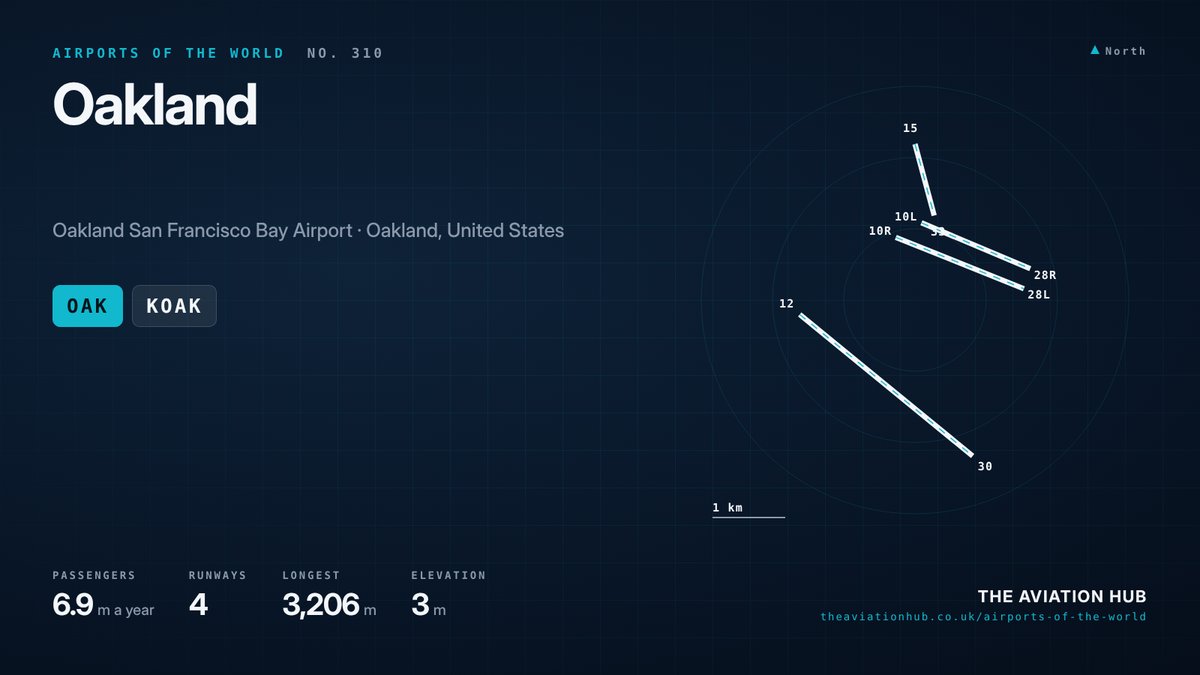
Oakland Airport sits on the eastern shore of San Francisco Bay, serving Oakland, the wider East Bay and a good slice of travellers who would rather avoid SFO. It handled about 9.2 million passengers in 2025, most of them on Southwest Airlines. The field is also a major FedEx cargo hub and a busy general aviation base. Since 2025 its official name has been Oakland San Francisco Bay Airport, after a bruising legal fight with its neighbour across the water.
Oakland Airport at a Glance
The IATA code is OAK and the ICAO code is KOAK. The terminals lie about 6 miles (10 km) south of downtown Oakland and roughly 20 miles by road from downtown San Francisco. Elevation is just 9 feet (3 m). There are four runways split between the South Field and the North Field, and two connected passenger terminals with 29 gates. The Port of Oakland owns and operates the 2,600 acre site.
Oakland Airport handled 9,210,509 passengers in 2025, down from about 10.8 million in 2024 and well below the 2019 peak of 13.4 million. Southwest Airlines runs an operating base here and carries the large majority of passengers. FedEx Express has run its West Coast cargo base at OAK since 1988 and upgraded it in 2013. Gates, parking and security times are listed on the airport’s official website.
A Short History of Oakland Municipal
The city began studying an airport in 1925, and the Dole Air Race to Hawaii forced the pace. Oakland bought 680 acres in April 1927 and laid a 7,020 ft runway in 21 days, then the longest in the world. Charles Lindbergh dedicated the field on 17 September 1927. It quickly became the West Coast’s long distance launch pad.
Charles Kingsford Smith left Oakland in 1928 on the first flight from the United States to Australia. Amelia Earhart departed from here on her final round the world attempt in 1937. After the Second World War the Port of Oakland built a new South Field on reclaimed bay land, with a long runway and a passenger terminal suited to jets. The original North Field became the general aviation side.
Terminal 2 arrived later as Southwest grew, and a $300 million programme begun in 2004 added five more gates there by 2008. A $100 million refurbishment of Terminal 1 finished in 2017. In 2024 the Port tried to rename the airport San Francisco Bay Oakland International. San Francisco sued, a judge blocked it, and a 2026 settlement confirmed the compromise name without the word international.
Runways at Oakland Airport
Runway 12/30 on the South Field handles almost all airline and cargo traffic. It is 3,206 m (10,520 ft) long and 46 m wide, built on fill that juts into the bay. The North Field has three shorter strips: 10R/28L at 1,894 m (6,213 ft), 10L/28R at 1,663 m (5,457 ft) and 15/33 at 1,029 m (3,376 ft) and 23 m wide. All four are asphalt.
Prevailing westerly winds off the Pacific mean runway 30 is in use most days, with arrivals crossing San Leandro and departures climbing out over the bay. The North Field runways keep training aircraft, business jets and some turboprops away from the jets. In 2013 the old runways 27 and 29 were renumbered 28 and 30 because of shifts in the Earth’s magnetic field. Fog and a crowded Bay Area airspace shared with SFO and San Jose are the main operational challenges.
Terminals and Airlines
Terminal 1 is the older building, with 16 gates and the federal inspection area for international arrivals without preclearance. It houses Alaska Airlines, Delta, Frontier, Hawaiian, Volaris and Viva, alongside some Southwest flights and the small regional carrier Advanced Air. Terminal 2 has 13 gates and is used entirely by Southwest. JSX runs its semi private jet service from a separate facility.
Southwest dominates Oakland Airport with a large fleet of Boeing 737-700s, 737-800s and 737 MAX 8s, giving the East Bay frequent nonstop service across the western United States. Alaska and Hawaiian, now under common ownership, add Seattle and Hawaii. On the cargo side, FedEx flies wide body freighters such as the Boeing 777F and 767F into its sortation hub most nights.
Routes and Destinations
Southern California is the backbone of the network. Southwest links Oakland Airport with Burbank, Los Angeles, Ontario, Long Beach and San Diego many times a day, and Las Vegas, Phoenix and Denver are major point to point markets. Hawaii is an important leisure market, with Honolulu, Maui, Kona and Lihue served directly.
International flying is limited to Mexico and Central America. Volaris and Viva serve Guadalajara and other Mexican cities, while Volaris El Salvador links Oakland with San Salvador, about 2,650 miles (4,250 km) away and among the longest routes. Long haul Europe has come and gone: Norwegian once flew Boeing 787s to London, Barcelona, Scandinavia, Rome and Paris, but those routes moved to SFO or ended. FedEx freighters keep cargo links to Asia busy.
Getting to and from Oakland Airport
BART is the easy option. The Oakland Airport Connector, opened on 22 November 2014, runs automated trains every few minutes to Coliseum station in about eight minutes. From there BART reaches downtown Oakland in around 15 minutes and downtown San Francisco in roughly 30. A surcharge applies to the airport link, but the full trip to San Francisco still costs only around $11.
AC Transit Line 73 runs from about 5am to midnight to Eastmont Transit Center, and Line 805 covers the night. Amtrak Capitol Corridor trains stop at Oakland Coliseum, next to the BART station. Drivers reach Oakland Airport from Interstate 880, about 2 miles away via Hegenberger Road or 98th Avenue, or from Doolittle Drive. Parking ranges from hourly garages to cheaper economy lots, and rideshare pickups are well signed.
Spotting and Photography
The shoreline around Oakland Airport is generous to enthusiasts. The San Leandro Marina, beside Oyster Bay Regional Shoreline, sits under the approach to runway 30 and gives low arrivals over the water, with the best light from sunrise to mid morning in summer. The Hayward Regional Shoreline further south suits the afternoon. Harbor Bay Parkway on Bay Farm Island in Alameda offers views of departures climbing out across the bay, with the San Francisco skyline in the distance.
The North Field is worth a visit too. The Oakland Aviation Museum occupies a historic hangar on the general aviation side, and North Field movements bring a mix of light aircraft and business jets. FedEx wide bodies arrive mostly in the evening and overnight. Stay on public paths, keep away from perimeter fences and comply with any request from airport police.
What Comes Next
The Port’s master plan is built for growth that has not yet returned. It projects 20 million passengers by 2028 and 25 million by 2035, and proposes a third terminal with up to 25 gates while consolidating Terminals 1 and 2. A draft environmental report appeared in 2023. Traffic actually fell in 2025, so the timetable looks optimistic.
The renaming row was about visibility, and the Port hopes the new name will draw airlines and international travellers who never thought of Oakland. The airport’s strengths are real: a long runway, a strong FedEx operation, BART on the doorstep and fewer delays than SFO. The verdict is cautious: Oakland will grow again, but only if airlines beyond Southwest commit to it. Compare it with SFO and San Jose on our Airports of the World map.
Continue to follow The Aviation Hub for more analysis and insight.
Advertise with us Your brand, in front of an aviation audience Home page and in-article placements, sold directly, one advertiser per slot. From £250 a year. See the rates

