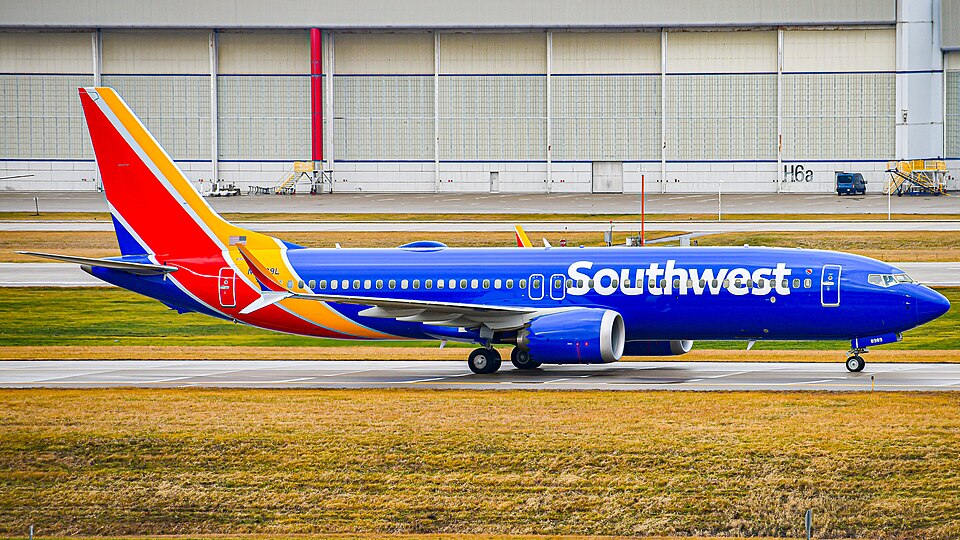
The US National Transportation Safety Board (NTSB) has published its final report into a Southwest Airlines Dutch roll on a flight to Oakland. Investigators found that a violent thunderstorm in New Orleans damaged the tail of the Boeing 737 MAX 8 nine days earlier. However, that damage went unnoticed for 43 flights and survived a scheduled maintenance check.
The report, released on 5 November 2026, also highlights a missed visual check in a Houston hangar.
Southwest Flight 746 Departs for Oakland
On 25 May 2024, Southwest Airlines flight 746 departed Phoenix Sky Harbor International Airport for Metro Oakland International Airport. The Boeing 737 MAX 8, registered N8825Q, carried 175 passengers and six crew.
Before departure, the captain spotted an earlier logbook entry describing the yaw damper overcorrecting in flight. Engineers had cleared that defect by resetting fault codes in a stall management yaw damper computer. Then, as he turned onto the runway, he felt a brief stiffness in the rudder pedals.
Dutch Roll at FL340
Shortly after the jet reached FL340, it entered light turbulence. The captain then noticed what he described as “a small amount of Dutch roll.” His first officer reported the tail moving back and forth, alongside slight rudder movement left and right.
Crucially, both pilots felt the rudder pedals moving during the oscillations. As a result, they concluded that the aircraft itself, not the turbulence, was causing the motion.
The autopilot stayed engaged throughout. After coordinating with air traffic control, the crew descended to FL320, but the oscillations returned several more times. No yaw damper light or master caution appeared at any stage. Meanwhile, the pilots alerted Southwest maintenance control through ACARS.
The aircraft landed safely in Oakland, and nobody on board suffered injury. Even so, the captain felt the same oscillations and pedal stiffness again after leaving the runway. Southwest therefore withdrew the aircraft from service at the gate.
Flight data later backed up the crew. The recorder showed oscillations lasting around 20 seconds, at roughly 0.9 Hz, with about 0.75 degrees of rudder movement either side. Every episode occurred with the yaw damper engaged.
The Damage Found After Landing in Oakland
Troubleshooting after the Oakland arrival uncovered serious structural damage inside the vertical stabiliser. Engineers found a damaged bearing on the main rudder power control unit (PCU) input rod, plus damage to the standby PCU forward support bracket.
More worryingly, the trailing edge ribs above and below the standby PCU had cracked. The upper rib had fractured through and next to two of the three holes securing the PCU support bracket. According to the NTSB, the fractures showed signatures consistent with overload failure.
A Thunderstorm in New Orleans
The trail led back to 16 May 2024. That evening, the aircraft sat overnight at remote stand R3W at Louis Armstrong New Orleans International Airport. A squall line then swept across the area while a tornado watch was in force. Later that night, the airport weather station, around 5,000 feet from the aircraft, recorded gusts of 73 knots.
The 737’s rudder system has no gust lock. Furthermore, only the main rudder PCU provides gust damping, while the standby unit has none. The NTSB concluded that the wind likely moved the rudder and damaged the ribs carrying the standby PCU.
Boeing’s maintenance manual did contain a conditional inspection for parked aircraft caught in extreme winds. However, it only referred to tornadoes and microbursts, and it set no wind speed threshold at all.
Southwest also had no process to alert maintenance control when storms hit parked aircraft, so nobody ordered the inspection. The jet flew again the next morning.
A Missed Check in Houston
Between 17 and 23 May, the aircraft completed 38 flights without any reported rudder problems. On 23 May, it underwent an A Core Check at Houston Hobby. This included an operational test of the standby hydraulic system.
The test requires someone at the tail to watch the rudder move as the pedals reach each stop. Southwest’s records showed a clean pass. However, hangar security footage told a different story. The rudder travelled right but not left, and nobody stood at the tail to check it.
According to the NTSB, the damage would have shown up during this test as a rudder that would not return to neutral. Instead, staff signed the test off and released the aircraft. Notably, flight data shows the abnormal rudder behaviour began on the very first flight after this check.
Warning Signs Before the Oakland Flight
The jet flew five flights on 24 May. On the fourth, flight 5816, the crew manually disconnected the yaw damper after it seemed to overcorrect in turbulence. Engineers at San Jose then deferred the yaw damper under the minimum equipment list.
After the fifth flight, the yaw damper passed a functional test and returned to service. The next morning, flight 746 set off for Oakland as the aircraft’s 44th flight since the New Orleans storm.
What the NTSB Concluded
The NTSB found the probable cause to be storm damage to the standby rudder PCU’s connection to the fin while the aircraft sat parked. That damage went undetected and led to abnormal operation of the standby PCU.
The Board cited three contributing factors. First, Southwest maintenance staff performed the standby hydraulic test incorrectly. Second, Boeing’s manual lacked a defined wind speed threshold for the storm inspection. Finally, Southwest lacked an adequate process to alert maintenance control after extreme wind events.
Southwest and Boeing Respond
Both companies have already acted. Southwest inspected the rudder PCU mountings across its entire 737 MAX fleet and found nothing abnormal. The airline also introduced a dedicated work card for the test, with individual sign offs from assigned mechanics. In addition, it now alerts maintenance control whenever parked aircraft face extreme winds.
Boeing, meanwhile, has revised its 737 maintenance manual. The extreme high wind inspection now applies once winds reach 65 knots, or 75 mph.
Why the Oakland Report Matters
The Oakland incident ended without harm, yet it shows how hidden damage can survive dozens of flights. Several safety layers failed here. A vague manual offered no trigger for inspection, Southwest had no storm alert process, and a test without a tail observer missed the clearest clue.
Ultimately, the crew’s sharp observations on the Oakland flight brought the problem to light. By treating the motion as a fault rather than turbulence, they gave engineers the chance to find the cracked ribs.
Read the full NTSB final report on the Oakland incident.
Continue to follow The Aviation Hub for more analysis and insight.
Advertise with us Your brand, in front of an aviation audience Home page and in-article placements, sold directly, one advertiser per slot. From £250 a year. See the rates