
Olbia Airport Guide: Gateway to the Costa Smeralda
Olbia Airport is the summer gateway to Sardinia's Costa Smeralda. Its runway, terminal, airlines, private jets, buses and what comes next.
 By The Aviation Hub
5 min read
Updated October 20, 2026
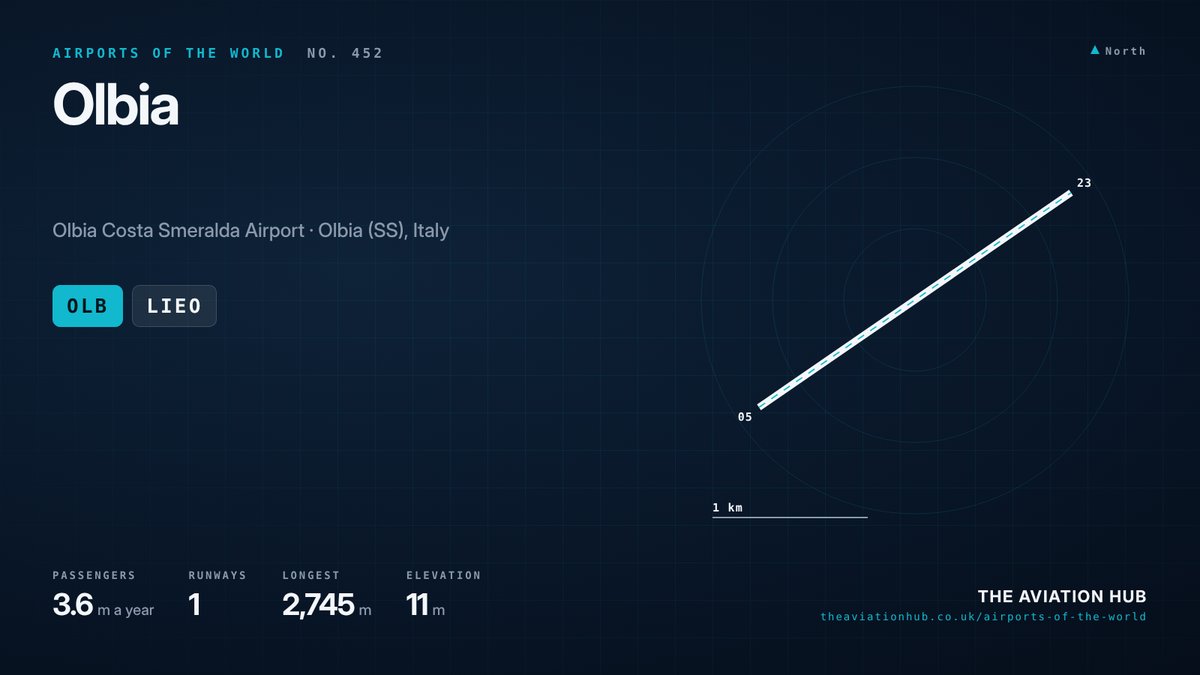
Olbia Airport sits on the edge of the port town of Olbia in north eastern Sardinia, a short drive from the yachts and villas of the Costa Smeralda. It handled close to 3.9 million passengers in 2024, the vast majority between May and October. Low cost airlines, European network carriers and a fleet of private jets all converge on its single runway each summer. Few Italian airports swing so sharply between quiet winters and frantic summers.
Olbia Airport at a Glance
The IATA code is OLB and the ICAO code is LIEO. The airport lies about 2 miles (3 km) south east of Olbia town centre and roughly 19 miles (30 km) from Porto Cervo. It sits 37 feet (11 m) above sea level, with one runway and one passenger terminal. Olbia Airport recorded 3,883,235 passengers in 2024, up 18.3 per cent, with 42,313 aircraft movements.
The operator is Geasar S.p.A. Volotea and easyJet have the largest networks, ahead of Ryanair and Eurowings. Lufthansa, Air France, British Airways and Austrian bring hub connections in summer. Flight information and transport details are on the airport’s official website.
How Olbia’s Airport Came to Be
Flying at Olbia began in 1921, when a military airfield opened at what was then called Terranova Pausania. A seaplane base followed in 1927, though the service ended in 1929. Allied bombers targeted the site during the Second World War, and the Germans opened Venafiorita airfield about 4.5 miles (7.2 km) south of town. The site took the Olbia name in 1945.
The Costa Smeralda changed everything. Prince Karim Aga Khan IV began developing the coast in the early 1960s and founded the airline Alisarda in 1963 to bring visitors in. Alisarda grew into Meridiana, which kept its headquarters and main base at Olbia for decades before becoming Air Italy in 2018. Air Italy collapsed in 2020. Jet aircraft needed a bigger field, and the present airport was completed in 1974.
After the Aga Khan died on 4 February 2025, Olbia Airport was renamed Olbia Costa Smeralda Prince Karim Aga Khan IV Airport in his honour. The terminal opened on 6 June 2004, built for 4.5 million passengers a year at a cost of 81 million euros.
Runways at Olbia Airport
There is one runway, 05/23, with an asphalt surface measuring 2,745 metres (9,006 feet) long and 45 metres wide. It comfortably handles Airbus A320 and Boeing 737 families and occasional wide body jets on long haul flights. The airport closed from 3 February to 14 March 2020 for taxiway and runway refurbishment and extension work, and the pandemic then kept it shut until 3 June 2020.
The runway lies on low ground near the Gulf of Olbia, with granite hills to the west. Winds funnelled between the hills and the sea can be gusty, especially when the mistral blows from the north west. Parking space for aircraft is the real constraint at Olbia Airport in summer, when business jets fill every available corner of the apron.
Terminals and Airlines
The 42,000 square metre terminal has 40 check in desks and 15 boarding gates. Gates A1 to A5 have jet bridges and serve Schengen flights by carriers such as Lufthansa and Air France. Gates A7 to A10 are bus gates for non Schengen flights, including British Airways and easyJet services to the UK, while lower floor B gates handle Ryanair. The building also houses shops, a wine bar, a small art gallery and indoor gardens of local plants.
Volotea serves the most destinations from Olbia Airport, followed by easyJet, with Ryanair, Eurowings, Condor and Norwegian also prominent. Network carriers include Lufthansa, Air France, British Airways and Austrian. Delta flies seasonally from New York JFK, and flydubai links Dubai. Aeroitalia and Volotea keep domestic links open all year, while Wizz Air, Transavia and Jet2 add more summer routes.
Routes and Destinations
Domestic links to Rome Fiumicino and Milan Linate run year round, supported by public service rules that keep fares affordable for Sardinians. In summer the network explodes across Europe, with heavy traffic from Germany, Switzerland, the UK, France and Scandinavia. London, Milan, Rome, Munich, Zurich and Paris are among the most important markets.
Long haul flying is growing. Delta’s New York JFK service is the longest route, and United plans seasonal flights to Newark from 28 May 2027. British Airways added a seasonal charter to Jersey in May 2026. Cargo is small, at around 1,300 tonnes in 2024, but private aviation is huge, with summer weekends bringing dozens of business jets carrying guests to the Costa Smeralda.
Getting to and from Olbia Airport
There is no rail link to the terminal, but buses are good. ASPO line 10 runs to Olbia town centre in around 15 minutes and is the cheapest sensible option. Line 2 serves Sa Minda Noa, while line 20, the Costa Smeralda Shuttle, runs to Porto Cervo and Baja Sardinia. Line 90 links Sassari and Alghero.
Regional coaches serve Nuoro, Cala Gonone, Santa Teresa di Gallura and Cagliari. By road, the airport connects with the SS125 coastal road and the SS729 towards Sassari. Taxis reach the town centre in about ten minutes and Porto Cervo in around 40, at summer prices. Car hire is popular, and parking sits in front of the terminal. The ferry port is close by, handy for travellers continuing to the Italian mainland.
Spotting and Photography
Summer turns Olbia Airport into a showcase of business aviation. Gulfstreams, Bombardier Globals and Dassault Falcons line the apron on busy weekends, alongside A320s and 737s from across Europe. The roads around the perimeter and the shore near the runway ends give views of arrivals over the water and the hills.
Midsummer light is harsh at midday, so mornings and evenings work best. Traffic is light in winter, when only domestic routes and a handful of international flights operate. Stay on public land, keep clear of the fence and the private aviation areas, and respect the privacy of high profile visitors. Local police patrol the airport closely in peak season.
What Comes Next
The 2004 terminal was built for 4.5 million passengers, and traffic is now close to that mark. More apron space for business jets and terminal capacity for summer peaks are the priorities. New long haul routes from the United States suggest growing demand from wealthy American travellers.
The challenge is seasonality: busy summers and quiet winters make investment hard to justify. The verdict: Olbia Airport will keep growing as a premium summer gateway, with long haul and private jets driving the next phase. Compare it with other Sardinian airports on the Airports of the World map.
Continue to follow The Aviation Hub for more analysis and insight.
Advertise with us Your brand, in front of an aviation audience Home page and in-article placements, sold directly, one advertiser per slot. From £250 a year. See the rates

