
Omaha Airport Guide: Eppley Airfield on the Missouri
Omaha Airport, officially Eppley Airfield, explained: runways, terminals, airlines, busiest routes, transport links and the big terminal rebuild.
 By The Aviation Hub
7 min read
Updated October 20, 2026
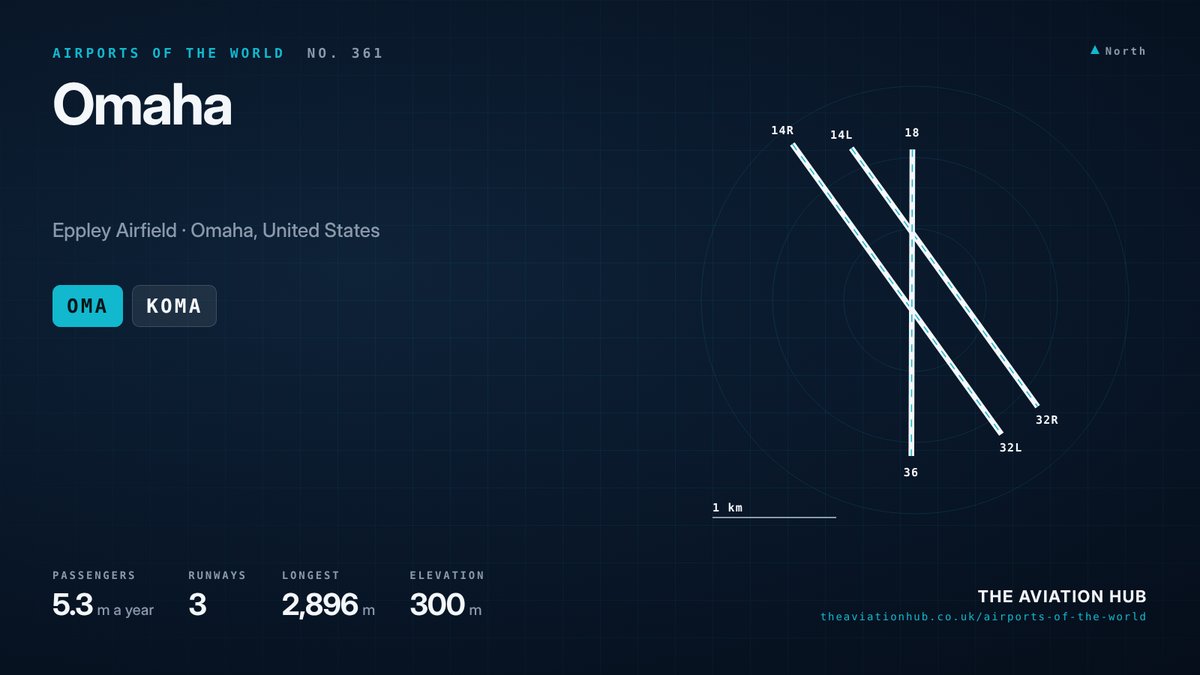
Omaha Airport, known officially as Eppley Airfield, sits on the west bank of the Missouri River a few miles from downtown Omaha. It handles more than five million passengers a year and serves as the main gateway for eastern Nebraska and south west Iowa. The field is compact and quick to use. Southwest Airlines dominates, while the big network carriers feed their hubs. A major terminal rebuild is now under way that will reshape the passenger experience.
Omaha Airport at a Glance
Eppley Airfield carries the IATA code OMA and the ICAO code KOMA. It lies about three miles (5 km) northeast of downtown Omaha, at an elevation of 984 feet (300 m). The Omaha Airport Authority owns and runs the field, which has three runways and one terminal building split into North and South sections. Parking, flight times and security updates are on the airport’s official website.
Traffic reached a record of roughly 5.3 million passengers in 2024, and 2025 finished about 1 per cent lower at around 5.2 million. Southwest carries well over a third of all passengers. American Airlines and Delta Air Lines follow, with United, Alaska, Frontier and Allegiant making up most of the rest. Eppley is not a hub for any carrier, so longer trips usually involve a connection at Denver, Chicago, Atlanta or Dallas.
How Omaha’s Airport Came to Be
The story starts in 1925, when the City of Omaha acquired 200 acres on the east side of Carter Lake as an extension of Levi Carter Park. Aircraft began landing there almost immediately. The site owes its odd geography to the Missouri River, which shifted course after a flood in 1877 and left the town of Carter Lake, Iowa, stranded on the Nebraska bank. Drivers from much of Omaha still pass a “Welcome to Iowa” sign on the way in, which baffles first time visitors.
The field operated for decades as Omaha Municipal Airport. The jet age demanded longer runways and better facilities, and the money came from a private source. The estate of Eugene C. Eppley, the hotel magnate behind the Eppley Hotel chain, gave the city a $1 million grant, which the federal government matched. The upgraded Omaha Airport took his name in 1960 and has been Eppley Airfield ever since.
Midwest Express turned the field into a small hub between 1995 and 2002. It kept Omaha as a focus city until the airline merged into Frontier in 2009. Low cost growth then took over. Southwest built up steadily and is now the largest operator by a clear margin.
Runways at Omaha Airport
Three runways cross the site, all 46 metres wide. The longest is 14R/32L at 2,896 metres (9,502 feet), with a mixed asphalt and concrete surface. Its parallel partner, 14L/32R, runs 2,591 metres (8,500 feet) and is concrete. The third, 18/36, measures 2,485 metres (8,154 feet), also asphalt and concrete, and serves as the crosswind option.
The parallels carry most airline traffic because they line up with the dominant winds. Northwesterly flow, common in winter, puts arrivals on runway 32 over the Iowa side of the river. Southerly winds in summer swing operations onto runway 14 or, when the wind blows straight from the south, onto 18. Demand rarely stretches the layout, so delays at Omaha Airport usually start with weather or congestion somewhere else.
The field sits low beside the Missouri behind flood levees. In 1978 a Mexican Air Force Douglas DC-6 suffered an engine fire on takeoff and crashed into one of those levees, killing all seven people aboard. In April 2024 an EF2 tornado tore through the general aviation area. It destroyed several hangars and damaged or wrecked around 30 aircraft, though the airport reopened soon afterwards.
Terminals and Airlines
One landside building feeds two concourses. The South Terminal, Concourse A, has gates A1 to A10 and hosts American, Delta, Alaska, Frontier and Allegiant. The North Terminal, Concourse B, has gates B11 to B19 and serves Southwest and United. Security is split by concourse, so passengers should check which side their airline uses before queuing.
The alliance picture is mixed. Oneworld members American and Alaska share the South Terminal with SkyTeam’s Delta, while Star Alliance member United sits beside Southwest in the north. Southwest carried about 37 per cent of passengers at Omaha Airport in 2024, American around 21 per cent and Delta about 18 per cent.
Southwest flies Boeing 737 variants, including the 737-800 and 737 MAX 8. The network carriers mix mainline Airbus A320 family jets and 737s with regional types such as the Embraer E175 on thinner routes. Frontier and Allegiant add low cost leisure flying, much of it to Florida, Arizona and Nevada.
Routes and Destinations
Denver is the busiest route by a distance, with around 375,000 passengers in 2025. Chicago O’Hare follows at about 242,000, then Phoenix at roughly 214,000, Atlanta near 189,000 and Dallas/Fort Worth at around 184,000. Every one of those cities is an airline hub, which shows how much local traffic connects onwards.
Beyond the top five, the network covers most major US hubs and a spread of leisure points. Las Vegas, Orlando and the Florida coast see heavy demand in winter, when Nebraskans head for the sun. Alaska Airlines links Omaha Airport with Seattle, one of the longest regular routes on the departure board. Summer brings extra frequencies to the mountain West and the coasts.
Cargo is a steady sideline. Freighter and feeder operators handled about 143 million pounds of air cargo in 2025, serving the metro area’s distribution businesses. Expect the occasional freighter alongside the narrow body passenger traffic.
Getting to and from Omaha Airport
Most passengers drive. Abbott Drive connects the terminal with downtown in around 10 minutes, and Interstates 480, 29, 680 and 80 are all close by. Short term, long term and economy parking sit beside the terminal, with shuttle buses serving the remote lots. A consolidated rental car facility links directly to the North Terminal.
Public transport is thin. Metro Transit route 106 runs only at weekday peak times, so it suits commuters more than travellers. Express Arrow intercity coaches stop at the terminal on their way to Norfolk, Nebraska. There is no rail link, and the Amtrak station near downtown is a short taxi ride away.
Taxis and ride share vehicles pick up from marked zones outside baggage claim. A trip to downtown or the Old Market typically costs around $20 to $30 and takes 10 to 15 minutes in normal traffic. For most visitors that is the cheapest sensible option, unless a hotel shuttle is available.
Spotting and Photography
The flat river plain makes Omaha Airport an easy place to watch aircraft. Parkland around Carter Lake and Levi Carter Park, south west of the field, gives open views of movements on the parallels. The cell phone waiting lot offers a quick look at arrivals without paying for parking. Afternoon light generally favours spots on the western side.
Traffic is modest, so patience pays. Southwest 737s dominate, with American, Delta and United jets in between and cargo flights adding variety. Northwesterly winds bring arrivals onto 32L and 32R, especially in winter. Southerly days move the action to the 14 end.
Stay on public land, keep clear of the levees and perimeter fences, and cooperate if airport police ask questions. Photography from public places is legal, and sensible behaviour around a working airport keeps it that way.
What Comes Next
The airport authority announced a terminal programme worth about $950 million (around £710 million) in January 2024. It replaces the two separate concourses with one unified concourse, growing from 375,000 to 646,000 square feet. The finished building will have 22 gates, a single consolidated security checkpoint and a customs arrivals hall serving two international gates. A new drop off lane and canopy were completed in August 2025.
Construction is phased to keep flights moving, so expect temporary walkways and gate changes for several years. Omaha Airport has spare runway capacity, and the project focuses on passenger comfort and international readiness rather than raw growth. Compare it with other fields in the region on the Airports of the World map. The verdict is simple: a dependable regional airport finally getting the terminal its traffic deserves.
Continue to follow The Aviation Hub for more analysis and insight.
Advertise with us Your brand, in front of an aviation audience Home page and in-article placements, sold directly, one advertiser per slot. From £250 a year. See the rates

