
Ontario California Airport Guide: The Inland Empire’s Hub
Ontario California Airport serves the Inland Empire with two long runways and a huge cargo operation. Codes, airlines, routes, transport and spotting.
 By The Aviation Hub
5 min read
Updated October 20, 2026
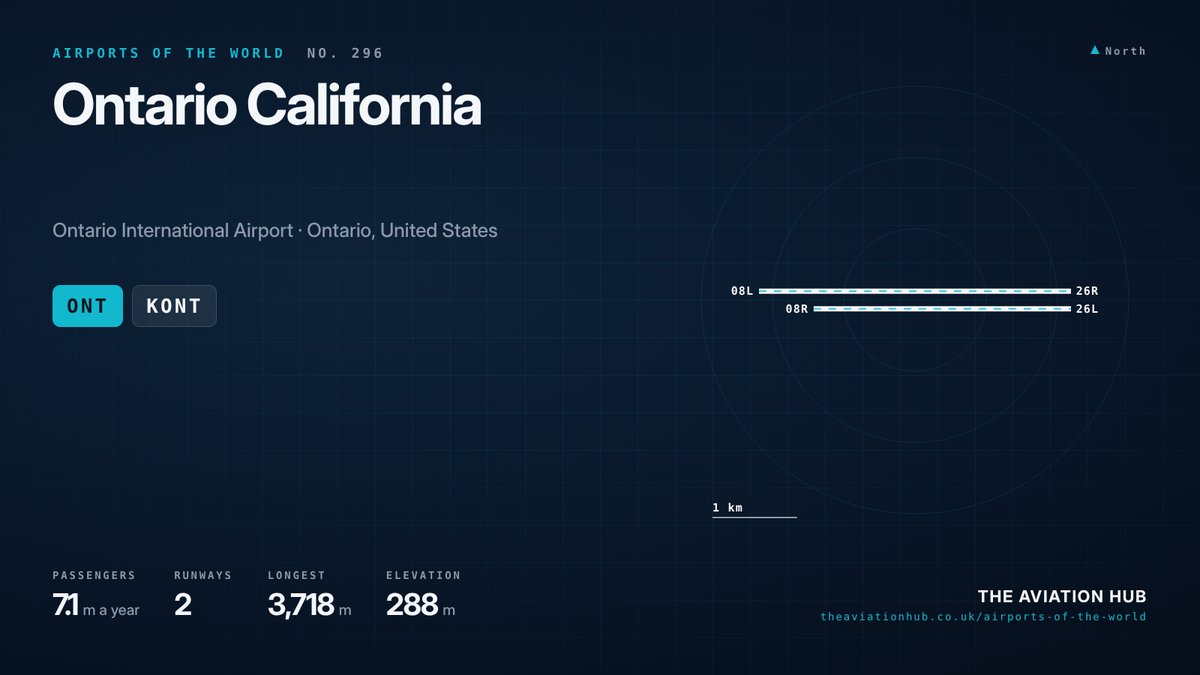
Southern California’s Inland Empire has more than four million residents and its own airport, about 38 miles east of downtown Los Angeles. Ontario California Airport handled about 7.1 million passengers in 2025, close to its all time record. Known by its code, ONT, it offers an easier alternative to LAX for travellers east of the city. It is also a major cargo airport, with UPS and FedEx moving freight around the clock. After years under Los Angeles control, it is now run locally.
Ontario California Airport at a Glance
The IATA code is ONT and the ICAO code is KONT. The airport sits in the city of Ontario in San Bernardino County, about 2 miles (3 km) east of the Ontario city centre, at an elevation of 288 metres (944 ft). It covers 1,741 acres, with two parallel concrete runways and two passenger terminals, numbered 2 and 4, plus a small international arrivals building.
Traffic in 2025 was roughly 7.1 million passengers, near the 2005 peak of about 7.2 million, and aircraft movements topped 106,000 in 2024. Southwest is the largest passenger carrier, and UPS runs its West Coast air and truck hub here. The Ontario International Airport Authority owns and operates Ontario California Airport. Live flight data and parking prices are on the airport’s official website.
How Ontario’s Airport Came to Be
Flying began in 1923 at Latimer Field, named after an orange packing company beside the strip. The city bought land in 1929 and founded Ontario Municipal Airport. New runways were completed during the Second World War, with the first landing on 27 February 1942, and the field trained military pilots through the war years.
In 1946 the airport took the Ontario International name after Pacific Overseas Airlines began trans Pacific flights from the field. It joined the Los Angeles regional airport system in 1967, and Los Angeles took ownership in 1985. Today’s Terminals 2 and 4 opened in 1998.
Local leaders fought for years to win the field back. Los Angeles World Airports agreed to the transfer in 2015, and the Ontario International Airport Authority took over in November 2016. Traffic had fallen about 40 per cent between 2007 and 2012, and the recovery under local control has been strong.
Runways at Ontario California Airport
Ontario California Airport has two parallel concrete runways, both 46 metres wide. Runway 08L/26R is 3,718 metres (12,197 ft) long, longer than three of the four runways at LAX, which makes ONT a natural alternate for heavy wide bodies bound for Los Angeles. Runway 08R/26L is 3,109 metres (10,200 ft) long.
Prevailing westerly winds mean runway 26 is used for most of the day, with aircraft landing from the east and departing to the west. Between 10pm and 7am, jet traffic uses contra flow procedures, landing from the east and taking off to the east, to limit noise over the cities to the west. In 1971 a Western Airlines Boeing 720 on a training flight crashed on approach, killing all five crew.
Terminals and Airlines
Terminals 2 and 4 are near mirror images, each about 265,000 square feet, with 12 and 14 gates respectively. Terminal 2 hosts Alaska Airlines, Delta, United, Frontier, Volaris, Avianca El Salvador and China Airlines. Terminal 4 handles Southwest, American, JetBlue and Starlux. International arrivals clear customs in a separate facility with two gates.
Southwest dominates with its Boeing 737 fleet. American, Delta and United feed their hubs, which brings all three global alliances to the field. China Airlines and Starlux bring wide bodies across the Pacific to Ontario California Airport. Cargo is the hidden giant. UPS runs a large hub, FedEx uses ONT as a major distribution point, and the field ranked eighth in the United States for cargo in 2024, then handled about 835,000 tons in 2025.
Routes and Destinations
Domestic flights dominate at Ontario California Airport. Southwest serves Oakland, Sacramento, San Jose, Las Vegas, Phoenix and Denver, among others. American connects Dallas Fort Worth and Phoenix, Delta links Atlanta and Salt Lake City, and United serves Denver, Houston, Chicago and San Francisco. Alaska flies to Seattle, Portland and Honolulu. Dallas Fort Worth, Denver and Phoenix are the busiest routes.
International service has grown fast. Volaris flies to several Mexican cities, including Guadalajara, and Avianca El Salvador serves San Salvador, reflecting the large Latino community of the region. The longest routes are the nonstops to Taipei, which China Airlines launched in 2018 and Starlux later joined.
Getting to and from Ontario California Airport
The airport sits between Interstate 10, Interstate 15 and State Route 60, so road access is easy. Downtown Los Angeles is about an hour away outside rush hour, and much longer at peak times. Palm Springs is roughly 90 minutes east. Taxis, ride hailing services and every major rental car company operate here, and parking is cheaper and closer than at LAX.
Public transport is limited. Omnitrans Route 380, branded ONT Connect, runs to Rancho Cucamonga station on the Metrolink San Bernardino Line, which continues to Los Angeles Union Station. Routes 61 and 81 link other Metrolink stations. A planned tunnel to Rancho Cucamonga was cancelled in December 2025 because of rising costs.
Spotting and Photography
Ontario California Airport offers spotters a backdrop few fields can match. The San Gabriel Mountains rise to the north, often snow capped in winter, behind aircraft on the runways. Public roads around both runway ends and along the perimeter give options for arrivals and departures.
Cargo is the real draw. UPS Boeing 747-8Fs, 767s and 757s arrive in waves overnight and in the early morning, and FedEx and other freighters add variety. Dry weather gives good light much of the year, though haze can soften distant views. Stay on public land, avoid stopping on busy roads and leave promptly if police ask.
What Comes Next
Passenger traffic is close to breaking the 2005 record, and the terminals still have room to grow. The authority continues to court new airlines, particularly on Latin American and trans Pacific routes. Cargo demand from the region’s vast warehouse sector keeps rising. Improving public transport is the main gap after the tunnel plan collapsed.
Ontario California Airport has shown what local control can achieve. It is likely to keep growing as a freight centre and as a relaxed alternative to LAX. See how it compares with other Californian airports on the Airports of the World map.
Continue to follow The Aviation Hub for more analysis and insight.
Advertise with us Your brand, in front of an aviation audience Home page and in-article placements, sold directly, one advertiser per slot. From £250 a year. See the rates

