
Orlando Airport Guide: Florida’s Theme Park Gateway
Orlando Airport in depth: four parallel runways, the new Terminal C, Southwest and JetBlue, Brightline trains and where to watch aircraft at MCO.
 By The Aviation Hub
6 min read
Updated October 20, 2026
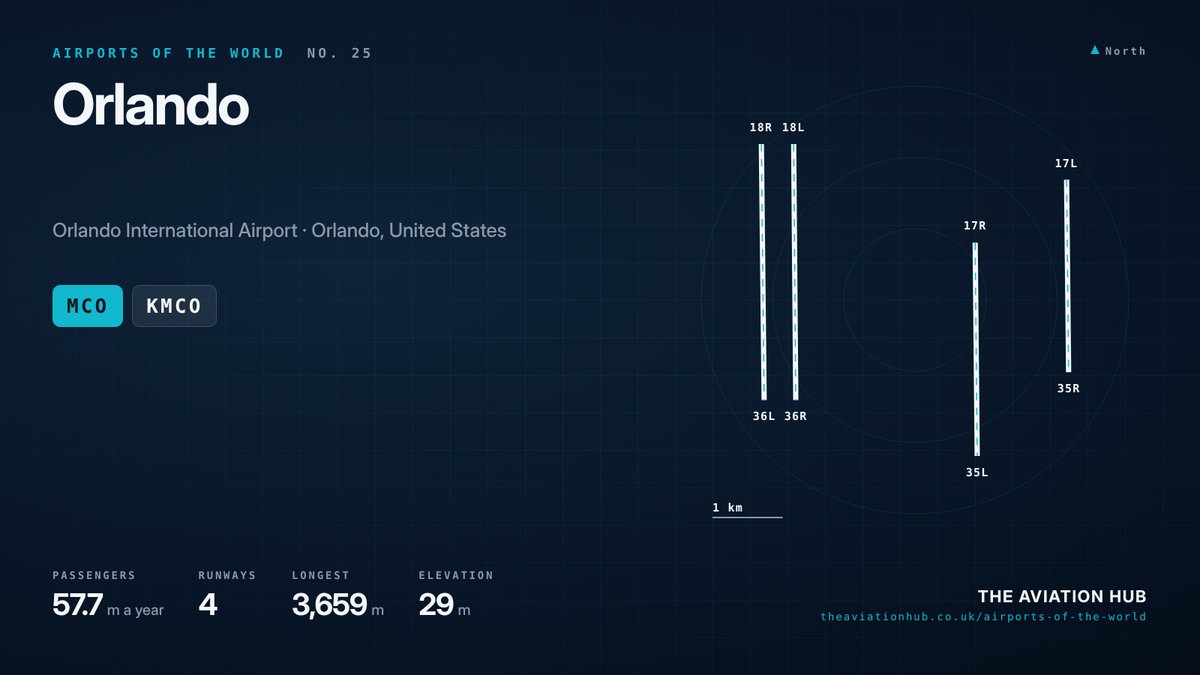
Orlando Airport is the busiest airport in Florida and the main gateway to the theme parks of central Florida. It sprawls across a former Strategic Air Command bomber base southeast of the city, which explains its long runways and its odd IATA code. Around 57.7 million passengers used it in 2025. Southwest is the largest airline, JetBlue has a focus city, and a brand new Terminal C has opened the way to a complex that could one day handle 100 million passengers a year.
Orlando Airport at a Glance
The IATA code is MCO and the ICAO code is KMCO. The field lies about 6 miles (10 km) southeast of downtown Orlando at an elevation of 29 m (96 ft). The Greater Orlando Aviation Authority, a city agency, owns and operates it. The site covers 11,605 acres, which makes it one of the largest commercial airports in the United States by land area.
Four parallel runways and three terminals, A, B and C, handle the traffic. Southwest, Frontier and Breeze run operating bases, JetBlue treats Orlando Airport as a focus city, and United has a maintenance base. More than 40 airlines fly here. The 345 ft control tower is the fourth tallest in North America. For terminal maps, parking and ground transport, visit the airport’s official website.
How Orlando’s Airport Came to Be
The US Army Air Forces built the airfield in 1942. It later became Pinecastle Air Force Base and then McCoy Air Force Base, a Strategic Air Command station flying B-47 and B-52 bombers. The base took its name from Colonel Michael Norman Wright McCoy, who died in a B-47 crash in 1958. The three letter code MCO is his legacy, and Orlando has never been able to shake it.
Airline flights followed a 1961 agreement between the city and the Air Force, with the civil side called the Orlando Jetport at McCoy. Walt Disney World opened in 1971 and changed everything. The military closed the base in 1975 and the city took over the whole site, renaming it Orlando International Airport in 1976. The current landside terminal and the first airsides opened in 1981, built around the hub and spoke design with automated people movers that Tampa had pioneered.
Delta ran a hub here until 2007. Hurricane Charley tore roofs off the airside buildings in 2004. The airport served as an emergency landing site for the Space Shuttle, and the South Terminal Complex, now Terminal C, opened in September 2022.
Runways at Orlando Airport
Orlando Airport has four parallel runways aligned north to south, in two pairs on either side of the terminal area. Runway 18L/36R is 3,659 m (12,005 ft) of asphalt and Runway 18R/36L is 3,659 m (12,004 ft) of concrete. These are the western pair and the longest, laid out originally for heavy bombers. Both are 61 m wide.
The eastern pair is newer. Runway 17R/35L is 3,048 m (10,000 ft) and opened in 1989, and Runway 17L/35R is 2,744 m (9,001 ft) and opened in 2003, both 46 m wide. The layout allows simultaneous independent arrivals on the outer runways with departures on the inners. Southerly operations on the 17s and 18s are typical in summer, with northerly 35 and 36 flows in the cooler months when fronts come through.
The flat Florida terrain and the long runways mean there is nothing demanding about the approaches, although summer thunderstorms often interrupt operations on afternoons from June to September. The former bomber runways are long enough for the heaviest Airbus A380 departures, and Emirates has flown the type here.
Terminals and Airlines
Terminals A and B at Orlando Airport share one large landside building on the north side of the field, joined to four airside satellites by elevated people movers. Gates 1 to 129 spread across Airsides 1 to 4. Terminal A handles check in for Southwest, Frontier and Avelo, with Southwest filling Airside 2. Terminal B serves American, Delta, United, Air Canada, Breeze and most of the remaining carriers. The Hyatt Regency hotel sits inside the landside building.
Terminal C, the first phase of the South Terminal Complex, opened on 19 September 2022 with gates numbered 230 to 254. JetBlue moved its entire operation there, and it is now the home of international flights by foreign airlines, including British Airways, Virgin Atlantic, Aer Lingus, Discover Airlines, Emirates and Norse Atlantic. The Terminal Link people mover connects it to the older terminals via the Intermodal Terminal.
Routes and Destinations
More than 170 destinations are served from Orlando Airport by over 1,000 daily flights. Atlanta is the busiest domestic route with about 1.35 million passengers in the year to May 2026, followed by Newark and Chicago O’Hare at just under a million each. New York, Boston, Chicago, Dallas, Philadelphia and Charlotte all feature heavily, reflecting how Orlando works as a leisure spoke for every major US hub.
Toronto was the busiest international route over the same period with about 689,000 passengers, then Panama City, Bogotá and London Gatwick. The British market is enormous for a leisure airport. British Airways, Virgin Atlantic and Aer Lingus fly year round, Norse Atlantic adds Boeing 787-9 capacity from Gatwick, and Virgin also serves Manchester. Traffic peaks in March, July and the weeks around Christmas. Cargo is modest for an airport this size.
Getting to and from Orlando Airport
The Brightline rail service began in September 2023 from the Intermodal Terminal beside Terminal C. Trains run to West Palm Beach, Fort Lauderdale and Miami in about three to three and a half hours. There is no rail link to downtown Orlando or the theme parks yet, although a SunRail extension is planned. Lynx local buses run from the A side of the main terminal, with route 11 to downtown and route 111 towards SeaWorld, each for $2.
Most visitors drive. The Beachline Expressway, State Road 528, runs west to International Drive and the parks in about 25 minutes, and State Road 417 loops around the east and south of the city. Rental car desks are on site in both terminals. Taxis to the Disney area cost roughly $60 to $70, and app based rides are usually cheaper. Parking garages accept E Pass and SunPass transponders, and the economy lots with shuttles are the cheapest long stay option.
Spotting and Photography
Orlando Airport has no official viewing area, but the open Florida landscape helps. The Hyatt Regency inside the main terminal has rooms with balconies overlooking the airfield. Roadside stops on Heintzelman Boulevard, in the middle of the field, catch departures from 35L and arrivals on 35R. To the north, McCoy Road sits under the approaches to 18L and 18R.
The light is harsh in the middle of the day, so early morning on the eastern side and late afternoon on the west give the best results. Northerly 35 and 36 operations bring arrivals in over Lake Nona. Keep to public roads and verges, do not stop on the expressway shoulders, and expect Orlando police and airport security to check on anyone standing near the fence for long.
What Comes Next
Terminal C was built with room to grow, and the airport authority plans to expand it with more gates once traffic justifies the spend. Terminal D will follow when annual passengers reach 70 million, taking the South Terminal Complex to 120 gates. The stated long term capacity for the whole site is 100 million passengers a year.
Nearer term projects include a renovation of the North Terminal, a new consolidated rental car centre, upgraded baggage systems, the SunRail extension to the Intermodal Terminal, a vertiport for air taxis and a study into a rail link to International Drive. Spirit’s collapse in May 2026 removed a major carrier. Orlando Airport is heading for a two terminal future that will finally match its traffic. See it alongside the other big US airports on the Airports of the World map.
Continue to follow The Aviation Hub for more analysis and insight.
Advertise with us Your brand, in front of an aviation audience Home page and in-article placements, sold directly, one advertiser per slot. From £250 a year. See the rates

