
Osaka Kansai Airport Guide: The Island in Osaka Bay
Osaka Kansai Airport sits on an artificial island in Osaka Bay and serves Kyoto, Kobe and Nara. Read about its runways, terminals, routes and spotting.
 By The Aviation Hub
7 min read
Updated October 20, 2026
Kansai International Airport is the main international gateway to western Japan and one of the most remarkable pieces of civil engineering in aviation. It sits on an artificial island in Osaka Bay, about 24 miles (38 km) south west of central Osaka and linked to the mainland by a single bridge. Around 34.1 million passengers used Osaka Kansai Airport in 2025, roughly four out of five of them on international flights. Two runways, a 1.7 km long main terminal and round the clock operations make it the long haul front door for Osaka, Kyoto, Kobe and Nara.
Osaka Kansai Airport at a Glance
The codes are KIX and RJBB. The island sits at just 17 ft (5 m) above sea level off the coast of Izumisano and Sennan, 24 miles (38 km) from Osaka station. Locals call it Kanku. The Sky Gate Bridge R, a double deck road and rail bridge almost 2.4 miles (3.75 km) long, is the only land link.
Osaka Kansai Airport has two runways and two terminals. The 2025 total was a record of around 34.1 million passengers, up 11 per cent on 2024 as inbound tourism to Japan kept surging. ANA and Japan Airlines are the main full service operators, Peach and Jetstar Japan have large bases, and FedEx and Nippon Cargo Airlines run freight hubs. Kansai Airports, a company mostly owned by Orix and the French group Vinci, has operated the field under a 45 year concession since April 2016. Flight details are on the airport’s official website.
How Kansai Came to Be
By the 1960s Osaka Itami Airport was boxed in by suburbs, limited by noise complaints and unable to grow. Planners first looked at a site near Kobe, but the city refused, so the decision fell on a wholly new island in the shallow waters of Osaka Bay. Construction began in 1987 with a sea wall and then millions of tonnes of fill from three mountains.
The airport opened on 4 September 1994 as Japan’s first airport open 24 hours a day. Renzo Piano designed the terminal, whose wing shaped roof is intended to guide air through the building. The island sank far faster than predicted, by around 8 m by 1999, and the terminal sits on adjustable jacks so it can be levelled. The bill came to roughly US$20 billion.
The field survived the 1995 Kobe earthquake without damage. A second island and a second runway opened in August 2007, and the low cost Terminal 2 followed in 2012. Typhoon Jebi flooded the island in September 2018 and a tanker struck the bridge, stranding thousands overnight. Full operations resumed on 1 October 2018 and the bridge was fully repaired by April 2019.
Runways at Osaka Kansai Airport
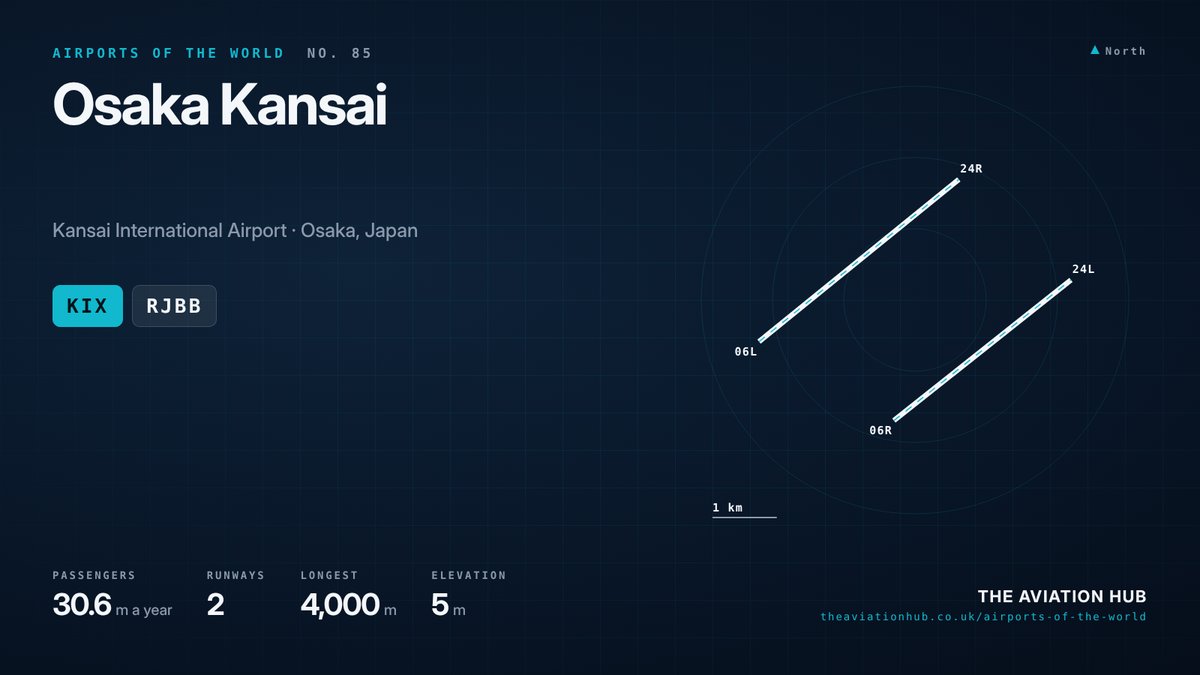
Runway 06R/24L is the original, 3,500 m (11,483 ft) long and 60 m (197 ft) wide, on the first island. Runway 06L/24R opened on 2 August 2007 on the second island and is longer at 4,000 m (13,123 ft) and the same width. Both are asphalt. The second runway let the airport keep flying around the clock while one strip is closed for maintenance, something Itami’s night curfew never allowed.
The two runways are usually split between arrivals and departures, with arrivals coming in over the bay. The 24 direction is more common on summer afternoons and the 06 direction on winter mornings. Sea winds are the deciding factor, and the island’s exposure means crosswinds and typhoon season cause more disruption than at inland fields. Fog is rare.
The runways are angled to keep approach paths over water rather than land, which is the whole point of Osaka Kansai Airport. Noise complaints are almost nil, and the cargo operators value the night slots. The second island was built higher than the first after lessons from the early subsidence.
Terminals and Airlines
Terminal 1 at Osaka Kansai Airport is the main building and is roughly 1.7 km long from end to end, with a wing shaped roof and a shuttle train along each pier. It handles ANA, Japan Airlines, Emirates, Qatar Airways, Korean Air, Cathay Pacific, Singapore Airlines, Air France, KLM, Lufthansa, Finnair and the main North American carriers. Jetstar Japan, Cebu Pacific and several other budget carriers also use it. A full renovation of the international departures area finished in winter 2023, and the Nintendo Check In games area has let travellers play for free since 2017.
Terminal 2 is a low cost building a shuttle bus ride away on the second island. It is single storey, has no air bridges and keeps costs down for Peach, Spring Airlines and Jeju Air. Peach, which is based here, uses it for both domestic and international flights.
FedEx opened its North Pacific hub on the cargo apron in 2014, sorting trans Pacific freight overnight. Nippon Cargo Airlines also bases freighters here, and the airport handled around 787,000 tonnes of freight in 2025.
Routes and Destinations
Seoul Incheon, Taipei, Shanghai, Hong Kong, Bangkok and Manila are the heaviest international routes, each served many times daily by a mix of full service and low cost airlines. Chinese and Korean visitors make up a large share of the inbound traffic. Domestically, Tokyo Haneda and Narita, Sapporo, Okinawa and Fukuoka lead, although Itami still takes most domestic trunk flights.
Long haul service reaches Los Angeles, San Francisco, Honolulu, Vancouver, Toronto, Paris, Amsterdam, Munich, Helsinki, Dubai, Doha and Istanbul. Air Canada’s seasonal Toronto flights, at about 6,600 miles (10,650 km), are the longest. Traffic peaks over Golden Week, the summer holidays and the autumn colours season in Kyoto.
Getting to and from Osaka Kansai Airport
Two railways cross the bridge into a station beneath Terminal 1. JR West runs the Haruka limited express to Tennoji, Shin Osaka and Kyoto in about 80 minutes to Kyoto, plus cheaper Kansai Airport Rapid trains to Osaka station in around 70 minutes. Nankai runs the rapi:t express to Namba in under 40 minutes, and its ordinary airport express trains are the cheapest sensible option at around 970 yen (£5).
Limousine buses leave from both terminals for Osaka, Kyoto, Kobe, Nara and the main hotels, taking 50 to 90 minutes. A high speed ferry crosses to Kobe Airport in about 30 minutes. Driving uses the Hanwa Expressway and the Hanshin Expressway Bayshore Route, and a taxi to central Osaka costs well over 15,000 yen, so almost everyone takes the train.
Multi storey parking sits in front of Terminal 1, with a surface car park at Terminal 2. Passengers can also leave cars at Rinku Town on the mainland.
Spotting and Photography
Osaka Kansai Airport is one of the best spotting airports in Japan. The Sky View observation hall, near the ferry terminal, has rooftop decks facing runway 06R/24L, with exhibits and a cafe below. A free shuttle bus runs there from Terminal 1. Arrivals on 24L pass almost overhead.
Terminal 1’s departure piers have floor to ceiling glass with views of the Emirates wide bodies, the FedEx Boeing 777F fleet and the Peach A320s. Across the water, the parks at Rinku Town on the mainland give long lens shots of arrivals over the bay with the bridge in the foreground. Morning light favours the mainland side and afternoon light the Sky View decks.
Japanese airports welcome spotters, and the Sky View decks are designed for them. Stay within marked areas, do not use ladders at the fence and follow staff instructions during typhoon warnings.
What Comes Next
Plans for a third runway, more aprons and a bigger cargo terminal have been on hold for years because of funding, and subsidence makes every new hectare expensive. The operator has instead put money into Terminal 1, with the renovation complete and capacity raised for the 2025 Osaka Expo. Passenger numbers have passed the design levels of the 1990s and the terminal is being pushed hard.
A new rail line, the Naniwasuji Line, is due around 2031 and will cut journey times to Umeda and the Osaka business district. Rising sea levels and typhoon risk mean the sea walls are being raised again after the 2018 flooding.
Osaka Kansai Airport is busy, exposed to the weather and still sinking slowly, but inbound tourism has made it one of Japan’s growth stories. Compare it with the other Asian gateways on the Airports of the World map.
Continue to follow The Aviation Hub for more analysis and insight.
Advertise with us Your brand, in front of an aviation audience Home page and in-article placements, sold directly, one advertiser per slot. From £250 a year. See the rates

