
Oslo Gardermoen Airport Guide: Norway’s Silent Hub
Oslo Gardermoen Airport is Norway's main hub, an SAS and Norwegian base with two runways and a 19 minute rail link. Read about its routes, access and spotting.
 By The Aviation Hub
7 min read
Updated October 20, 2026
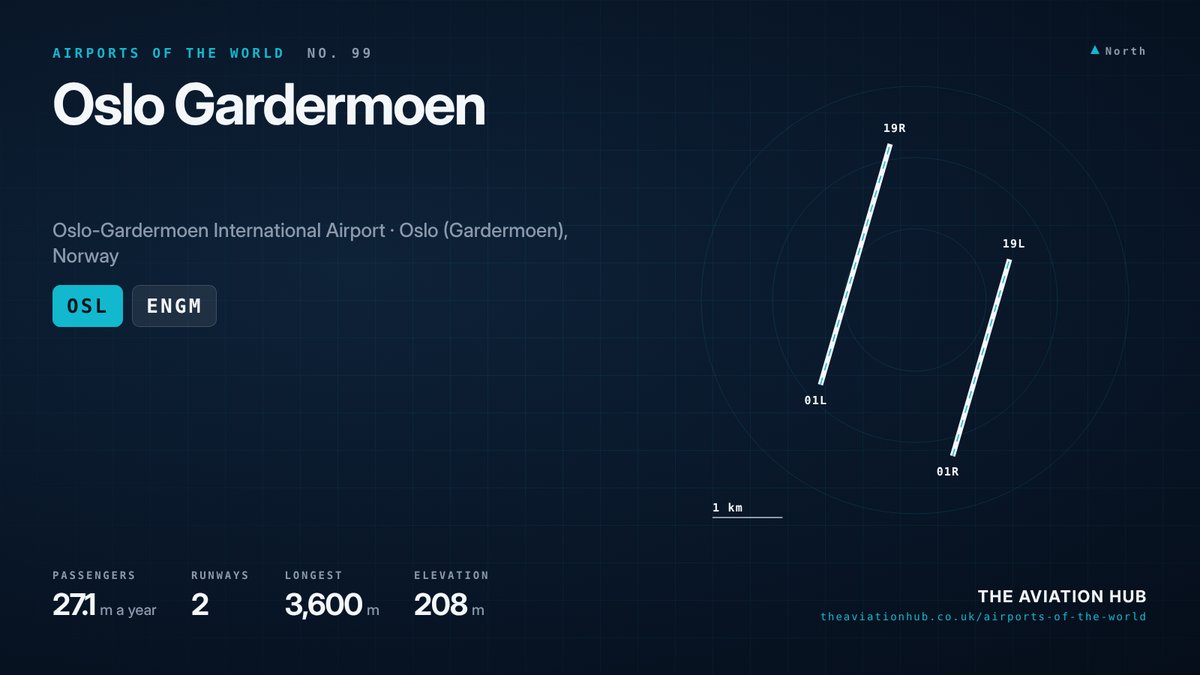
Oslo Airport, Gardermoen is the main airport of Norway and the busiest in the country by a wide margin. It lies in Ullensaker municipality, about 30 miles (47 km) north east of Oslo city centre, on a flat moor of pine forest and farmland. Oslo Gardermoen Airport handled around 27 million passengers in 2025 and is the hub of Scandinavian Airlines in Norway and an operating base for Norwegian, Norse Atlantic and Wideroe. Opened in 1998 to replace cramped Fornebu, it is a model of Scandinavian efficiency with one of the highest public transport shares of any airport in the world.
Oslo Gardermoen Airport at a Glance
The codes are OSL and ENGM. The field sits at 681 ft (208 m) above sea level on the Romerike plain, 30 miles (47 km) from the capital by the Gardermoen Line railway and roughly the same by the E6 motorway. The site sits over one of the largest aquifers in Norway, which shapes everything from de icing to drainage.
Oslo Gardermoen Airport has two parallel runways and a single terminal with four piers. The 2025 total was a little over 27 million passengers, still short of the 28.6 million peak of 2019 but growing steadily. SAS runs its Norwegian hub here, Norwegian Air Shuttle has its largest base, Norse Atlantic Airways flies Boeing 787s to Thailand from the field, and Wideroe connects the regional airports. The state owned company Avinor owns and operates the airport along with most of Norway’s other airfields. Flight information is on the airport’s official website.
How Oslo’s Airport Came to Be
Gardermoen has been military ground since the 1740s, when the army used the moor as a camp and drill field. The name joins Garder, a farm first recorded in 1328, with the Norwegian word mo, meaning moor. Flying began in 1912, and the Luftwaffe built the first proper runways and hangars during the occupation. After the war it served as a military base and a charter airport while scheduled flights used Fornebu on the Oslo fjord.
Fornebu could not grow, hemmed in by water and suburbs, and in 1992 the Norwegian parliament chose Gardermoen for a new national airport after a long and bitter debate over rival sites. The decision remains controversial. Engineer Jan Fredrik Wiborg, who alleged that weather data for the site had been falsified, died in Copenhagen in 1994 in circumstances that have never been fully explained.
Oslo Gardermoen Airport opened on 8 October 1998, the morning after the last flights left Fornebu, with a terminal designed by Aviaplan. Freezing fog and supercooled rain that December damaged at least 20 engines. The north pier opened in April 2017, roughly doubling the terminal to 265,000 square metres, and the wide body gate expansion on the east pier was completed in 2022.
Runways at Oslo Gardermoen Airport
Runway 01L/19R is the western and longer of the pair at 3,600 m (11,811 ft) and 45 m (148 ft) wide on asphalt. Runway 01R/19L, to the east, is 2,950 m (9,678 ft) long and 45 m (148 ft) wide, also asphalt. The parallels are spaced widely enough for independent operations and together allow around 80 movements an hour.
Both runways carry Category III instrument landing systems, which matters at a field where fog and freezing rain have closed operations repeatedly. Both directions see regular use, and the pattern shifts with the weather. Arrivals from the south pass over the forests of Romerike and the approaches are straightforward.
Winter is the defining challenge. Snow clearance crews keep the runways open through conditions that would shut most airports in Europe, but the use of de icing chemicals is restricted to protect the aquifer below. The 3,600 m western runway handles most of the international traffic, including the heavy long haul departures to Asia and North America.
Terminals and Airlines
The single terminal is a long timber and glass hall with four piers. The west wing holds the domestic A gates, used mainly by SAS, Norwegian and Wideroe for the dense domestic network. The north pier, opened in 2017, has 11 gates split between domestic C gates and international D gates. The east pier handles the rest of the international traffic, with E gates for Schengen flights and F gates for non Schengen flights to Britain, North America and Asia.
The small south pier has eight B gates without jet bridges and since 2024 has also handled early morning Schengen departures as G gates. SAS, which left Star Alliance for SkyTeam in 2024, shares the international piers with KLM, Lufthansa, Swiss, Austrian, Turkish Airlines, British Airways, Emirates, Qatar Airways and the low cost carriers Ryanair and Wizz Air. Norwegian’s short haul network and Norse Atlantic’s long haul flights give the home carriers most of the traffic.
The terminal is famously silent, with gate announcements made only at the gate itself. The departure duty free shop is reportedly the largest in Europe. International to domestic connections require passengers to collect and recheck bags for customs, although a streamlined domestic transfer process covers many through tickets.
Routes and Destinations
Norway’s geography makes domestic flying essential and the routes from Oslo Gardermoen Airport to Trondheim, Bergen and Stavanger are among the busiest in Europe, with SAS and Norwegian flying them almost hourly. Tromso and Bodo complete the top five, and Wideroe’s Dash 8 fleet reaches dozens of small airports along the coast and in the far north.
Copenhagen, Stockholm, Amsterdam, London Heathrow and Paris lead the European routes, and London Gatwick, Manchester and Edinburgh add British capacity. Long haul is thinner but growing. Norse Atlantic flies seasonally to Bangkok and Phuket, Thai Airways also serves Bangkok, SAS serves Newark and New York JFK, and Emirates, Qatar Airways and Ethiopian connect the Middle East and Africa. Bangkok, at around 5,400 miles (8,700 km), is one of the longest routes. Summer brings the heaviest leisure traffic, and winter fills the ski charter and northern lights flights.
Getting to and from Oslo Gardermoen Airport
The railway station sits directly beneath the terminal. Flytoget, the airport express, reaches Oslo Central in 19 to 22 minutes with six trains an hour on weekdays, for around 230 kroner (£17). Vy and SJ regional trains use the same station and take a few minutes longer for roughly half the fare, which makes them the cheapest sensible option. Around 70 per cent of passengers arrive by public transport.
Express coaches link the airport with Oslo, Fredrikstad, Sarpsborg, Ski and Gjovik, and most long distance buses in eastern Norway call at the terminal. By road the E6 passes about 4 miles (6 km) away and the E16 about 1 mile (2 km), with tolls on most of the connecting roads. A taxi to the city centre takes 45 minutes and costs upwards of 900 kroner (£65). The airport has 11,400 parking spaces across short stay, long stay and budget car parks.
Spotting and Photography
Oslo Gardermoen Airport is a friendly place for enthusiasts by European standards. The terminal has large windows along the piers with views across both aprons, and the north pier in particular overlooks the wide body stands. Outside, the roads and tracks through the forest on either side of the runways give views of arrivals, with the western side best for the 01L/19R heavies.
The light is long and low for much of the year, which rewards patience. Summer evenings bring near continuous daylight with golden light until late, and winter offers the chance to photograph aircraft in snow, though the sun barely clears the trees in December. The mix includes SAS Airbus A320neo and A350-900 fleets, Norwegian Boeing 737 MAX 8s, Norse 787s, Wideroe Dash 8s and the Royal Norwegian Air Force transports that still use the military side of the field.
Stay on public roads, keep clear of the military area north of the terminal, and respect the fence. Norwegian police are relaxed about photography from public land, but the military base is a different matter.
What Comes Next
Avinor’s plans allow the existing terminal to handle up to 35 million passengers, with further pier extensions and apron work as traffic recovers. A third runway has been debated for years and remains politically difficult because of the aquifer and local opposition, and the current two runway system has capacity to spare for now. The Gate to Europe commercial development east of the airport, approved in 2017, is adding hotels, offices and logistics space.
Norway’s push towards electric regional aircraft, with Avinor and Wideroe among the pioneers, is likely to make Gardermoen an early testbed. Growth will be steady rather than spectacular.
Oslo Gardermoen Airport is a calm and well run hub with room to grow. Compare it with the other Nordic airports on the Airports of the World map.
Continue to follow The Aviation Hub for more analysis and insight.
Advertise with us Your brand, in front of an aviation audience Home page and in-article placements, sold directly, one advertiser per slot. From £250 a year. See the rates

