
Ottawa Airport Guide: Canada’s Capital and Porter’s Hub
Ottawa Airport explained: Uplands history, three runways, the terminal, Porter and Air Canada, routes to Paris and London, and the new light rail link.
 By The Aviation Hub
5 min read
Updated October 20, 2026
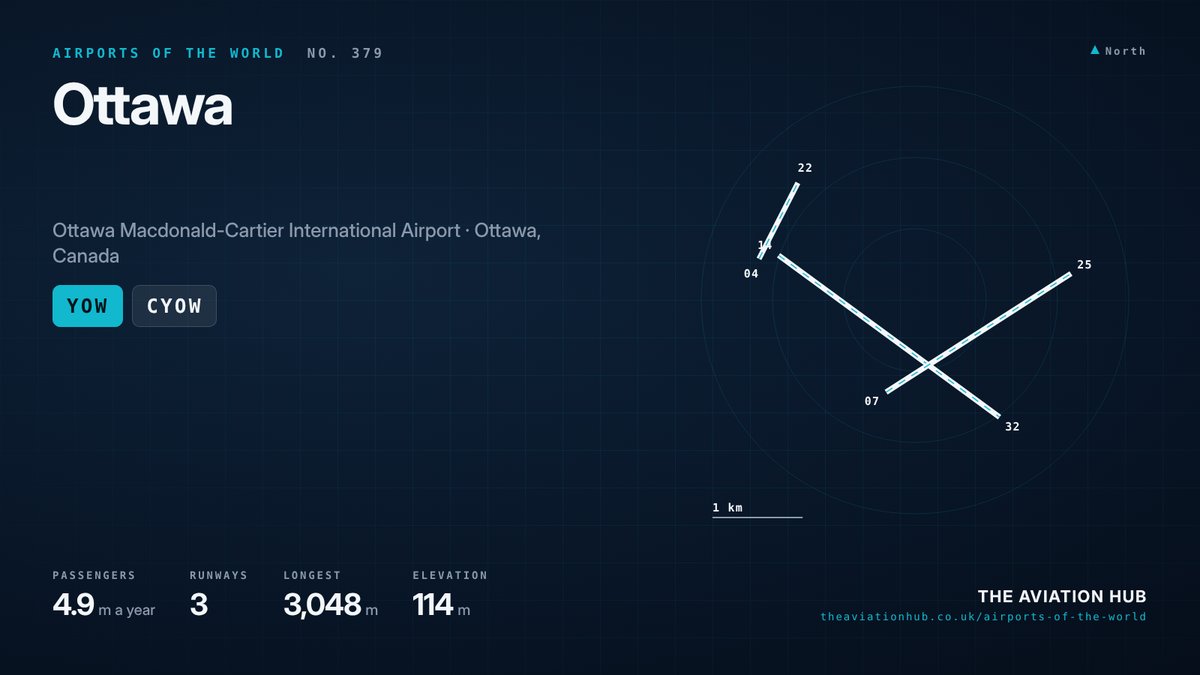
Ottawa Airport, officially Macdonald Cartier International, serves Canada’s capital and the surrounding National Capital Region. It sits on the Uplands plateau south of the city and handled nearly 4.9 million passengers in 2025. Porter Airlines has built its hub here, and a new light rail line now reaches the terminal. For politicians, civil servants and visitors alike, it is the front door to Parliament Hill.
Ottawa Airport at a Glance
The airport uses the IATA code YOW and the ICAO code CYOW. It lies about 9 miles (15 km) south of downtown Ottawa, at an elevation of 374 feet (114 m). There are three runways and a single passenger terminal. Transport Canada owns the site, and the Ottawa Macdonald Cartier International Airport Authority runs it.
Traffic reached about 4.87 million passengers in 2025, making Ottawa Airport the sixth busiest in Canada and the second busiest in Ontario. Porter uses it as a hub, while Air Canada and Air Transat treat it as a focus city. US border preclearance lets transborder passengers clear American immigration before departure. Travel information is on the airport’s official website.
A Short History of Uplands
The Ottawa Flying Club founded the field at Uplands in the late 1920s, and the airport officially opened on 20 August 1938. During the Second World War it hosted No. 2 Service Flying Training School, part of the British Commonwealth Air Training Plan. Expansion in 1950 swallowed the farming village of Bowesville, and in the 1950s Uplands was Canada’s busiest airport by aircraft movements, peaking at more than 307,000 in 1959.
That year brought an infamous setback. A US Air Force F-104 Starfighter flew a low pass and its sonic boom shattered most of the glass in the new terminal, delaying its opening. The episode has been called the most expensive five seconds in Canadian civil aviation history.
The field became Ottawa International Airport in 1964. In 1993 it took its current name, honouring Sir John A. Macdonald and Sir George Etienne Cartier, two founding fathers of Canada. The present terminal opened in October 2003, and a second phase added twelve gates in 2008.
Runways at Ottawa Airport
The main runway, 14/32, is 3,048 metres (10,000 feet) long and 61 metres wide, with an asphalt surface. Runway 07/25 measures 2,438 metres (8,000 feet) and is also 61 metres wide and asphalt. The third, 04/22, is just 1,006 metres (3,300 feet) long and 23 metres wide, and serves general aviation.
The two main runways cross, giving controllers options in shifting winds. Prevailing westerlies mean runways 25 and 32 often see the heaviest use. Arrivals on runway 32 cross open country south east of the field, while runway 14 approaches pass over the city’s southern suburbs. Ottawa’s winters are severe, so snow clearing and aircraft deicing are central to the operation from November to April.
The Royal Canadian Air Force’s 412 Transport Squadron is based at Ottawa Airport, flying Challenger business jets for government and VIP travel. State visits regularly bring foreign government aircraft to the field.
Terminals and Airlines
All airline passengers use the 2003 terminal, which combines domestic, transborder and international areas. The 2008 extension added twelve gates and seven jet bridges. Preclearance for US flights sits in a dedicated zone.
Porter flies Embraer E195-E2 jets and De Havilland Dash 8 turboprops on domestic and transborder routes. Air Canada and Air Canada Express provide the largest network into Toronto and Montreal, with mainline service to London Heathrow. WestJet, Air Transat, Air France and United add more links, with Star Alliance, SkyTeam and the main Canadian carriers all represented.
Northern carriers give the airport a distinctive flavour. Canadian North, formerly First Air, is based here, and Air North and Propair also serve the field.
Routes and Destinations
Toronto dominates. Pearson had about 105 weekly flights in July 2025, with Billy Bishop City Airport adding about 71. Montreal followed with around 49 weekly flights, then Calgary at about 46 and Halifax and Vancouver at roughly 43 each.
Paris Charles de Gaulle was the busiest international route in 2024, with more than 160,000 passengers, helped by Air France’s service, launched in 2023 and daily in summer since 2024. Newark and Chicago came next. Air Canada flies to London Heathrow, and Air Transat launched a seasonal London Gatwick route in May 2026.
Winter brings sun routes to Florida, Mexico and the Caribbean. Porter has added several US routes from Ottawa Airport since 2023.
Getting to and from Ottawa Airport
O-Train Line 4 opened on 6 January 2025 and has run daily since March 2025, ending at Airport station by the terminal. It connects with Line 2 at South Keys for onward travel towards downtown. The train is the cheapest sensible option for most travellers, and the full trip to the centre takes roughly 35 to 45 minutes with connections.
OC Transpo route 97 once ran express along the transitway, and since August 2025 route 105 has operated around the clock from St Laurent station. Its number honours the Avro Canada CF-105 Arrow. Taxis, limousines, shuttles, rental cars, Uber and Lyft are available outside arrivals.
By car, the Airport Parkway links the terminal with central Ottawa in around 20 minutes. Cyclists can ride downtown along the Capital Pathway in warmer months.
Spotting and Photography
Ottawa Airport rewards patient enthusiasts. Porter E195-E2s and Dash 8s, Air Canada jets and northern operators share the apron with RCAF Challengers and visiting government aircraft. Wide bodies from Air France and Air Canada add bigger metal.
Public roads on the airport’s edges give views of the crossing runways. Winter offers crisp light and dramatic snow clearing scenes. The Canada Aviation and Space Museum at Rockcliffe, across the city, makes a fine companion visit.
Respect the fences and any military areas, stay on public land and cooperate with airport security and police.
What Comes Next
Porter is the growth engine. In November 2022 the airline and the airport authority announced more than $65 million of investment, including two hangars for E195-E2 and Dash 8 maintenance, expected to create about 200 jobs. New transborder and European links continue to arrive, and the large site at Ottawa Airport leaves room for further terminal and apron expansion as demand requires.
The light rail link has transformed access, and Ottawa Airport now looks well placed to grow its international network. Compare it with other Canadian gateways on the Airports of the World map. The verdict: a capital city airport with renewed momentum and the infrastructure to match.
Continue to follow The Aviation Hub for more analysis and insight.
Advertise with us Your brand, in front of an aviation audience Home page and in-article placements, sold directly, one advertiser per slot. From £250 a year. See the rates

