
Padang Airport is the gateway to West Sumatra, the homeland of the Minangkabau people on Indonesia’s Indian Ocean coast. Officially Minangkabau International Airport, it opened in 2005 to replace a cramped field inside the city. Traffic reached about 2.27 million passengers in 2024, below a 2018 peak of more than four million. Its terminal roof, shaped like the horn tipped houses of Minangkabau tradition, makes it instantly recognisable from the air and the road.
Padang Airport at a Glance
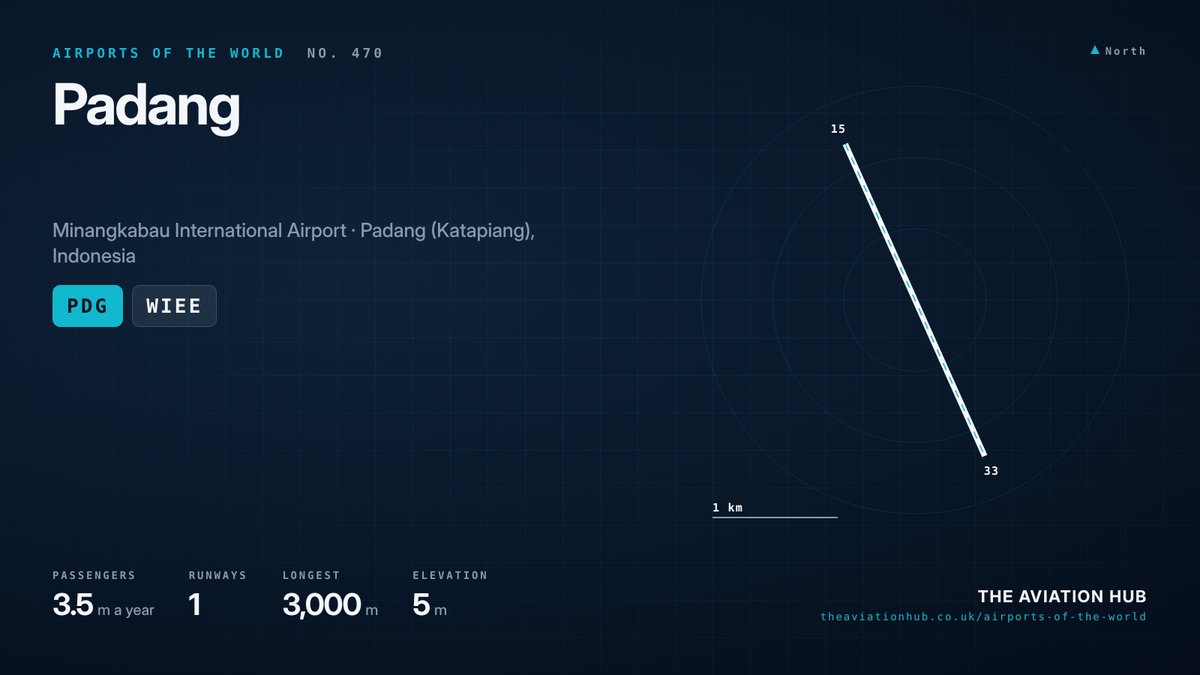
The codes are PDG for IATA and WIEE for ICAO. The airport lies at Ketaping in Padang Pariaman Regency, about 14 miles (23 km) north west of Padang city centre. Elevation is just 5 metres (18 feet), close to the Indian Ocean shore. There is one runway and one terminal for domestic and international flights.
Traffic in 2024 was 2,273,642 passengers, down 5.3 per cent, with about 18,100 aircraft movements and 10,500 tonnes of cargo. Lion Air group carriers, Garuda Indonesia, Citilink and Pelita Air serve Jakarta, while AirAsia, Batik Air Malaysia and Scoot fly abroad. Angkasa Pura II, now part of InJourney Airports, operates Padang Airport. Schedules are on the airport’s official website.
How Padang’s Airport Came to Be
For decades Padang relied on Tabing Airport, inside the city. Tabing had little room to grow, hills nearby, weak safety facilities and rising congestion. A new site on flat coastal land north of the city offered a fresh start.
Construction began in 2001, funded by a soft loan of about 9.4 billion yen from the Japan Bank for International Cooperation and around Rp 97.6 billion from the national budget. A joint venture of Shimizu and Marubeni built the airport with Indonesia’s Adhi Karya. It opened on 22 July 2005, and Tabing became the Sutan Sjahrir Air Force Base.
The name honours the Minangkabau, the matrilineal people of West Sumatra. In 2026 the regency government proposed renaming the airport after Syekh Burhanuddin, a Sufi scholar who spread Islam in the region, though the transport ministry has the final say. In 2023 the government also proposed downgrading the airport’s international status, but local opposition kept it.
Runways at Padang Airport
There is a single asphalt runway, 15/33, measuring 3,000 metres (9,843 feet) long and 45 metres wide. It was extended from 2,750 metres in 2017. An instrument landing system is installed, and the runway can handle wide body aircraft, which matters for pilgrimage charters.
The runway runs north west to south east, parallel to the coast. Heavy tropical rain is the main operational challenge. On 2 August 2015 Citilink Flight 970, an Airbus A320 from Batam, skidded off the runway in a downpour. None of the 174 passengers were hurt, though two were treated for shock.
The airport also sits in a highly active earthquake zone, close to the Sunda megathrust. The September 2009 Sumatra earthquake brought down about 100 metres of terminal roof, yet Padang Airport reopened the next day for relief flights. A further extension to 3,600 metres is planned.
Terminals and Airlines
The single terminal carries a bagonjong roof, with sweeping curved peaks drawn from the traditional rumah gadang houses. A two phase expansion completed in 2017 enlarged it to about 49,000 square metres with 32 check in counters, lifting capacity to around 5.9 million passengers a year. The apron fits up to 11 narrow body jets.
Lion Air, Batik Air, Super Air Jet and Wings Air form the largest group. Garuda Indonesia, Citilink and Pelita Air add Jakarta capacity, and Citilink also uses Jakarta’s Halim airport. AirAsia, Batik Air Malaysia and Lion Air fly to Kuala Lumpur, and Scoot serves Singapore. Susi Air links remote points including the Batu Islands and Sipora in the Mentawai chain.
Routes and Destinations
Jakarta is the dominant route, with several airlines flying between Padang Airport and Soekarno Hatta or Halim. Batam, Medan and Yogyakarta are other key domestic links, flown largely by Lion Air and Super Air Jet. The Minangkabau tradition of merantau, leaving home to work elsewhere, drives heavy family travel.
Kuala Lumpur is the main international market, with three airlines competing. Singapore follows. Lion Air flies seasonal routes to Jeddah and Medina, and Saudia adds seasonal Medina flights for pilgrims. Susi Air supports the Mentawai Islands, a surfing destination of global repute.
Demand peaks around Eid al Fitr, when the mudik homecoming fills every seat, and during the Hajj season. Cargo grew by a quarter in 2024 to about 10,500 tonnes.
Getting to and from Padang Airport
A dedicated rail link opened on 21 May 2018, inaugurated by President Joko Widodo. Trains run about 2.4 miles (3.9 km) on a new spur from the airport station to Duku, then continue on the existing line to Padang Station in the city. The full journey takes roughly 40 minutes to an hour. The train is the cheapest sensible option and avoids road congestion, although frequencies are limited.
Buses also run into Padang, and taxis wait outside arrivals between 07:00 and 22:30. Use the official metered taxis to avoid inflated fares. The drive to the city takes 30 to 45 minutes depending on traffic. Bukittinggi, the highland town popular with visitors, is around two to three hours by road.
Spotting and Photography
The coastal setting gives Padang Airport open views and dramatic tropical skies. Quiet roads near the runway ends and the flat land around Ketaping let enthusiasts watch aircraft on final approach. The terminal roof itself makes a fine subject.
Expect Lion Air Boeing 737-900ERs, Batik Air Airbus A320s, Citilink A320s, Garuda 737-800s and Super Air Jet A320s. AirAsia and Scoot bring international colour, while Saudia wide bodies appear in pilgrimage season. Stay on public land, keep clear of fences and follow any instructions from airport security.
What Comes Next
A renovation worth about Rp 553 billion is planned, with completion expected in the first quarter of 2027. The longer runway extension to 3,600 metres would open the door to heavier long haul pilgrimage flights. The proposed name change will also be decided in the coming years.
Padang Airport has capacity to spare, so recovering lost traffic is the real task. Stronger tourism to the highlands and the Mentawai Islands could help close the gap to its 2018 peak. See how it compares with Medan and other Sumatran airports on our Airports of the World map.
Continue to follow The Aviation Hub for more analysis and insight.
Advertise with us Your brand, in front of an aviation audience Home page and in-article placements, sold directly, one advertiser per slot. From £250 a year. See the rates

