
Palembang Airport Guide: South Sumatra’s Gateway by LRT
Palembang Airport is the main gateway to South Sumatra. Read about its wartime history, runway, airlines, routes, LRT link and future expansion plans.
 By The Aviation Hub
5 min read
Updated October 20, 2026
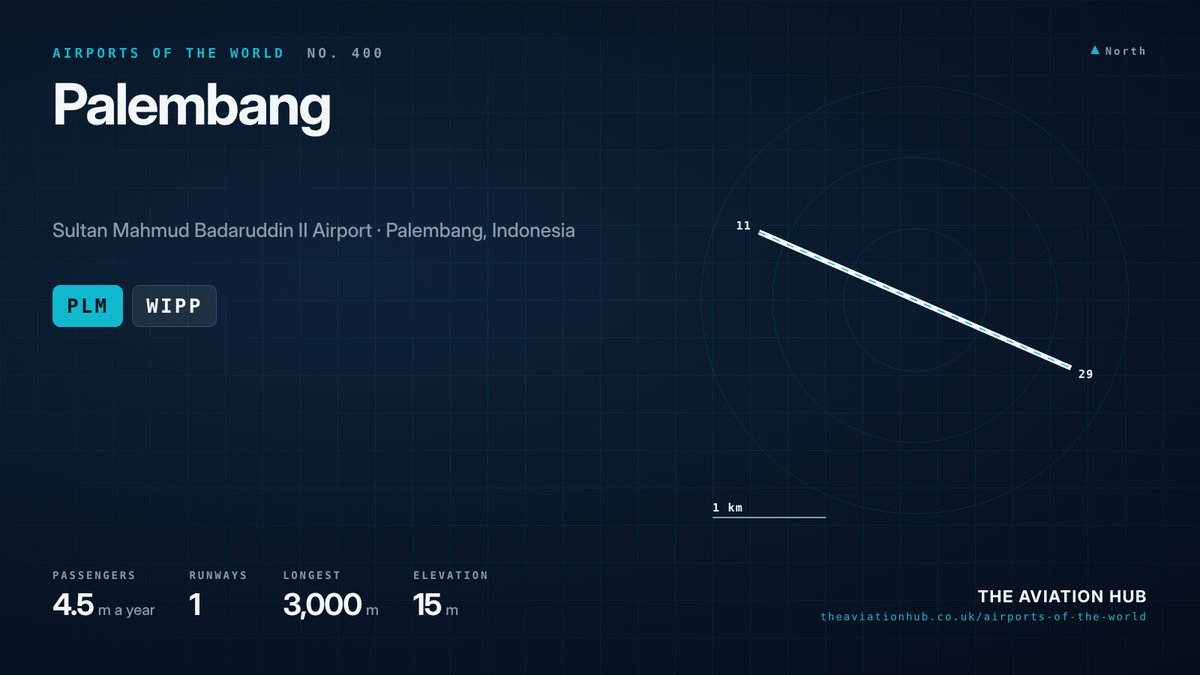
Palembang, on the banks of the broad Musi river, is one of the oldest cities in Indonesia and the capital of South Sumatra province. Palembang Airport, officially Sultan Mahmud Badaruddin II International Airport, is its link to Jakarta and the rest of the archipelago. It served more than five million passengers at its 2018 peak, when the city co hosted the Asian Games. Traffic has been lower since, but the airport boasts a modern terminal and a direct light rail connection to the city.
Palembang Airport at a Glance
The IATA code is PLM and the ICAO code is WIPP. The airport lies about 8 miles (13 km) northwest of central Palembang, at an elevation of 15 m (49 ft). It has one runway and one three storey passenger terminal. Palembang Airport handled 2,858,042 passengers in 2024, up from about 2.77 million in 2023, along with roughly 7,200 tonnes of cargo. The peak was 5,167,436 passengers in 2018. No airline uses it as a formal hub, but Indonesia’s major domestic carriers all fly here. The Indonesian Air Force’s Sri Mulyono Herlambang base sits directly across the runway from the terminal.
How Palembang’s Airport Came to Be
The site has served aviation for more than a century. Around 1920 the Dutch East Indies government acquired former plantation land and created Talang Betutu Airfield. In 1937 a KLM Douglas DC-3 named Specht crashed after take off, killing four people.
Palembang’s oil refineries made the airfield a strategic prize in the Second World War, and Allied prisoners of war were later forced to help rebuild it. After independence, Indonesian authorities opened it to civilian use on 1 January 1950 as Talang Betutu Airport. In 1967 it was renamed after Sultan Mahmud Badaruddin II, who ruled the Sultanate of Palembang Darussalam from 1803 to 1819 and resisted Dutch colonial power.
International status followed in 1970. The worst accident came in 1975, when Garuda Indonesia Flight 150 crashed on approach in fog, killing 25 of the 61 people aboard and one person on the ground. The current terminal opened in 2005 and was expanded in 2011, 2012 and 2017.
Runways at Palembang Airport
A single asphalt runway, 11/29, handles all traffic. It is 3,000 m (9,843 ft) long and 45 m wide, following an extension completed in the 2003 to 2005 redevelopment. The added length allows wide body aircraft to operate, which made it possible to run Hajj flights to Saudi Arabia directly from Palembang.
The runway is shared with the Indonesian Air Force base on the opposite side, so military aircraft and helicopters operate alongside airline traffic. Tropical thunderstorms are frequent, especially in the wet season from November to April. Smoke haze from forest and peatland fires across Sumatra has periodically disrupted flights at Palembang Airport during dry seasons, sometimes cutting visibility below landing minimums.
Terminals and Airlines
The three storey terminal was enlarged before the 2018 Asian Games to about 46,000 square metres, giving capacity of around 4.6 million passengers a year. The apron holds 13 aircraft and is planned to grow to 19 stands.
Garuda Indonesia and its low cost arm Citilink fly here, as do Batik Air and Super Air Jet from the Lion group and Pelita Air. Most aircraft are Boeing 737s and Airbus A320 family jets. International services have been patchy. The airport lost its international status in 2024 because it had no foreign flights, and regained it in 2025.
Routes and Destinations
Jakarta dominates the schedule. The trip to Soekarno Hatta takes about an hour, and several airlines fly it many times a day, with the Lion group and Citilink competing hard on fares. Surabaya, Medan and Yogyakarta are the other main domestic routes, linking Palembang Airport with the rest of Sumatra and Java.
International links have centred on Kuala Lumpur and Singapore, popular with travellers for shopping, medical care and onward connections. Hajj and Umrah flights to Saudi Arabia are an important seasonal market in this largely Muslim province. Demand peaks around Eid, when families travel home in large numbers, and during school holidays. Cargo is modest, at around 7,200 tonnes a year.
Getting to and from Palembang Airport
The Palembang LRT is the standout option. Built for the Asian Games, it has been described as the first practical modern light rail system to operate in Indonesia. Its airport station connects directly to the terminal by skybridge, and the line runs through the city centre to Jakabaring Sport City south of the river. Airport passengers pay Rp 10,000 (about 50 pence), double the normal fare, which still makes it the cheapest way into town. The ride from Palembang Airport to Ampera station, near the famous bridge over the Musi, takes around half an hour.
Official taxi operators, including Blue Bird, run around the clock, with a Rp 7,000 flag fall plus Rp 5,000 per kilometre. Grab and Gojek are also available outside Palembang Airport. DAMRI buses serve Baturaja, Prabumulih and Muara Enim for travellers heading further into South Sumatra. More details are on the airport’s official website.
Spotting and Photography
Palembang has a mix of civil and military traffic, but caution is essential. The Air Force base across the runway is a military installation, and photographing it can bring trouble with the authorities.
The terminal windows and the LRT skybridge offer glimpses of the apron and civil aircraft. Afternoon storms can produce dramatic skies, while the morning light is usually cleaner. Keep to public areas of Palembang Airport, avoid pointing cameras at military aircraft or facilities, and follow any instruction from police, soldiers or airport staff.
What Comes Next
Long term plans call for a terminal of up to 115,000 square metres, handling as many as nine million passengers a year, with the apron expanded to 19 stands. The timing depends on traffic recovering towards its 2018 peak.
Restoring international routes is the immediate priority after the status was reinstated in 2025. With a growing regional economy and a rail link few Indonesian airports can match, the infrastructure at Palembang Airport is ready for growth. Find more airports on the Airports of the World map.
Continue to follow The Aviation Hub for more analysis and insight.
Advertise with us Your brand, in front of an aviation audience Home page and in-article placements, sold directly, one advertiser per slot. From £250 a year. See the rates

