
Palermo Airport Guide: Punta Raisi Between Mountains and Sea
Palermo Airport sits between mountains and sea west of the city. Our guide covers its history, runways, airlines, routes, transport and spotting.
 By The Aviation Hub
6 min read
Updated October 20, 2026
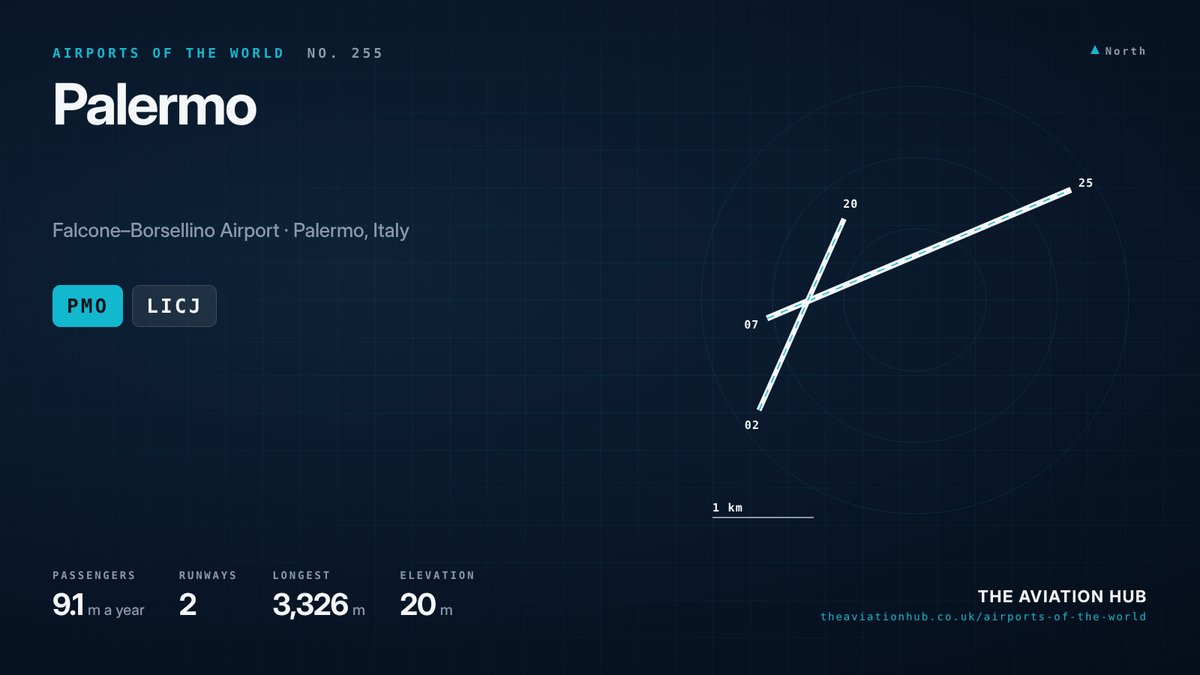
Falcone Borsellino Airport occupies a narrow strip of coast at Punta Raisi, west of the Sicilian capital, with steep mountains on one side and the Tyrrhenian Sea on the other. Palermo Airport handled more than 9.2 million passengers in 2025, making it the second busiest airport in Sicily after Catania. Its name honours two judges murdered by the Mafia, and its setting makes it one of the more dramatic approaches in Italy.
Palermo Airport at a Glance
The IATA code is PMO and the ICAO code is LICJ. Palermo Airport lies in the municipality of Cinisi, about 22 miles (35 km) west northwest of the city centre, at an elevation of 20 metres (65 feet). It has two runways and a single passenger terminal.
Traffic reached about 9.2 million passengers in 2025, up around 3 per cent on the previous year, from roughly 65,000 aircraft movements. Ryanair is the largest airline, and Volotea and Wizz Air, which reopened its Palermo base in August 2026, also base aircraft here. GESAP, a company owned by local public bodies, runs the airport. Flight times and parking details are on the airport’s official website.
How Palermo’s Airport Came to Be
Palermo’s original airport was Boccadifalco, on the edge of the city. Its short runway and mountainous surroundings made it unsuitable for jets, so a new site was chosen on the flat coastal strip at Punta Raisi. The new airport opened in 1960 and took the name of the local cape.
The early years were marked by tragedy. On 5 May 1972 Alitalia Flight 112, a Douglas DC-8, flew into Montagna Longa on approach, killing all 115 people on board. On 23 December 1978 Alitalia Flight 4128, a DC-9, crashed into the sea short of the runway, with more than 100 deaths. The two disasters gave Punta Raisi a reputation that took years to shake off.
In 1992 the Mafia murdered the anti Mafia judges Giovanni Falcone and Paolo Borsellino. Falcone was killed by a bomb on the motorway at Capaci as he drove from this very airport into Palermo. The airport was later renamed in their honour, and a plaque with their portraits greets passengers in the departure hall.
Runways at Palermo Airport
Palermo Airport has two asphalt runways. The main runway, 07/25, is 3,326 metres (10,912 feet) long and 60 metres wide. The secondary runway, 02/20, is 2,074 metres (6,804 feet) long and 45 metres wide.
Runway 07/25 runs parallel to the coast and handles almost all airline traffic, including the wide bodies used on transatlantic flights. Runway 02/20 crosses it and is used mainly when strong winds make the main runway difficult, or by smaller aircraft.
The terrain shapes everything. Mountains rise sharply south of the airfield, and the sea lies just to the north, so approaches follow carefully designed paths. Runway 25 is the direction normally in use. Gusty winds and turbulence off the high ground can make landings lively, especially in winter.
Terminals and Airlines
All passenger flights use a single terminal with separate areas for Schengen and non Schengen traffic. The building has been modernised in stages, and the railway station is a short walk away.
Ryanair dominates the schedule at Palermo Airport, flying Boeing 737-800 and 737 MAX 8 jets to Bari, Bologna, Milan, Rome, Berlin and a long list of other points. Wizz Air and Volotea add Airbus capacity on domestic and European routes, and Aeroitalia flies to Italian cities. easyJet serves Milan Malpensa and a range of seasonal destinations.
ITA Airways links Palermo with Rome Fiumicino and Milan Linate, giving connections into its network. Lufthansa adds links to its German hubs. In summer, holiday airlines and leisure carriers from across Europe add further capacity.
Routes and Destinations
Domestic flying is the core of the business. Rome and Milan are the biggest markets by far, served by several airlines and many daily flights. Bologna, Turin, Venice, Bari and Naples also see frequent services, reflecting long standing ties between Sicilians and the cities of the north.
Internationally, Germany, France, Spain and the UK supply the most visitors, with Berlin, Paris, Barcelona and London among the leading destinations. TUI plans to add London Gatwick from March 2027, and Ryanair and Wizz Air keep adding routes to central and eastern Europe.
Transatlantic service has arrived in recent years. Neos began seasonal flights to New York JFK in June 2024, and United followed with seasonal Newark service in May 2025. At roughly 4,450 miles (7,200 km), Newark is the longest route from Palermo Airport. Cargo is minor, at around 1,500 tonnes a year.
Getting to and from Palermo Airport
The airport’s own railway station is the northwestern end of Palermo’s metropolitan rail service. Trains run to Palermo Centrale about every 30 minutes on weekdays, from early morning until around 10pm. The journey takes roughly an hour, and the fare is a few euros.
Private coaches leave from outside the terminal for central Palermo and take around 50 minutes. They are frequent and usually the cheapest sensible option for reaching the city centre, while other coaches run to Trapani, Agrigento, Catania and Messina.
By road, Palermo Airport sits beside the A29 motorway, which runs east along the coast to the city. Taxis take 35 to 50 minutes and cost around €45 to €50 (roughly £38 to £43) to the centre. Car parks face the terminal, and car hire is popular with visitors touring western Sicily.
Spotting and Photography
The setting makes Palermo Airport a rewarding place for photographers. Mountains frame the approaches, and the sea provides a backdrop on the northern side. Public roads around Cinisi and Terrasini give views of the field, and the beaches near Punta Raisi let enthusiasts watch aircraft turning over the water.
Ryanair 737s dominate, but summer brings variety from across Europe, plus the Neos and United wide bodies on transatlantic flights. The sun sits to the south, behind the mountains, so positions north of the runway near the shore give the best light for most of the day.
Respect the fences and the airport’s security zone. Stay on public roads and beaches, keep clear of access points and never fly drones near the approach paths.
What Comes Next
Growth is steady, and GESAP is investing in the terminal and aprons to handle summer peaks. Debate over selling a stake in the operator to private investors has run for several years, and the outcome will shape how much money flows into new facilities.
The terrain limits any major expansion of the airfield itself, so future capacity will come from better use of the existing runways and buildings. Palermo Airport looks set to keep growing on the back of tourism and transatlantic demand, while carrying a name that reminds every visitor of Sicily’s recent history. See how it compares with other Italian airports on the Airports of the World map.
Continue to follow The Aviation Hub for more analysis and insight.
Advertise with us Your brand, in front of an aviation audience Home page and in-article placements, sold directly, one advertiser per slot. From £250 a year. See the rates

