
Palm Springs Airport Guide: Desert Gateway With a Winter Rush
Palm Springs Airport is an open air, mid century terminal beneath the San Jacinto Mountains. Read how its winter season, routes and runways work.
 By The Aviation Hub
7 min read
Updated October 20, 2026
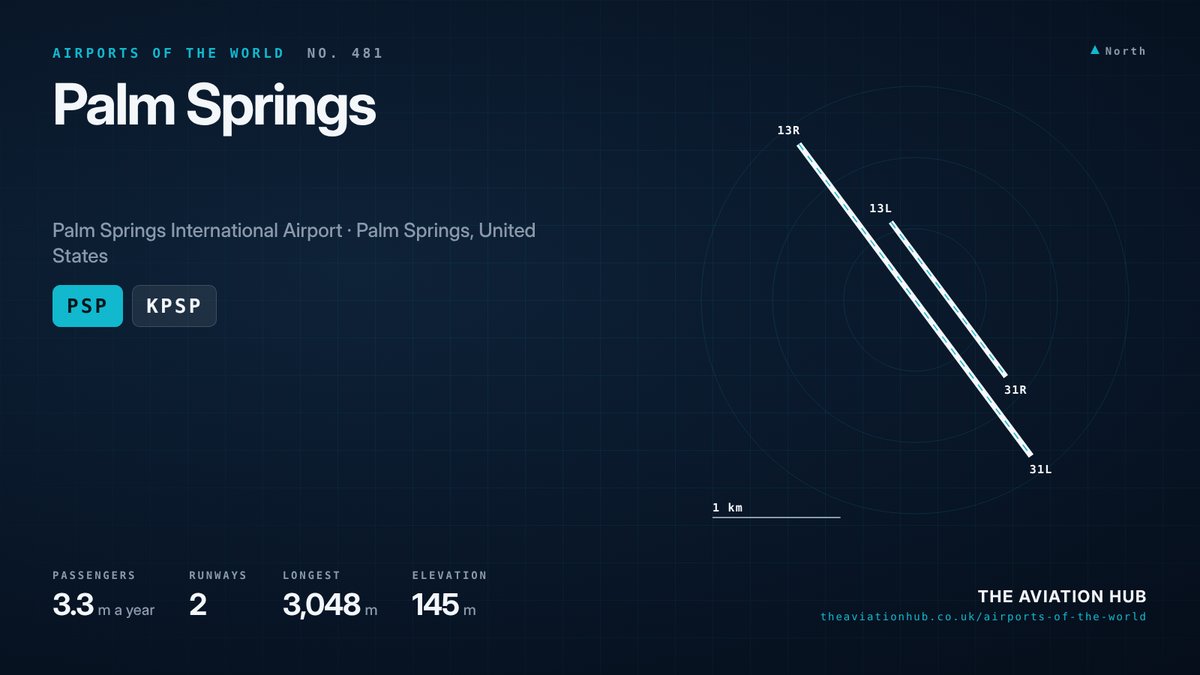
Palm Springs International Airport serves the Coachella Valley resort cities of southern California, around 110 miles (175 km) east of Los Angeles. It sits two miles (3 km) from downtown Palm Springs, with the 10,000 ft wall of the San Jacinto Mountains filling the view to the west. Around 3.3 million passengers a year use Palm Springs Airport, most of them between November and April when snowbirds from Canada and the northern states arrive. The 1966 terminal by Donald Wexler is a landmark of desert modernism, and much of the passenger journey happens outdoors.
Palm Springs Airport at a Glance
The codes are PSP and KPSP. The field lies at 477 ft (145 m) above sea level on the valley floor, about 2 miles (3 km) east of the downtown strip along Palm Canyon Drive. There are two parallel runways and a single terminal with 19 gates across two concourses. Just over 3.3 million passengers passed through in 2025, up around 2 per cent on 2024 and a record for the field.
No airline bases aircraft here. Alaska, American, Delta, Southwest and United carry most of the traffic, with SkyWest flying regional jets for several of them. WestJet, Air Canada, Flair and Porter arrive from Canada in winter. The City of Palm Springs owns Palm Springs Airport and runs it through its Aviation Department. Live flight information and parking rates are on the airport’s official website.
How Palm Springs Got Its Airfield
The United States Army Air Corps laid out an emergency landing field on Agua Caliente tribal land in 1939, attracted by reliable clear weather and the short hop to March Field near Riverside. A larger Palm Springs Army Airfield followed in early 1942 and spent the war as a ferrying, training and transport base. American Airlines Flight 28 collided with an Army bomber near Palm Springs in October 1942.
The military sold the site in 1946, and the city bought the land in 1961 to build a proper municipal airport. Donald Wexler, the architect who gave Palm Springs much of its mid century identity, designed the terminal that opened in 1966 with its folded roof and open air walkways.
The Sonny Bono Concourse, named after the singer, congressman and former mayor, opened in November 1999 with eight jet bridge gates. The shorter parallel runway arrived in 1993 to separate light aircraft from airline traffic.
Runways at Palm Springs Airport
Runway 13R/31L is the airline runway at 3,048 m (10,000 ft) long and 46 m (150 ft) wide. The length matters, because summer heat pushes density altitude well above 3,000 ft and eats into aircraft performance. Boeing 737-800s and Airbus A320s on hot afternoons use most of it.
Runway 13L/31R is a general aviation strip of 1,510 m (4,953 ft) and 23 m (75 ft), completed in 1993 to keep the valley’s light aircraft and business jets off the main runway. Both are asphalt. The two sit close together, so the tower sequences light traffic around the airliners.
Wind through the San Gorgonio Pass to the northwest generally favours landing on 31L, which brings arrivals in low over Cathedral City with the mountains behind them. Departures from 31L climb straight towards the pass and its forest of wind turbines, then turn out. Terrain on three sides constrains the instrument approaches at Palm Springs Airport, so an easterly wind combined with the valley’s rare poor visibility can mean holding or a diversion to Ontario.
Terminals and Airlines
The Wexler main building holds ticketing, security and baggage claim, with a courtyard of shops, restaurants and a children’s play area that is open to the sky. Open air walkways lead north to the elevated Sonny Bono Concourse, which has eight gates with jet bridges and handles most of the Boeing 737 and Airbus A320 family flights.
The Agua Caliente Concourse on the south side, once called the Regional Concourse, is at apron level with 11 hardstand positions. Passengers walk out to Embraer E175s, Bombardier CRJ-700s and the occasional Boeing 737, which is a pleasure in January and a trial in July. Six of the stands can take aircraft up to the Airbus A321, and they are the only stands at the airport for the Airbus A220.
There are no airline lounges. The open design means a delay at Palm Springs Airport can be spent in the sun watching the ramp.
Routes and Destinations
Denver is the busiest route with around 195,000 passengers a year, split between United and Southwest. Seattle follows at around 188,000, mostly on Alaska, then San Francisco, Dallas Fort Worth and Phoenix. Alaska and Southwest also connect Portland, the Bay Area and Las Vegas, and American adds Chicago in winter.
Canada is the defining international market, and all international flights come from cities with United States preclearance, so passengers arrive as domestic. WestJet is the only Canadian carrier here year round, flying Calgary, Edmonton and Vancouver through the summer and adding Winnipeg in winter. Air Canada serves Vancouver and Toronto, and Flair and Porter fly seasonal services. The Toronto flights cover about 2,080 miles (3,350 km). The longest routes on the board are the seasonal nonstops from New York JFK, at about 2,370 miles (3,820 km).
Seasonality is extreme. Monthly passenger numbers in March can be more than three times the August figure, and several routes disappear entirely between May and October. Cargo is negligible beyond a FedEx feeder.
Getting to and from Palm Springs Airport
Driving is the norm. The terminal sits on Tahquitz Canyon Way, which runs straight into downtown in five minutes, and Gene Autry Trail and Ramon Road link to Interstate 10 in about ten. Rancho Mirage and Palm Desert are 20 to 30 minutes down Highway 111, and Indio is around 40. Los Angeles is a two hour drive on a good day and three or more on a Friday afternoon.
SunLine SunBus routes 2 and 4 stop at the airport and run downtown and along the valley for a couple of dollars, which is the cheapest option. An Amtrak Thruway coach calls at baggage claim and runs via Riverside to connect with trains at Fullerton. A taxi or rideshare to the downtown hotels costs around $15 to $20 (£11 to £15).
Parking is close and simple, with short term spaces opposite the terminal and a long stay lot a short walk away. Rental car desks sit in the main building, and most visitors collect a car on arrival.
Spotting and Photography
Palm Springs Airport is a photographer’s airport. The mountain backdrop, clear desert air and low winter sun produce some of the best airliner images in the United States. The terminal courtyard and the Bono Concourse windows give views of the ramp with San Jacinto behind it, and the hardstand gates put passengers a few metres from the regional jets.
Outside, the approach to 31L crosses Ramon Road and Gene Autry Trail at low height, and the open ground along those roads gives a clean side profile of arrivals. Mornings light the landing aircraft against the mountains. Afternoons flatter departures from 31L as they lift off towards the pass. On the rare days when 13R is in use, arrivals come in over the desert from the northwest.
Keep to public roads, do not stop on Gene Autry Trail itself and stay well back from the fence. Airport police patrol the perimeter roads, and summer heat is a genuine hazard, so carry water.
Growing Without Losing the Look
A master plan launched in 2023 and approved by the city council in January 2025 maps out how Palm Springs Airport could double its capacity to around 6.4 million passengers a year by 2042 without losing the Wexler character. The first phase proposes seven new gates, a federal inspection station for international flights, a larger baggage claim and a consolidated rental car centre. The 2021 ticketing hall and a 2023 baggage claim refurbishment were the first steps, and more restaurants and duty free shopping have followed.
Growth depends on Canada and the northern snowbird markets, and both have held up well. The constraint is summer, when heat limits aircraft performance and demand collapses. The airport is heading for steady winter growth and a smarter, cooler terminal, not for a transformation. Compare it with the rest of California on the Airports of the World map.
Continue to follow The Aviation Hub for more analysis and insight.
Advertise with us Your brand, in front of an aviation audience Home page and in-article placements, sold directly, one advertiser per slot. From £250 a year. See the rates

