
Palma de Mallorca Airport Guide: The Balearic Holiday Hub
Palma de Mallorca Airport handles nearly 34 million passengers a year, most of them in summer. Read how Spain's island gateway works and where to watch it.
 By The Aviation Hub
7 min read
Updated October 20, 2026
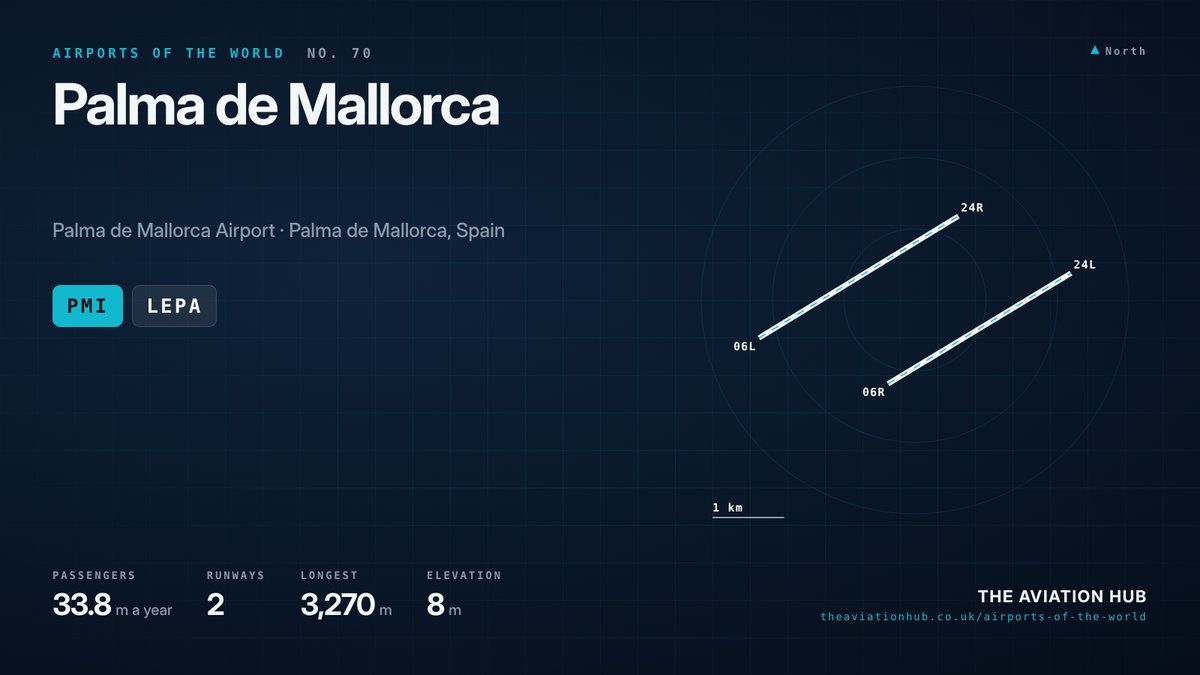
Palma de Mallorca Airport, known locally as Son Sant Joan, lies about 5 miles (8 km) east of the Balearic capital beside the resort of Can Pastilla and the bay of Palma. It is the third busiest airport in Spain after Madrid and Barcelona and the main door to Mallorca, an island that receives more than ten million tourists a year. Around 34 million passengers used the airport in 2025, with Germany and the United Kingdom supplying the bulk of the foreign traffic. On a summer Saturday it ranks among the busiest airports in Europe by movements.
Palma de Mallorca Airport at a Glance
The codes are PMI and LEPA. The field sits just 27 ft (8 m) above sea level on the coastal plain of the Pla de Sant Jordi, with the sea a short distance to the south and the city to the west. It has two parallel runways and one large terminal divided into four modules lettered A to D. The Son Sant Joan air base of the Spanish Air and Space Force shares the runways.
Palma de Mallorca Airport handled roughly 33.8 million passengers and 246,000 aircraft movements in 2025. Air Europa has its main base here, and Eurowings, easyJet, Jet2.com, Ryanair and Vueling all station aircraft on the island for the season. Aena, the Spanish state controlled airport operator, owns and runs the airport. Terminal maps and parking rates are on the airport’s official website.
How Palma’s Airport Came to Be
Flying on Mallorca began in the 1920s with trials at Son Sant Joan and at Son Bonet, a few miles to the north. Son Bonet became the island’s civil airport and served it through the first post war years of tourism, while Son Sant Joan was developed as a military field. By the late 1950s Son Bonet could not cope and the government approved the transfer of civil traffic.
Palma de Mallorca Airport opened to domestic and international flights on 7 July 1960, just as the package holiday boom began. Traffic multiplied through the 1960s and 1970s, and the airport became the summer base for a generation of British and German charter airlines. A second runway followed to keep up with the peaks.
The present central terminal, designed by the Mallorcan architect Pere Nicolau Bover, opened in 1997 and tied the modules together. Air Berlin ran a hub here until 2016 that connected German cities with Spanish destinations, and its collapse in 2017 left a gap that Eurowings and others quickly filled. In June 2024 torrential rain flooded the terminal and damaged the runways, a reminder of the site’s low elevation.
Runways at Palma de Mallorca Airport
Palma de Mallorca Airport has two parallel asphalt runways. Runway 06L/24R is 3,270 m (10,728 ft) long and 06R/24L is 3,000 m (9,842 ft), both 45 m wide. The lengths are generous for a field dominated by the Airbus A320 family and the Boeing 737, and they comfortably take Air Europa’s Boeing 787s and the other wide bodies that visit.
The runways sit about 1.5 km apart, and in normal operations one handles arrivals and the other departures. In the summer sea breeze, aircraft land on 24L from the northeast over the farmland of the Pla de Sant Jordi and depart from 24R out over the bay. Northeasterly winds switch the field to landings on 06R and departures on 06L, with arrivals passing low over the beach at Can Pastilla.
The summer peak is intense. On the busiest Saturdays the airport handles more than 1,100 movements, with the morning arrivals wave from northern Europe and the evening departures both stretching the system. Spanish military aircraft from the air base add occasional transport and training types.
Terminals and Airlines
The terminal at Palma de Mallorca Airport is one building with four modules fanning out from the central check in hall. Module A on the northern side has 28 gates and handles most non Schengen flights, including everything to the United Kingdom and Ireland, so Jet2.com, easyJet UK, Ryanair UK flights, British Airways and TUI Airways board here. Module B, with eight bus gates, serves the Air Nostrum regional flights for Iberia to the mainland and the other islands.
Module C on the eastern side is the largest, with 33 gates, and takes the German and other Schengen carriers, among them Eurowings, Condor, Lufthansa, easyJet Europe and Norwegian. Module D on the southern side has 19 gates and handles Spanish and further Schengen traffic. It closed in November 2025 for roof and interior renovation. Lounges are run by Aena, with a Sala VIP in the Schengen and non Schengen areas.
Routes and Destinations
Madrid and Barcelona are the busiest routes year round, served by Air Europa, Iberia Express, Vueling and Ryanair with a shuttle like frequency. Valencia follows, with Malaga, Bilbao and Seville also linked to the mainland network, and short inter island hops to Ibiza and Menorca run several times a day.
Germany is the largest foreign market by far. Dusseldorf, Frankfurt, Munich, Hamburg, Cologne, Stuttgart, Berlin and Hanover are all served many times daily in summer, and Mallorca is sometimes called Germany’s seventeenth state. Manchester, London Gatwick, London Stansted, Birmingham, Leeds Bradford and Edinburgh lead the British routes. Zurich, Vienna, Amsterdam, Copenhagen and Paris add depth. The longest regular flight is United’s seasonal service to Newark at roughly 3,900 miles (6,300 km), with most of the network under three hours.
Seasonality is severe. The airport is around four times busier in August than in January, and many northern European routes operate only between April and October. Cargo is light and mostly belly freight.
Getting to and from Palma de Mallorca Airport
The EMT bus is the cheapest sensible option. Route A1 runs to the city centre and the port in about 20 to 30 minutes for a few euros, and route A2 runs east along the Playa de Palma to El Arenal. The buses leave from the arrivals forecourt and run frequently through the day. There is no rail link, though a metro or tram extension to the airport has been discussed for years.
Taxis wait outside arrivals and cost around €25 to €30 to the centre, taking 15 to 20 minutes via the Ma 19 motorway. Transfers to the resorts in Alcudia, Pollenca and the east coast take about an hour. Car hire is enormous business, with the on site rental hall among the largest in Spain, and the Ma 19 and Ma 20 ring road give fast access to the whole island. Multi storey and long stay car parks sit in front of the terminal.
Spotting and Photography
Palma de Mallorca Airport is one of the best summer spotting locations in Europe for sheer volume and variety. The classic position is on the beach and promenade at Can Pastilla, where aircraft arriving on 06R cross the shoreline a few hundred feet up. The road behind the 24L threshold on the eastern side gives views of landings when the sea breeze blows. Inside, the gate areas give views of the aprons.
Light is good almost all day. Mornings favour the beach side and afternoons the eastern approach. The mix includes the whole European low cost and leisure scene, Air Europa’s Boeing 787s and 737 MAX 8s, Condor’s Airbus A330-900s in their striped liveries and Jet2.com’s 737-800s and Airbus A321neos in force. Business jets are plentiful in August.
The Guardia Civil patrol the perimeter and the air base is sensitive. Stay on public ground, do not photograph the military side and keep off the fence line.
What Comes Next
Aena is investing in Palma to cope with traffic well above the terminal’s nominal capacity of 25 million a year. The Module D renovation is the most visible element. The Balearic government has pressed for limits on growth to protect the island from over tourism, and no new runway is planned.
The field will therefore grow by handling its summer peaks more smoothly rather than by getting bigger. Palma de Mallorca Airport remains the model of the European holiday airport. Compare it with the other leisure gateways on the Airports of the World map.
Continue to follow The Aviation Hub for more analysis and insight.
Advertise with us Your brand, in front of an aviation audience Home page and in-article placements, sold directly, one advertiser per slot. From £250 a year. See the rates

