
Paphos Airport Guide: Cyprus’s Western Holiday Gateway
Paphos Airport handled 3.8 million passengers in 2025. Read about its runway, terminal, Ryanair and UK routes, bus links and spotting tips.
 By The Aviation Hub
6 min read
Updated October 20, 2026
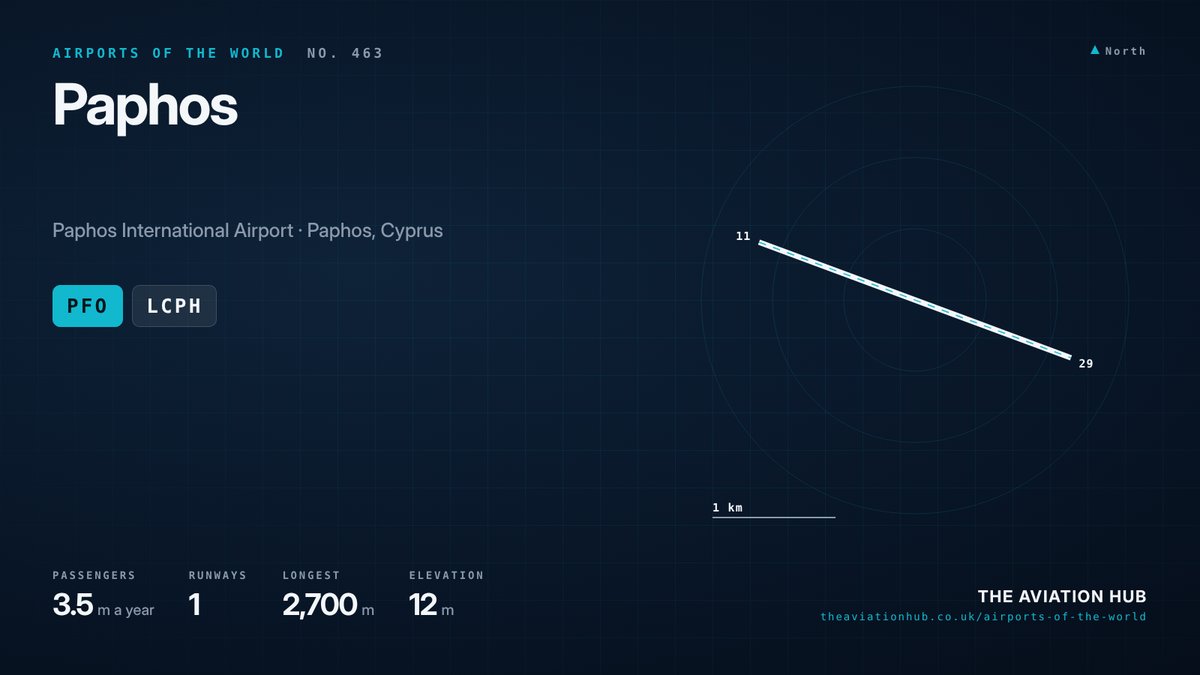
Paphos Airport stands on the south west coast of Cyprus, a few minutes inland from the beaches at Timi and Mandria. It is the island’s second airport after Larnaca, and it handled more than 3.8 million passengers in 2025. Most are holidaymakers and second home owners from Britain, heading for Kato Paphos, Coral Bay and the Akamas peninsula. The field also hosts a military air base, and its runway sits barely a stone’s throw from the Mediterranean.
Paphos Airport at a Glance
The codes are PFO for IATA and LCPH for ICAO. The airport lies near the village of Timi, around 4 miles (6.5 km) south east of the edge of Paphos. By road, the town centre is about 13 miles (21 km) away. Elevation is just 12 metres (41 feet). There is one runway and one passenger terminal.
Traffic reached 3,837,155 passengers in 2025, up 5.5 per cent, across about 22,700 aircraft movements. Ryanair treats the field as a focus city, while easyJet, Jet2.com and TUI Airways carry much of the British market. Hermes Airports runs both Paphos Airport and Larnaca under a concession from the Republic of Cyprus, which still owns the site. Timetables and parking details are on the airport’s official website.
How Paphos Came to Have an Airport
Cyprus lost its main airport in 1974. Nicosia International closed after the Turkish invasion and was left stranded in the United Nations buffer zone. Larnaca opened in 1975 as an emergency replacement, but the west of the island still had no airfield of its own.
Paphos Airport opened in 1982 to fill that gap. Tourism to the region grew quickly through the 1980s and 1990s, driven by British package holidays. A National Guard air base was later added on the field. Named after the Greek prime minister Andreas Papandreou, it gives Greek and Cypriot forces a foothold in the south east Mediterranean.
In May 2006 Hermes Airports took over the construction, development and operation of Paphos and Larnaca under a 25 year concession. The current terminal opened in November 2008 and replaced the original 1980s building. In 2012 Ryanair based two aircraft at Paphos, launched 15 new routes and began offering more than 80 weekly flights, which reset the economics of the field.
Runways at Paphos Airport
There is a single asphalt runway, 11/29, measuring 2,700 metres (8,858 feet) long and 45 metres wide. That length suits the Airbus A320 and Boeing 737 families that dominate the schedule. Wide body jets can operate, though they are rare visitors. The runway runs roughly east to west, parallel to the coast.
A parallel strip, once designated 11L/29R, now serves as a taxiway, and it has caused trouble. On 21 September 2011 a Thomson Airways Boeing 737-800 landed on it by mistake, then taxied safely to the apron. Warnings were issued in 2011 and 2012, and by 2014 the surface carried large TAXI and TAXIWAY markings to stop crews confusing the two.
Sea breezes off the Mediterranean usually blow from the west on summer afternoons, favouring runway 29. Arrivals then approach from the east along the coastline past Mandria. The military side handles occasional fighter and transport movements, which share the runway with airliners.
Terminals and Airlines
All passenger flights use the 2008 terminal, which has 28 check in desks, seven gates and 22 aircraft stands. Cyprus is outside the Schengen area, so every international flight goes through passport control. The building copes well for most of the year but fills quickly during summer Saturday waves.
Ryanair has the largest network, with routes across the UK, Ireland, Greece, Poland and much of Europe. easyJet, Jet2.com and TUI Airways serve British airports, and British Airways adds flights from London. Lufthansa, Aegean, LOT and Wizz Air bring Central European and Greek links. Several Israeli carriers also fly to Paphos Airport, reflecting strong tourism from Tel Aviv.
Routes and Destinations
London Gatwick was the busiest route in 2024, with about 385,000 passengers. Manchester followed with almost 300,000, then London Stansted with around 211,000. Tel Aviv came fourth at roughly 210,000 and Thessaloniki fifth at nearly 158,000.
The rest of the top ten underlines the British accent at Paphos Airport, with Birmingham, Bristol and Newcastle all present. Athens and Vienna complete the list. Many British passengers own or rent homes around Paphos and Peyia, which keeps traffic flowing well outside the peak months.
Summer is still the busiest period, peaking between June and September. Winter schedules remain healthier than at many Mediterranean leisure airports, because the climate draws long stay visitors in the cooler months. There are no long haul flights, and cargo is negligible at about 80 tonnes a year.
Getting to and from Paphos Airport
Cyprus has no railway, so every journey is by road. Regular public buses link the terminal with the harbour bus station at Kato Paphos, with limited services to the upper town at Karavella and to Polis. The bus is the cheapest sensible option for the resort area, costing a few euros for a journey of around 30 to 40 minutes.
Direct shuttle coaches run to Limassol, Nicosia and Larnaca. Limassol is about 38 miles (61 km) to the east along the A6 motorway. Taxis to Kato Paphos take around 20 minutes. Car hire is popular, and drivers should remember that Cyprus drives on the left. A four lane road between the airport and Paphos is planned to relieve the busy B6 and E603.
Spotting and Photography
Paphos Airport sits right on the coast, so the beaches and quiet roads around Timi and Mandria give open views of aircraft on approach. Low sun over the sea can make for striking shots in the evening. The terrain is flat, with the Troodos foothills inland as a backdrop.
Expect a steady stream of Ryanair Boeing 737 MAX 8s, easyJet Airbus A320neos and Jet2 737-800s, with British Airways and Israeli carriers adding variety. The National Guard base makes photography of military aircraft and installations a serious matter. Keep the camera on airliners, stay on public land and follow any instruction from police or soldiers.
What Comes Next
Traffic grew again in 2025, and the 2008 terminal now carries far more than it did on opening day. In 2025 Hermes Airports began a second phase of works that will extend the terminal, lift capacity by about 30 per cent to five million passengers a year and enlarge the southern parallel taxiway. The planned four lane road to Paphos would ease a well known bottleneck for holiday traffic.
Paphos Airport looks set to keep growing steadily, anchored by British demand and Ryanair’s network, with Israeli and Central European markets adding depth. A stronger winter season will matter more than summer peaks. See how it compares with Larnaca and other Mediterranean fields on our Airports of the World map.
Continue to follow The Aviation Hub for more analysis and insight.
Advertise with us Your brand, in front of an aviation audience Home page and in-article placements, sold directly, one advertiser per slot. From £250 a year. See the rates

