
Paris CDG Airport Guide: Inside the Air France Hub
Paris CDG Airport is the home of Air France and the third busiest hub in Europe. Four runways, the circular Terminal 1, routes, rail links and where to spot.
 By The Aviation Hub
7 min read
Updated October 20, 2026
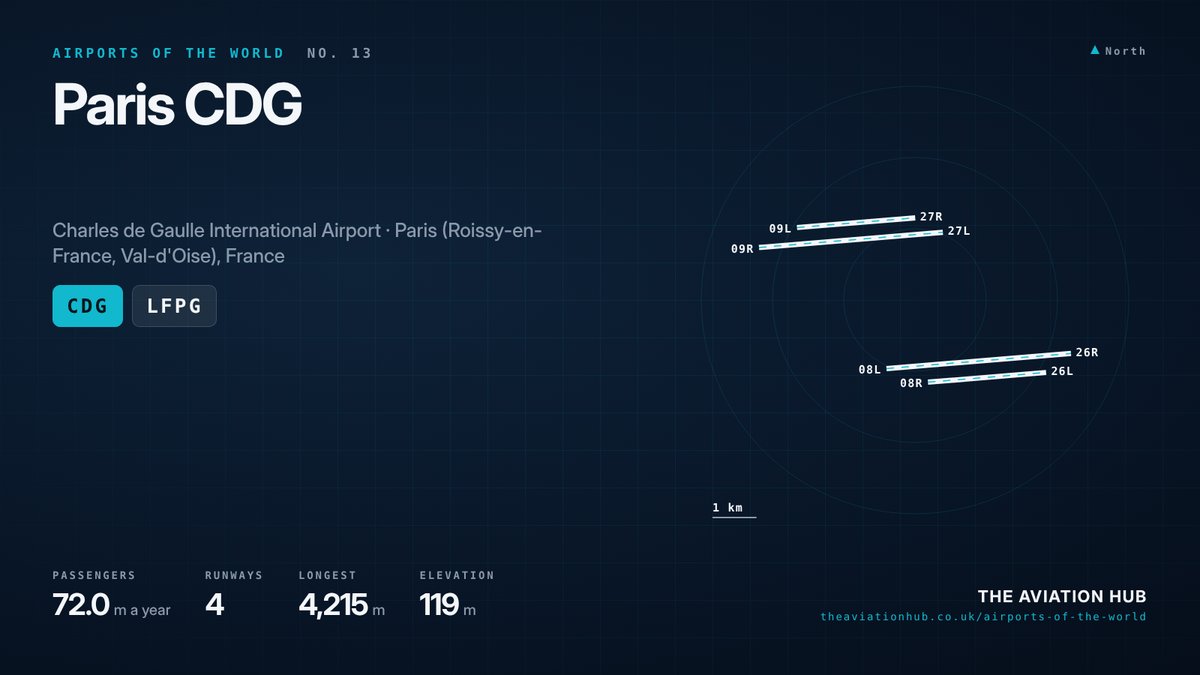
Paris CDG Airport sits at Roissy, around 14 miles (23 km) northeast of the centre of Paris, and is the main gateway to France. Air France built its entire long haul network around it, and SkyTeam partners Delta and KLM feed it from both sides of the Atlantic. More than 72 million passengers passed through in 2025, making it the third busiest airport in Europe after Istanbul and London Heathrow. Four runways, three terminals and a maze of sub terminals cover 32 square kilometres, almost a third of the area of the city itself.
Paris CDG Airport at a Glance
The IATA code is CDG and the ICAO code is LFPG. The terminals lie about 14 miles (23 km) from Notre Dame, across the boundary of three départements north of the city. Elevation is 392 feet (119 m) on the plain of France north of the Seine.
Four parallel runways serve three passenger terminals, with Terminal 2 split into seven halls lettered 2A to 2G. Traffic reached roughly 72 million passengers and about 474,000 aircraft movements in 2025. Air France is the hub carrier, Air France Hop and easyJet keep bases on the field, and FedEx Express runs its main European hub on the eastern side. Groupe ADP, the part state owned operator of the Paris airports, runs the site. Live flight information and terminal maps sit on the airport’s official website.
How Paris Built Its Northern Airport
Orly, south of the city, could not grow in the 1960s, so planners picked farmland at Roissy for a new field called Aéroport de Paris Nord. Construction began in 1966 and the airport opened on 8 March 1974, named after the wartime leader and president who had died in 1970. The code CDG is simply his initials.
Paul Andreu’s circular Terminal 1, a concrete drum with glass tube escalators crossing its central void, became an icon of 1970s design and even appeared on an Alan Parsons Project album cover. Terminal 2 arrived in stages from 1982 as Air France grew, with 2E, inaugurated in 2003, and 2F forming the heart of the hub. The TGV station opened beneath Terminal 2 in 1994 and turned the airport into a rail junction.
Two events scarred the record. Air France Flight 4590, a Concorde bound for New York, crashed into a hotel at Gonesse in July 2000 after striking a metal strip on the runway, killing 113 people. In May 2004 part of the new Terminal 2E jetty collapsed and killed four passengers, forcing a rebuild that took until 2008.
Runways at Paris CDG Airport
Paris CDG Airport has four runways in two parallel pairs, one north of the terminals and one south. The northern pair consists of 09L/27R at 2,700 metres (8,858 feet) of asphalt and 09R/27L at 4,200 metres (13,780 feet). The southern pair mirrors it, with 08L/26R stretching 4,215 metres (13,829 feet) and 08R/26L at 2,700 metres (8,858 feet) on a concrete surface.
The layout is deliberately simple. The two long inner runways take departures and the two short outer runways take arrivals, so an Airbus A380 can lift off from 26R while an A320 lands on 26L alongside. Westerly operations dominate because of the prevailing wind, and all four strips are normally in use at once. Night flights are restricted, a constraint Air France has learned to plan around.
Terminals and Airlines
Terminal 1 reopened in December 2022 after a complete refit and houses most Star Alliance airlines, including Lufthansa, Swiss, United and Turkish, along with Qatar Airways, Etihad and Aer Lingus. The satellites radiate from the central drum and passengers reach them through underground walkways. Terminal 3, a plain hall near the Roissypole business district, handles charter and low cost carriers and surprised many by winning a Skytrax award in 2024.
Terminal 2 is where the Air France hub at Paris CDG Airport lives. Halls 2E, 2F and 2G are Air France territory, with 2E and its three satellites taking long haul flights alongside Delta, Korean Air and Japan Airlines, 2F serving Schengen Europe with KLM, and 2G a remote hall for Hop regional turboprops and jets. Oneworld carriers such as British Airways, American, Cathay Pacific and Qantas spread across 2A and 2C, while 2B and 2D hold a mixed bag from SAS and ITA Airways to easyJet and Norwegian. The Air France La Première lounge in 2E remains one of the most exclusive in the world.
Routes and Destinations
Air France serves nearly every major city in Africa, and the French speaking world gives the schedule a shape no other European hub matches. Abidjan, Dakar, Casablanca and Algiers see multiple daily flights. New York JFK was the busiest intercontinental route in 2024, followed by Montreal and Dubai, and the transatlantic bank each morning fills 2E with Boeing 777-300ERs, Airbus A350-900s and Delta A330neos.
Within Europe, Barcelona, London Heathrow and Amsterdam lead. The busiest domestic routes are Nice, Toulouse and Marseille, though a 2023 law banned domestic flights where a rail journey of under two and a half hours exists, which ended the Orly shuttles to Bordeaux, Nantes and Lyon, while connecting flights from CDG continue. The longest nonstop flights head to Santiago and Buenos Aires, and Papeete is served via Los Angeles. Cargo is substantial, with FedEx, Air France Cargo and a daily wave of freighters pushing throughput to around 1.9 million tonnes in 2024.
Getting to and from Paris CDG Airport
The RER B suburban train is the cheapest sensible way into town and the one most visitors use. It stops at Terminal 1 (via the CDGVAL shuttle) and at Terminal 2, and reaches Gare du Nord in about 30 minutes and Châtelet in 35 for around €13 (£11). Trains run every ten to fifteen minutes but can be crowded and stop at every station outside peak times. The long delayed CDG Express, a nonstop service to Gare de l’Est in 20 minutes, is due to open in early 2027.
The Roissybus coach runs to Opéra in about an hour for roughly €17. Taxis charge a fixed fare of €56 to the Right Bank and €65 to the Left Bank, with journeys of 45 minutes to well over an hour on the A1 motorway. Terminal 2 also has a TGV station, so passengers from Lille, Lyon, Brussels and beyond can reach Paris CDG Airport by high speed rail without entering the city. Car parks P1 to PX surround the terminals, and the CDGVAL and LISA automated shuttles link them with the halls.
Spotting and Photography
The classic viewing point is the mound beside the Rue de la Grande Ferme at Épiais lès Louvres, south of runway 08L/26R, which looks straight across to departures on 26R and landings on 26L with the Terminal 2 satellites behind. On easterly days spotters move to the fields near Le Mesnil Amelot at the eastern end of the north runways. The Sheraton inside the Terminal 2 complex and the Hilton at Roissypole give room views of the airfield, and the top floors of the Terminal 1 car parks catch movements on the northern side.
Morning light suits the southern side and afternoon light the northern fence. The mix at Paris CDG Airport rewards patience: Air France A350s and 777s, Delta and United wide bodies, African carriers rarely seen elsewhere in Europe, and FedEx MD-11s and 777Fs in the early hours. Police patrol the perimeter regularly, so stay off private farm tracks, keep ladders away from the fence line and carry identification.
Expansion Plans
Terminal 4, a €9 billion project that would have added capacity for 40 million more passengers by 2037, was cancelled in 2021 after the pandemic and new climate rules changed the government’s view. Groupe ADP has pivoted to rebuilding what exists, with the refurbished Terminal 1, a merged 2B and 2D, and a plan to rename every terminal in March 2027 so that the lettering finally makes sense. The CDG Express rail link is the biggest single change on the horizon.
Movements are effectively capped by the night restrictions and by political pressure on aviation emissions, so growth will come from bigger aircraft rather than more flights. Paris CDG Airport will remain the fortress hub of Air France and the main link between Europe and francophone Africa. Compare its layout with other hubs on the Airports of the World map.
Continue to follow The Aviation Hub for more analysis and insight.
Advertise with us Your brand, in front of an aviation audience Home page and in-article placements, sold directly, one advertiser per slot. From £250 a year. See the rates

