
Paris Orly Airport lies about 8 miles (13 km) south of the centre of Paris, straddling the boundary of the Val de Marne and Essonne departments. It is the second airport of the French capital after Charles de Gaulle, but the busiest in France for domestic flights and the main gateway to Corsica, the French Caribbean and the Indian Ocean territories. Around 35 million passengers used it in 2025. A strict night curfew and a cap on annual movements keep it smaller than it would otherwise be, and a metro line that reached the terminals in 2024 finally gave it a fast link to the city.
Paris Orly Airport at a Glance
The codes are ORY and LFPO. The field sits at 291 ft (89 m) above sea level on the plateau south of the Seine, with the towns of Orly, Villeneuve le Roi, Athis Mons and Paray Vieille Poste at its edges and the A6 and A106 motorways alongside. It has three runways and a single terminal complex now numbered Orly 1 to 4. Groupe ADP, in which the French state holds a controlling stake, owns the airport and runs it under the Paris Aeroport brand.
Paris Orly Airport handled roughly 34.9 million passengers and 216,000 aircraft movements in 2025. Transavia France, easyJet, Vueling, Corsair, French Bee, Air Caraibes and La Compagnie all base aircraft here. Air France ran it as a secondary hub for decades, but ended that role in March 2026, handing its domestic routes to Transavia France and keeping only its Corsica public service routes. Terminal allocations and transport options are listed on the airport’s official website.
How Orly Came to Be
Orly began as a secondary field to Le Bourget. Engineer Eugene Freyssinet built two enormous concrete airship hangars on the site from 1923, and the airport opened as Villeneuve Orly in 1932. The Luftwaffe used it during the occupation and Allied bombing wrecked it. The United States Army Air Forces rebuilt the field and ran it until 1947, and the US Air Force kept a lease on part of the site until 1967.
The modern airport dates from the South Terminal of 1961, a glass fronted building that became a tourist attraction in its own right. Orly was the main Paris airport through the 1960s until Charles de Gaulle opened in 1974 and took the long haul traffic. The West Terminal followed in 1971 and expanded through the 1990s as Air France’s domestic shuttle base.
Several accidents scarred its history. In 1962 an Air France Boeing 707 crashed on departure, killing 130 people, and in 1974 a Turkish Airlines McDonnell Douglas DC-10 lost a cargo door after take off and came down in the Ermenonville forest with the loss of all 346 on board. In 2019 a new junction building, Orly 3, linked the two older terminals into one, and the complex was renumbered Orly 1 to 4.
Runways at Paris Orly Airport
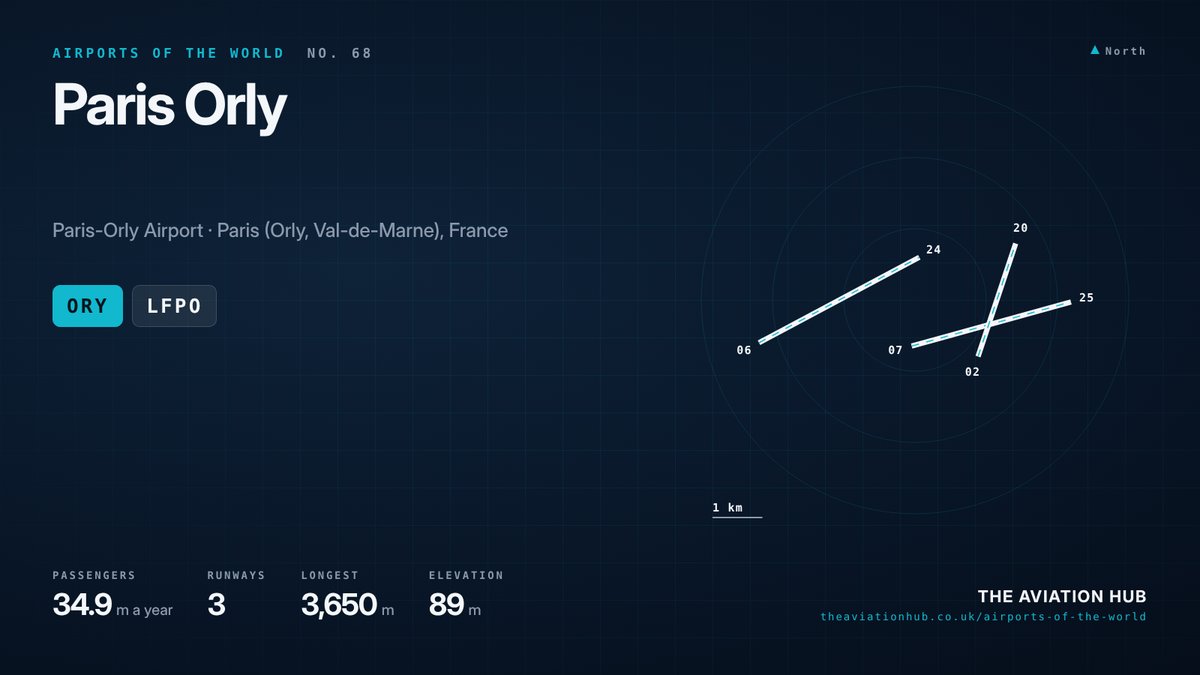
Paris Orly Airport has three runways. The longest, 06/24, is asphalt and measures 3,650 m (11,975 ft) by 45 m. Runway 07/25 is 3,320 m (10,892 ft) long and runs nearly parallel to it, offset to the southeast. The third, 02/20, is 2,400 m (7,874 ft) long with a 60 m width, and crosses Runway 07/25 on the eastern side of the field.
The two near parallel runways carry almost all the traffic. In the prevailing westerly wind, aircraft land on 25 and depart from 24, with arrivals streaming in over Villeneuve le Roi and the Seine. Easterly flow reverses the pattern to land on 06 and depart from 07. Runway 02/20 is used mainly when strong crosswinds or works close the others.
Movements are capped at 250,000 a year by government decree, and a curfew bans scheduled operations between 11.30 pm and 6 am. The curfew dates from 1968 and the cap from 1994, and together they explain why Orly’s growth has come from bigger aircraft rather than more flights, and why Transavia’s Boeing 737-800s and the Airbus A320neo family dominate the scene.
Terminals and Airlines
Orly 1 and Orly 2 are the former West Terminal, with gates lettered A, B and C. Air France used them for its domestic network until 2026, and Transavia France now runs its domestic flights from Orly 2. Orly 3, the 2019 junction building, holds gates D and E and is used by easyJet and Ryanair.
Orly 4 is the former South Terminal of 1961, with gates E and F. It handles much of the long haul flying, including Corsair and Air Caraibes on the Caribbean and Indian Ocean routes. Lounges are modest compared with Charles de Gaulle, and the whole complex can be walked end to end in about 15 minutes.
Routes and Destinations
Nice is the busiest route from Paris Orly Airport, a shuttle operated by Air France for decades and now dominated by easyJet and Transavia. Toulouse comes next, followed by Pointe a Pitre in Guadeloupe, which ranks as a domestic destination because it is part of France. Saint Denis de la Reunion and Fort de France complete the top five, and the Corsican airports of Ajaccio, Bastia and Figari are heavy, especially in summer.
Internationally, Madrid, Lisbon and Rome Fiumicino led in 2024, with Barcelona, Porto, Casablanca, Algiers and Tunis close behind. Long haul flying centres on the French overseas territories, with Fort de France, Saint Denis de la Reunion and Cayenne served by wide bodies. The longest nonstop sector is Corsair’s flight to Mauritius at around 5,850 miles (9,440 km), just ahead of Reunion, while French Bee continues to Papeete in Tahiti via San Francisco. La Compagnie’s all business class Airbus A321neos fly to New York Newark, and French Bee reaches San Francisco and Los Angeles.
Summer is the peak, driven by Mediterranean and North African leisure traffic. Cargo is minimal, since the freight business of the Paris region lives at Charles de Gaulle.
Getting to and from Paris Orly Airport
Metro Line 14 reached Paris Orly Airport in June 2024 and changed everything. The automated trains run from the Aeroport d’Orly station beneath the terminals via Gare de Lyon to Chatelet in about 25 minutes and continue to Madeleine and Saint Lazare. The airport fare is around €13, which still makes it the cheapest fast option. Tram T7 links Orly 4 to Villejuif Louis Aragon on Metro Line 7 for a standard fare and is the cheapest sensible option for anyone with time.
The older Orlyval people mover connects the terminals to Antony on RER B, useful for the southern suburbs. RATP bus 183 and several Noctilien night buses serve the airport. By road, the A106 spur leaves the A6 directly into the terminals, and a taxi to central Paris costs a fixed €36 to €44 and takes 30 to 50 minutes. Metro Line 18 is due to add an orbital link to Massy and Saclay from 2027.
Spotting and Photography
Paris Orly Airport has a long tradition of public viewing, and the panorama terrace on the fourth floor of Orly 4 overlooks the main aprons and runways. Outside the fence, the Villeneuve le Roi side near the 25 threshold gives close views of arrivals in westerly flow, and the Musee Delta in neighbouring Athis Mons displays a Concorde and a Mercure.
Morning light favours the Villeneuve le Roi side for westerly arrivals, while the terrace works best in the afternoon. Traffic is mostly Airbus A320 family and Boeing 737-800s, but the Airbus A350-900s of French Bee and Air Caraibes, Corsair’s A330-900s and the occasional Air Algerie or Royal Air Maroc Boeing 787 add weight. Transavia’s new Airbus A320neos and A321neos are replacing its 737s.
French police are relaxed about spotters on public ground but strict near the fence. Stay on footpaths, do not climb on street furniture and expect identity checks during security alerts.
What Comes Next
Growth at Paris Orly Airport is bounded by the movement cap and the curfew, neither of which the government intends to lift. Groupe ADP is instead investing in the terminal buildings, with Orly 1 and 2 being refreshed and more gates converted for larger aircraft. Air France’s retreat frees slots that Transavia, easyJet and Vueling have been quick to take, so the airport is becoming a low cost and leisure field with a long haul niche to the French overseas territories.
Orly will not challenge Charles de Gaulle, but as a convenient, metro connected airport close to the city it has a secure future. See where it sits among the European capitals on the Airports of the World map.
Continue to follow The Aviation Hub for more analysis and insight.
Advertise with us Your brand, in front of an aviation audience Home page and in-article placements, sold directly, one advertiser per slot. From £250 a year. See the rates

