
Patna Airport Guide: Bihar’s Gateway and Its Short Runway
Patna Airport, officially Jay Prakash Narayan Airport, pairs a new terminal with a famously tight runway. Read about its routes, access and future plans.
 By The Aviation Hub
5 min read
Updated October 20, 2026
Patna Airport, officially Jay Prakash Narayan Airport, is the main air gateway to Bihar, one of India’s most populous states. It sits inside the city, squeezed between a zoo and a railway line, and its short runway has shaped its story for decades. A large new terminal opened in 2025, and passenger numbers are climbing quickly. The challenge now is whether the airfield itself can keep up with demand.
Patna Airport at a Glance
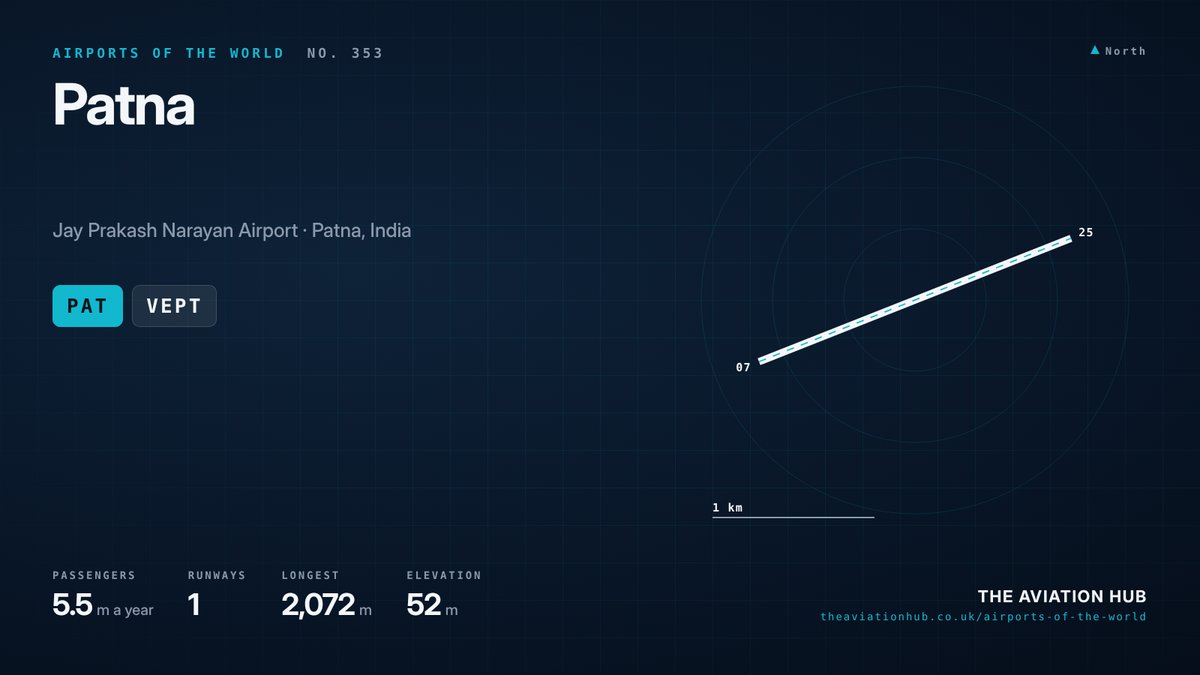
The airport carries the IATA code PAT and the ICAO code VEPT. It lies roughly 4 miles (7 km) south west of central Patna at an elevation of 52 m (170 ft). There is one asphalt runway, 07/25, and a single passenger terminal for domestic flights.
Patna Airport handled about 4.4 million passengers in the 2025 to 2026 financial year, up almost 15 per cent, with around 31,000 aircraft movements. IndiGo is the largest airline by a wide margin, followed by Air India, Air India Express and SpiceJet. The Airports Authority of India owns and operates the field. Flight information and passenger guidance are on the airport’s official website.
How Patna’s Airport Came to Be
The airport grew up on the western side of Patna, close to the Bailey Road corridor, long before the city spread around it. It carries the name of Jayaprakash Narayan, the independence activist and political leader from Bihar known as JP, who led a powerful opposition movement in the 1970s.
Two events from the turn of the century left their mark. On 17 July 2000 Alliance Air Flight 7412, a Boeing 737-200, crashed into a residential area near the airport while approaching to land, killing 60 people. Months earlier, in December 1999, the hijacking of Indian Airlines Flight 814 from Kathmandu led to the end of Nepal services. Patna Airport has had no scheduled international flights since, although it retains customs airport status.
For more than two decades the old terminal struggled with rising traffic. Work on a replacement began in October 2018, slipped during the pandemic, and the new building opened on 3 June 2025.
Runways at Patna Airport
Runway 07/25 is 2,072 m (6,798 ft) long and 45 m wide, with an asphalt surface, and displaced thresholds at both ends cut the distance available for landing. It is short for a state capital airport. Airbus A320neos and Boeing 737s operate, but often with weight restrictions, especially in the hot months before the monsoon.
Extension is effectively impossible. The Sanjay Gandhi Biological Park, Patna’s zoo, borders the field at one end, while the railway line near Phulwari Sharif station blocks the other. Tall trees in the zoo have long caused arguments over obstacle clearance. Pilots treat the field with respect, and airlines plan carefully when the runway is wet. Dense winter fog in December and January also disrupts schedules, as it does across northern India.
Terminals and Airlines
The new terminal at Patna Airport cost about ₹1,217 crore (roughly £110 million) and has 13 boarding gates, five aerobridges and 64 check in counters. Its two storey design draws on Madhubani folk art and the ruins of the ancient university at Nalanda. Annual capacity is about 10 million passengers, more than double current traffic. Digi Yatra biometric boarding has been available since July 2024.
IndiGo dominates, with flights to around 15 destinations using A320 family jets. Air India and Air India Express offer links to Delhi, Bengaluru and other cities, while SpiceJet flies Boeing 737s on several trunk routes. Alliance Air has also served the airport. With every flight domestic, alliance membership plays no role, and the terminal layout is simple to navigate.
Routes and Destinations
Delhi is the busiest route from Patna Airport by a long way, flown many times a day by IndiGo, Air India, Air India Express and SpiceJet. Mumbai, Bengaluru, Kolkata and Hyderabad are the other major routes, carrying business travellers and the large Bihari workforce employed in India’s major cities. Chennai and Ahmedabad complete the main network.
Demand peaks around Chhath Puja in October or November, when huge numbers of people return home to Bihar, and again around Diwali and Holi. Airlines add capacity and fares climb steeply at these times. Pilgrims bound for Bodh Gaya more often use Gaya airport to the south. A new domestic cargo terminal opened in February 2025, raising annual capacity from 7,500 to 22,000 tonnes.
Getting to and from Patna Airport
Patna Airport sits within the city, so road journeys are short when traffic allows. The drive to Gandhi Maidan and the old city centre takes around 20 to 40 minutes, and Patna Junction railway station is a similar distance. Prepaid taxis and app based cabs wait outside arrivals and are the most practical choice for visitors.
Auto rickshaws are the cheapest sensible option for light travellers, though they are less comfortable with luggage. A multilevel car park on the city side holds around 1,100 vehicles. Phulwari Sharif railway station lies just beyond the field, but there is no direct rail service to the terminal. Allow extra time at peak hours, since traffic on the approach roads can be heavy.
Spotting and Photography
Spotting at Patna Airport is limited by its urban setting and Indian security rules. Photography near airports is sensitive in India, and police and security staff may question anyone with a long lens near the perimeter. The safest views come from inside the new terminal, whose glazed departure areas overlook the apron.
The traffic mix is narrow, mostly IndiGo A320neos and A321neos alongside Air India and SpiceJet jets. The short runway makes landings interesting to watch, with crews braking firmly. Winter haze and fog limit photography for weeks at a time, while post monsoon clear days in October and November give the best light. Always carry identification and stop if asked.
What Comes Next
The new terminal solved the building problem but not the runway. The Airports Authority of India plans a civil enclave at Bihta Air Force Station, about 12 miles (20 km) away, where larger aircraft could operate. The Bihar government is acquiring around 126 acres for the project. A new 25 m control tower came into service at the existing field in December 2023.
Growth will continue as Bihar’s economy expands and more airlines add seats. Yet the runway caps how far Patna Airport can go in its current form, and Bihta looks like the long term answer for larger jets and international routes. Expect strong passenger growth and a gradual shift of heavier traffic once the new site is ready. See how it compares with other Indian airports on our Airports of the World map.
Continue to follow The Aviation Hub for more analysis and insight.
Advertise with us Your brand, in front of an aviation audience Home page and in-article placements, sold directly, one advertiser per slot. From £250 a year. See the rates

