
Bayan Lepas, on the south east corner of Penang Island, has hosted an airport since the days of the Straits Settlements. Penang Airport now handles more than eight million passengers a year and serves as the main air gateway for northern Peninsular Malaysia. It also moves a large share of the country’s electronics exports, thanks to the factories next door. A long awaited expansion is under way to ease a terminal that has outgrown its design capacity more than once.
Penang Airport at a Glance
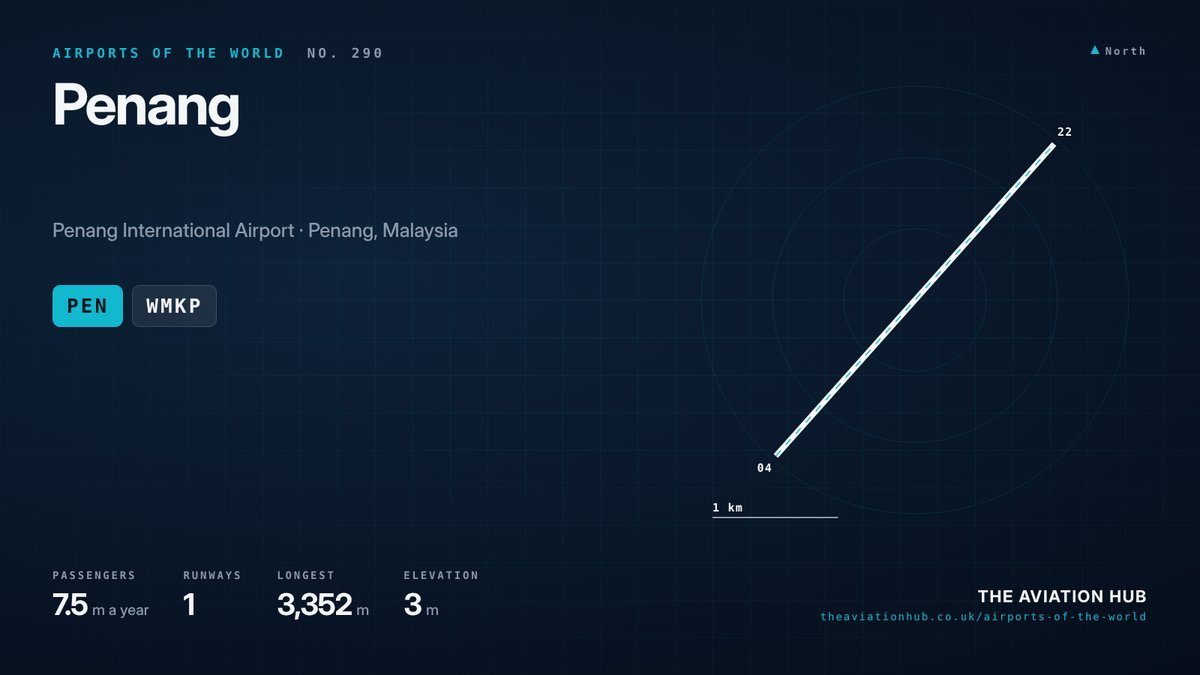
The IATA code is PEN and the ICAO code is WMKP. The airport lies about 10 miles (16 km) south of central George Town, at an elevation of just 3 metres (11 ft) above the Strait of Malacca. It has one runway and a single passenger terminal, alongside a large cargo complex serving the Bayan Lepas Free Industrial Zone.
Traffic reached about 8.3 million passengers in 2025, back level with the 2019 peak. Firefly uses the airport as its main hub, and AirAsia runs an operating base here. Malaysia Airports, the state backed operator of most Malaysian airports, manages the site. Flight schedules and expansion updates are posted on the airport’s official website.
How Penang’s Airport Came to Be
The airport was completed in 1935 as Bayan Lepas Airport, when Penang was part of the British Straits Settlements. Engineers built it on soft mudflats, which is why the early runways were laid in concrete for all weather use. Japanese forces attacked the field in December 1941 during the invasion of Malaya.
Major works in the 1970s added a new terminal in the Minangkabau style, with its distinctive upswept roof lines. The field became Penang International Airport in 1979. Four years later, in 1983, it made world headlines, when Australians Kevin Barlow and Brian Chambers were arrested in the terminal trying to smuggle heroin. Both were later hanged, a case that drew worldwide attention to Malaysian drug laws. Works finished in 1998 raised capacity to 3.5 million passengers a year. A later expansion completed in 2012 raised capacity to 6.5 million passengers a year, a figure traffic overtook within a few years.
Runways at Penang Airport
Penang Airport has a single asphalt runway, 04/22, which is 3,352 metres (10,997 ft) long and 46 metres wide. That length comfortably handles wide body freighters such as the Boeing 747-8F and 777F as well as the narrow body jets that make up most passenger flights. There is little room for a second runway, since the site is hemmed in by the sea, hills and the industrial zone.
The monsoons decide the runway in use. North easterly winds from roughly November to March favour runway 04, while the south west monsoon from around May to September brings more use of runway 22. Afternoon thunderstorms are common through much of the year. Apron space has been a constraint for years, with only 16 aircraft stands until the current upgrade.
Terminals and Airlines
All passenger flights use one terminal at Penang Airport, split into domestic and international areas. Firefly flies ATR 72 turboprops and Boeing 737s from its hub here, while AirAsia, Malaysia Airlines and Batik Air Malaysia connect the island with Kuala Lumpur and beyond. Singapore Airlines and Scoot join AirAsia and Batik Air on the Singapore route.
Foreign carriers include Cathay Pacific to Hong Kong, along with Chinese, Taiwanese, Thai and Indonesian airlines. Gulf links to Dubai, via Langkawi with flydubai, and to Doha, seasonally with Qatar Airways, give the island one stop connections to Europe. Malaysia Airlines and its oneworld partners are the main alliance presence, while the low cost carriers dominate the domestic gates.
Routes and Destinations
Kuala Lumpur is the dominant route, carrying about 2.2 million passengers in 2019 between Penang and KLIA. Flights to Subang, Kota Kinabalu, Kuching and Langkawi fill out the domestic map. Singapore is the strongest international route, with roughly 800,000 passengers in the first nine months of 2023 alone, which made it the third busiest route between Malaysia and another ASEAN country. Demand from Penang Airport to Singapore is driven by business travel, family ties and Singaporeans heading for the island on short breaks.
Bangkok, Jakarta, Medan, Hong Kong, Taipei and several Chinese cities follow. Chennai and Yangon add South Asian and Burmese links. Cargo is just as important. Penang ranks second in Malaysia for cargo tonnage after KLIA, handling roughly 100,000 tonnes a year, and its exports carried a value of about RM365 billion in 2023.
Getting to and from Penang Airport
Road is the only option for now. Rapid Penang runs four bus routes to the terminal, including the 401E to George Town, for a fare of a few ringgit. The ride to the heritage centre takes around an hour, depending on traffic. Grab, the regional ride hailing app, is widely used and takes about 30 to 40 minutes to George Town.
Prepaid taxi coupons are sold inside arrivals. Drivers heading for the mainland can use the Sultan Abdul Halim Muadzam Shah Bridge, which lands close to the airport and avoids the older Penang Bridge. Parking at Penang Airport is next to the terminal. The planned Mutiara light rail line, expected around 2031, will put a station near the airport.
Spotting and Photography
Penang Airport is a pleasant, warm place to watch aircraft. Public roads around the perimeter give views of arrivals, and the terminal car parks offer glimpses of the apron. Traffic is a lively mix of AirAsia A320neos, Firefly ATRs, regional jets from across Asia and heavy freighters serving the electronics industry.
Mornings are often the safer bet, since heavy afternoon storms can end a session early. Malaysian airports are security conscious. Stay on public land, avoid restricted signs and move on if asked by the authorities.
What Comes Next
The RM1.5 billion expansion is the big story. Works at Penang Airport began in October 2024 and aim to lift capacity to 12 million passengers a year by 2028. The project includes a larger terminal, an outlet mall developed with Mitsui and apron upgrades raising the number of aircraft stands from 16 to 28. The Mutiara light rail line should then close the transport gap early in the next decade.
Penang Airport has spent years running beyond its design capacity, and the new works should finally catch up with demand. Growth in electronics, tourism and regional flights all point upward. Explore other South East Asian gateways on the Airports of the World map.
Continue to follow The Aviation Hub for more analysis and insight.
Advertise with us Your brand, in front of an aviation audience Home page and in-article placements, sold directly, one advertiser per slot. From £250 a year. See the rates

