
Perth Airport lies about 6 miles (10 km) east of the city centre on flat land spanning the cities of Belmont, Kalamunda and Swan. It is the main gateway to Western Australia, the fourth busiest airport in the country and a field with an unusual blend of traffic. Boeing 787s fly nonstop to London, Airbus A330s shuttle to Singapore and Bali, and a vast fly in fly out workforce heads north to the iron ore and gas fields every morning. Around 14 to 17 million passengers a year use it, depending on how the regional charter traffic is counted.
Perth Airport at a Glance
The codes are PER and YPPH. The airport sits 20 m (67 ft) above sea level on the coastal plain between the city and the Darling scarp, with the Swan river to the west. It has two runways in service, a third under construction, and four passenger terminals split between two precincts on opposite sides of the field. The airport counted about 17.5 million passengers in the 2025 financial year including regional charters, against a calendar year figure of around 14.7 million.
Qantas, Virgin Australia and Virgin Australia Regional treat the city as a hub, and Jetstar, Alliance Airlines, Network Aviation, National Jet Express and Skippers Aviation all base aircraft here for the mining trade. Perth Airport Pty Ltd has run the field since 1997 under a 99 year federal lease, and it is owned by a group of Australian investment and superannuation funds. Terminal and transfer information is on the airport’s official website.
How Guildford Aerodrome Became Perth’s Airport
Perth’s first airfield was at Maylands beside the Swan river, a site that could never take large aircraft. The government chose land at Guildford in 1938, and the Royal Australian Air Force used it through the Second World War. Civil flights began in 1944 when Qantas and Australian National Airways moved in, and Guildford Aerodrome became Perth Airport in 1953, a year after it gained international status. Maylands closed in 1963.
Two early accidents marked the field. A MacRobertson Miller Airlines DC-3 crashed after take off in 1949, killing all 18 on board, and an Australian National Airways DC-4 came down near York in 1950 with 28 dead. The jet era brought longer runways and, in 1986, the international terminal on the eastern side along with a control tower that remains the tallest in Australia.
Privatisation under a 99 year lease followed in 1997. Terminal 2 for regional airlines opened in 2013 and the Virgin Australia domestic pier at Terminal 1 in 2015, starting the long consolidation on the eastern side. Qantas launched its nonstop Boeing 787-9 service to London Heathrow in March 2018, and Paris and Rome have since followed, Rome on a seasonal basis.
Runways at Perth Airport
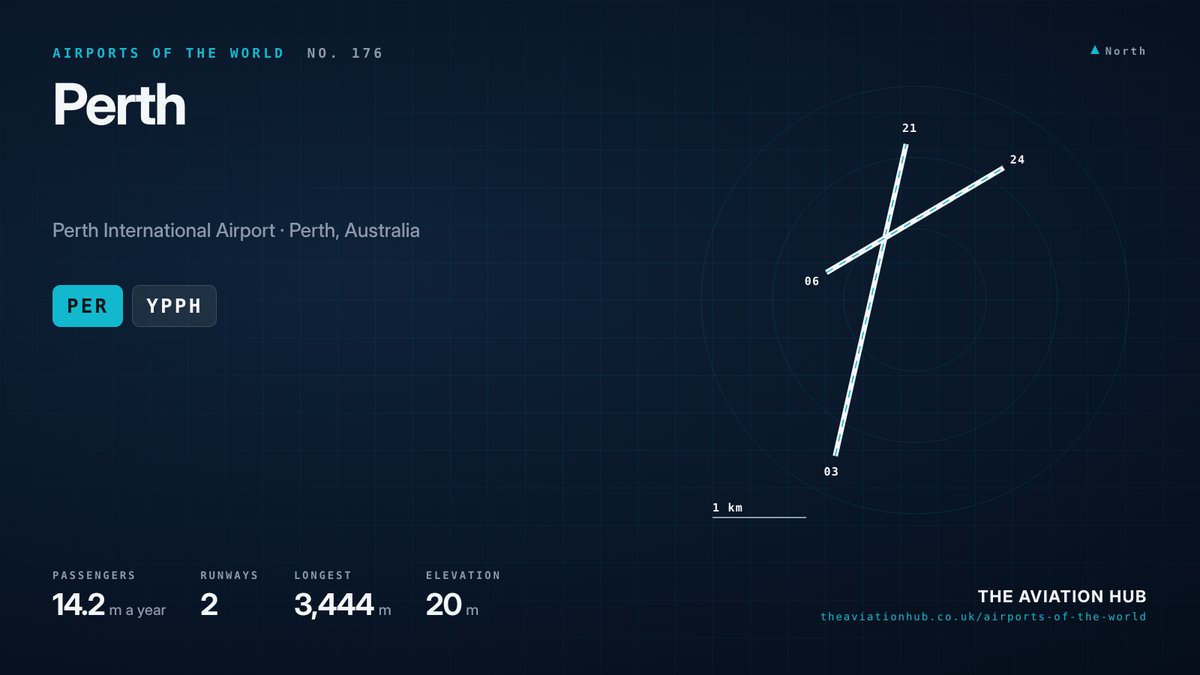
The main runway 03/21 is 3,444 m (11,299 ft) long and 45 m wide with an asphalt surface, running from southwest to northeast across the whole site. The crossing runway 06/24 is 2,163 m (7,096 ft) by 45 m, also asphalt, and serves crosswind conditions. It was rebuilt in 2005 to take wide bodies up to the Airbus A380. The Qantas 787 bound for London needs a long take off run on hot evenings.
Perth’s wind is famously regular. On summer afternoons the sea breeze known as the Fremantle Doctor blows in from the southwest and runway 21 takes over, with arrivals from the northeast over the hills. Winter northerlies and morning conditions favour runway 03 with its approach over the southern suburbs. Strong easterlies off the desert bring 06 into use.
A third runway, designated 03R/21L and 3,000 m long, started construction in December 2025 after decades of planning and is due to open in 2029 at a cost of around A$1 billion. It will allow simultaneous operations and end the morning crush when mining charters and east coast departures compete for one strip. Noise over the eastern suburbs remains a constant complaint at Perth Airport.
Terminals and Airlines
Terminal 1 on the eastern side handles most international flights, with Singapore Airlines, Qatar Airways, Emirates, Cathay Pacific, Malaysia Airlines, AirAsia, Garuda, South African Airways and Air New Zealand among its users, and it includes the domestic pier used by Virgin Australia since 2015. Terminal 2 next door opened in 2013 for regional airlines and takes Virgin Australia Regional, Alliance and Rex, plus Jetstar’s domestic flights since 2024. Airport Central railway station sits between them.
Terminals 3 and 4 on the western side belong to Qantas. T4 handles Qantas and QantasLink domestic flights and Qantas international check in, while T3 holds the customs and immigration facilities for the Qantas international services to London, Paris, Singapore and Bali, along with some domestic flights. The two precincts are about 7 miles (11 km) apart by road and a free transfer bus links them, so connections between Qantas and anyone else need extra time.
Routes and Destinations
Melbourne, Sydney and Brisbane are the busiest routes, each flown many times a day by Qantas, Virgin Australia and Jetstar and each well over three hours. Adelaide and Darwin follow. The regional network is remarkable, with Qantas Network Aviation Fokker 100s and Airbus A320s, Virgin Australia Regional 737s and Alliance Embraer E190s carrying mine workers to Karratha, Port Hedland, Newman, Paraburdoo and Kalgoorlie on weekly rosters.
Singapore, Denpasar and Kuala Lumpur lead the international table, with Doha, Dubai, Hong Kong, Johannesburg and Auckland among the other main routes. London Heathrow, at roughly 9,000 miles (14,500 km) and about 17 hours, is the longest route and the reason the city sells itself as the western gateway to Australia. Qantas also flies to Paris and adds Rome in the northern summer. Cargo is modest, mostly belly freight of seafood, fresh produce and mining spares.
Getting to and from Perth Airport
The Airport Line, opened in October 2022, is the cheapest sensible option. Airport Central station lies a short covered walk from Terminals 1 and 2 and trains reach Perth station in about 18 minutes for a standard Transperth fare. Redcliffe station on the same line serves Terminals 3 and 4, though it is nearly 1 km from the Qantas terminals, and Transperth bus 292 covers the gap.
By road the Tonkin and Roe highways run either side of the field, with Airport Drive serving T1 and T2 and Dunreath Drive and Brearley Avenue serving T3 and T4. A taxi to the city centre takes 20 to 30 minutes and costs around A$45 (£23), with ride share collected from marked bays. SkyBus has run the transfer coaches since November 2025. Multistorey and long stay car parks serve both precincts.
Spotting and Photography
Perth Airport provides a public viewing area off Dunreath Drive near the runway 03 threshold, with a shelter shaped like a Boeing 747 fuselage, and it is the easiest place for a first visit. The T1 observation deck on level 3 overlooks the international apron. The roads around the northern end of runway 03/21 near Guildford catch arrivals on 21 under the afternoon sea breeze, while the southern approach to 03 passes over industrial estates.
Qantas 787-9s, Singapore Airlines A350-900s and 777-300ERs, Qatar and Emirates wide bodies, Fokker 100s still working the mines and a steady flow of 737s and A320neos pass through daily. Morning light suits the eastern side and the afternoon sun lights the T1 apron from the west. Keep off the perimeter road, obey the signs around the new runway construction site and do not fly drones, which are banned near the field.
What Comes Next
The next decade reshapes everything. Besides the third runway, Qantas is due to move from the western precinct into a new terminal at Airport Central by 2031 as part of an investment the airport values at around A$5 billion, finally putting every airline on one side of the field. The programme also covers new multi storey car parks and a hotel.
Perth Airport is spending its way out of a divided layout and into a single hub for the Indian Ocean rim and the mines of the Pilbara. Compare it with Sydney, Melbourne and Brisbane on the Airports of the World map.
Continue to follow The Aviation Hub for more analysis and insight.
Advertise with us Your brand, in front of an aviation audience Home page and in-article placements, sold directly, one advertiser per slot. From £250 a year. See the rates

