
Philadelphia Airport Guide: American’s Transatlantic Hub
Philadelphia Airport is American Airlines' main gateway to Europe and the busiest in Pennsylvania. Read about its runways, terminals and spotting.
 By The Aviation Hub
7 min read
Updated October 20, 2026
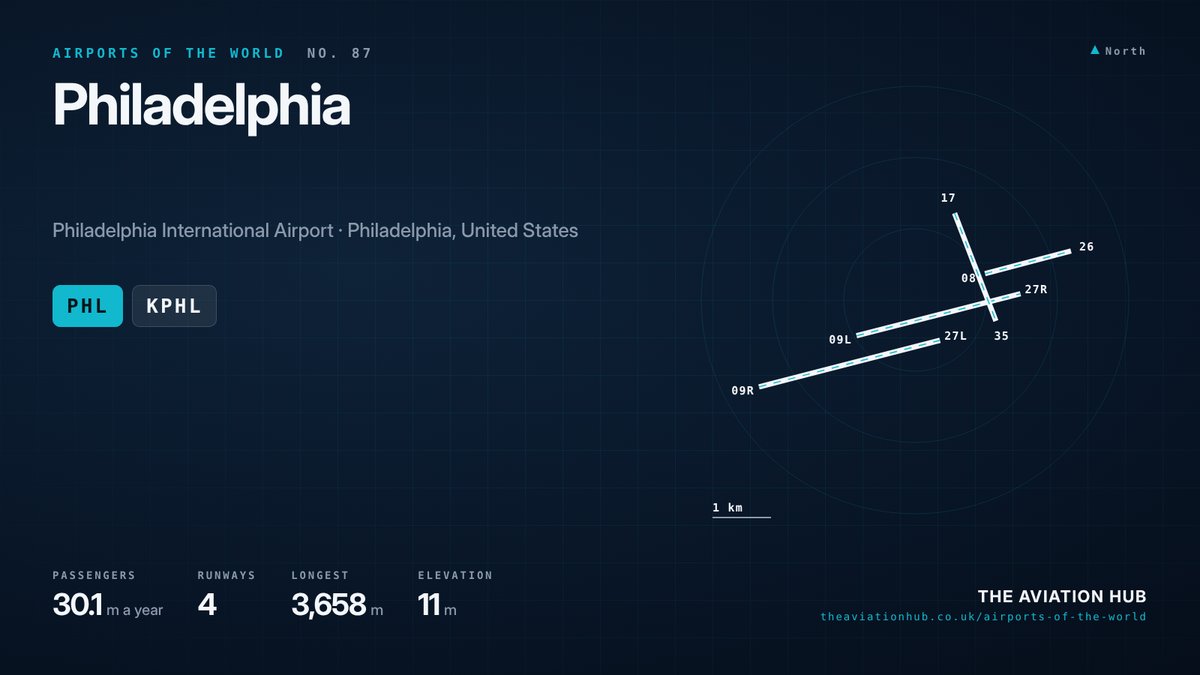
Philadelphia International Airport is the busiest airport in Pennsylvania and American Airlines’ main gateway between the United States and Europe. It sits on the Delaware River about 7 miles (11 km) south west of Center City, hemmed in by Interstate 95, the river and the old Hog Island shipyard. Around 30 million passengers used Philadelphia Airport in 2025. Four runways, seven terminal buildings and a large UPS cargo hub make it a crowded and complicated field that spotters know well from the Delaware shoreline.
Philadelphia Airport at a Glance
The codes are PHL and KPHL. The field lies at 36 ft (11 m) above sea level on flat reclaimed land along the Delaware, 7 miles (11 km) from City Hall. Part of the property crosses into Delaware County, and the river forms the southern boundary.
Philadelphia Airport has four runways and terminals lettered A to F with around 126 gates. The 2025 total was about 30.1 million passengers, slightly down on 2024 and still short of the 2019 peak of 33 million. American Airlines carries nearly half of all traffic and runs its primary north east hub here. Frontier treats it as a focus city and UPS runs a regional cargo hub. The City of Philadelphia owns and operates the airport through its Department of Aviation. Parking and flight information is on the airport’s official website.
How Philadelphia’s Airport Came to Be
The Pennsylvania National Guard began flying from the Hog Island site in 1925, and Charles Lindbergh dedicated it as Philadelphia Municipal Airport in 1927. Airlines ignored it for years and used Camden Central Airport across the river in New Jersey instead. A proper terminal finally opened on 20 June 1940, and the carriers moved across.
In 1945 American Overseas Airlines began direct flights to Europe and the city renamed the field Philadelphia International Airport. The terminal that became Terminals B and C opened in 1953 and is still in use. Terminals D and E followed in 1973 and 1977. Terminal A opened in 1990 for international flights, and the A West extension with its wide body gates arrived in 2003.
US Airways made Philadelphia its transatlantic base through the 1990s and 2000s, and the merger with American in 2013 cemented that role. Runway 17/35 was extended in 2009 and the main runway 09R/27L was lengthened to 12,000 ft in 2019 to handle heavier long haul departures.
Runways at Philadelphia Airport
Runway 09R/27L is the main strip at 3,658 m (12,000 ft) long and 61 m (200 ft) wide, running along the river on the south side of the field. Its 2019 extension made it the longest civil runway in Pennsylvania and gave American’s Airbus A330 and Boeing 787 fleets full payload to Europe in summer heat. Runway 09L/27R is its parallel partner at 2,896 m (9,500 ft) long and 46 m (150 ft) wide, sitting closer to the terminals.
Runway 17/35 crosses the field at 1,981 m (6,500 ft) and is used mainly for regional jet departures and arrivals, which keeps the parallel pair free for larger aircraft. Runway 08/26 is a short 1,524 m (5,001 ft) commuter strip on the north east side. All four are asphalt.
The airport normally runs on the 27 ends with arrivals over the river, switching to the 09s when the wind turns east. The close spacing of the parallels and the crossing runway make Philadelphia Airport one of the more delay prone fields in the north east, especially in summer thunderstorms. A 1970 United 737 engine failure here was the first hull loss of the type, with no fatalities.
Terminals and Airlines
Terminal A is the international building. A West handles American’s long haul fleet, British Airways and Lufthansa’s Discover Airlines, while A East takes Aer Lingus, Aeromexico and international arrivals for Frontier. Terminals B and C are the heart of the American operation, linked to A by walkways and housing most of the domestic mainline flights. Terminal F, opened in 2001, is the regional terminal for American Eagle flights and is reached by shuttle bus or a long walk.
Terminal D serves Air Canada, Delta and United. Terminal E hosts Southwest, Frontier and Allegiant, plus check in for Alaska, JetBlue and Sun Country. All the terminals connect airside, so passengers can walk between most gates without clearing security again. American runs its Admirals Club lounges in A West, B and C, and the Flagship Lounge in A West serves the transatlantic departures.
The airport ranked last among large US airports in a 2023 J.D. Power satisfaction survey, and the city has since put money into bathrooms, air conditioning and the ageing B and C buildings.
Routes and Destinations
Orlando is the busiest domestic route at more than 850,000 passengers a year, followed by Atlanta and Chicago O’Hare. Dallas Fort Worth, Boston, Charlotte, Miami and Denver are all heavy. American’s hub bank structure means a huge flow of connecting traffic between the north east and Florida, the Caribbean and the Midwest.
London Heathrow is the top international route at around 458,000 passengers, with Cancun close behind and Punta Cana third. American flies from Philadelphia Airport to Dublin, Lisbon, Madrid, Barcelona, Rome, Athens, Paris, Amsterdam, Zurich and Venice, while Qatar Airways’ Doha service, which resumed in August 2026, is the longest at around 6,800 miles (10,900 km). Summer is the transatlantic peak, winter the Caribbean peak. UPS freighters fill the cargo apron each night.
Getting to and from Philadelphia Airport
SEPTA’s Airport Line is the cheapest and simplest option. Regional rail trains stop at four stations along the terminals and reach Center City in about 25 minutes, running every 30 minutes on weekdays and hourly at weekends from 5am to midnight. A single fare costs around $7 (£5.50).
Interstate 95 passes the front door via exits 12 and 12A, and Route 291 gives a back way in. Driving to the city centre takes 15 to 30 minutes depending on traffic. Taxis charge a flat fare of around $32 to Center City, and rideshares cost slightly less. SEPTA bus routes 37, 108 and 115 serve the terminals too.
Short term garages sit opposite each terminal, with economy parking served by shuttle. American’s Landline coach service links the airport with several cities in the region as a feeder for connecting passengers.
Spotting and Photography
Philadelphia Airport is a spotter friendly field thanks to its river frontage. Fort Mifflin, the Revolutionary War fort on the Delaware just east of the airport, sits under the approach to runway 27R and is the classic location when the airport runs west. The park at Heinz National Wildlife Refuge on the northern edge gives views across the field.
On the New Jersey side, the river bank at National Park and Red Bank Battlefield looks straight across the water at the 27L and 27R thresholds and the long haul departures. The cell phone lot and the upper levels of the terminal garages overlook the ramps. Morning light favours the New Jersey bank and afternoon light the Fort Mifflin side.
Airport police patrol the perimeter road regularly and will stop anyone parked near the fence. Use the public parks and the river banks, carry identification and move on when asked.
What Comes Next
The big project is a consolidated rental car centre, which will clear the surface lots and simplify the chaotic terminal roadway. A long running capacity programme studied adding runway space along the river, but so far only the runway extensions have been built. Instead the city is spending on the existing terminals, with federal money for electrical and climate systems and a rolling refurbishment of B and C.
American’s commitment is the key variable. The airline has pulled back some European routes in recent years while adding others, and the hub’s future depends on how it balances Philadelphia with New York and Charlotte.
Philadelphia Airport is a hard working hub with tired buildings and an excellent location, and the next decade will decide whether it modernises or stagnates. See how it ranks against the other US gateways on the Airports of the World map.
Continue to follow The Aviation Hub for more analysis and insight.
Advertise with us Your brand, in front of an aviation audience Home page and in-article placements, sold directly, one advertiser per slot. From £250 a year. See the rates

