Phnom Penh Airport today means Techo International Airport, which opened on 9 September 2025 and replaced the old field at Pochentong. It lies on former farmland about 14 miles (23 km) south of the Cambodian capital. A 4,000 m runway and a terminal by Foster + Partners give the city a gateway built for the Airbus A380. The airport handled about 2.4 million passengers in the first half of 2026, and the government wants it to become a regional hub.
Phnom Penh Airport at a Glance
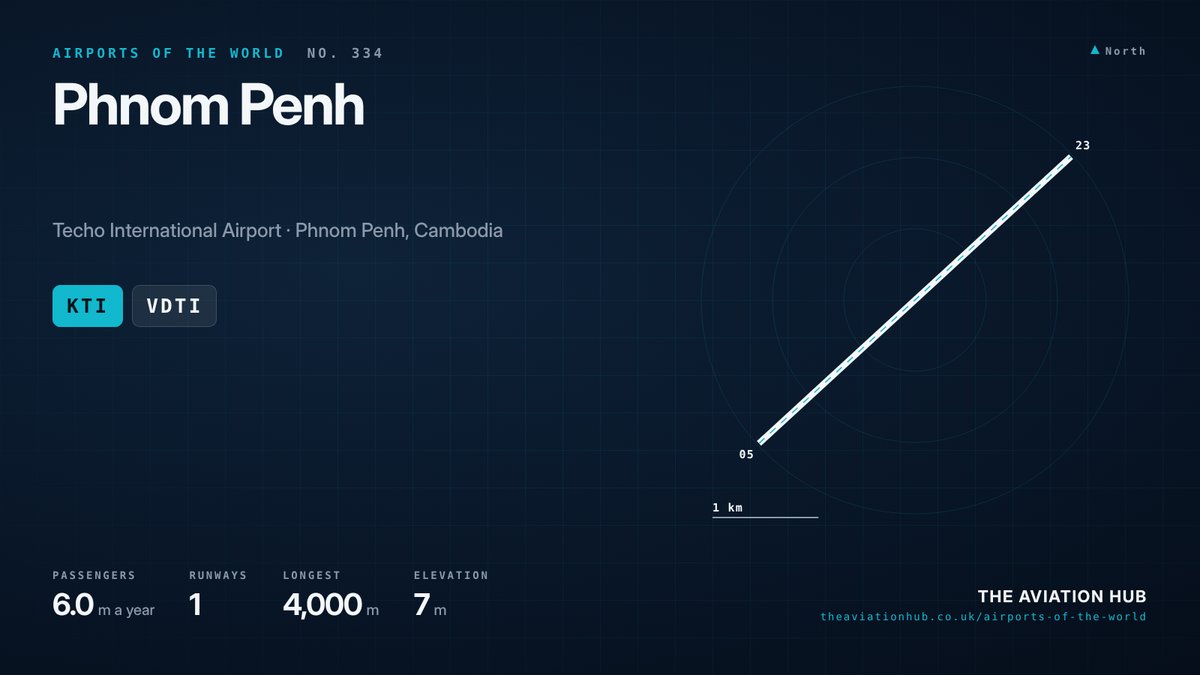
The airport carries the IATA code KTI and the ICAO code VDTI. It sits in Kandal Stueng district of Kandal province, and the 2,600 hectare site reaches into neighbouring Takeo. The elevation is just 7 m (22 ft). One runway and one terminal serve the field for now.
Cambodia Airport Investment, known as CAIC, owns Phnom Penh Airport. The Overseas Cambodian Investment Corporation holds 90 per cent and the State Secretariat of Civil Aviation the rest. Cambodia Airports, part of VINCI Airports, runs the site under a management contract. Flight times and transport details are on the airport’s official website.
The airport handled about 1.67 million passengers between opening and the end of 2025. Air Cambodia, Cambodia Airways and Sky Angkor Airlines use it as a hub, AirAsia Cambodia has a base here, and Vietnam Airlines treats it as a focus city.
How Phnom Penh’s New Airport Came to Be
For more than six decades the capital relied on Pochentong, formally Phnom Penh International Airport, which opened in 1959. Its single 3,000 m runway sat inside a growing city, with housing and factories close to the fence. Traffic peaked at just over 6 million passengers in 2019, and there was no room to grow.
The government announced a new airport in January 2018, and work began in 2019 on farmland in Kandal. China Development Bank pulled out of a planned loan in 2021, so CAIC turned to local bond investors. The early estimate of US$1.5 billion grew, and officials now quote about US$2.3 billion including supporting infrastructure. Hundreds of families were displaced, and many protested that compensation was too low.
Hun Sen announced the name in December 2021. Techo is a title the king once gave to army commanders. Pochentong handled its final scheduled flights on 8 September 2025. The next morning Air Cambodia flight K6611 from Guangzhou became the first scheduled arrival at the new Phnom Penh Airport. Prime Minister Hun Manet held the official inauguration on 20 October 2025. He has pledged to turn the old site into a public park, although a logistics hub is also under study.
Runways at Phnom Penh Airport
Phnom Penh Airport has a single concrete runway, 05/23. It is 4,000 m (13,123 ft) long and 60 m (197 ft) wide, which is 1,000 m longer than the runway at Pochentong. It runs from southwest to northeast, with two parallel taxiways, and the full length is available in both directions.
Both ends have an instrument landing system and 900 m of approach lighting, and the runway is suitable for Category II operations. The airport is built to Code 4F, so it can take the A380 and the Boeing 747-8. Southwesterly winds in the wet season, from May to October, tend to favour runway 23. The drier northeasterly flow from November to March tends to bring runway 05 into use.
Terminals and Airlines
Foster + Partners designed the terminal. A five storey head house connects to a northern pier, and together they cover more than 230,000 square metres. The roof rests on structural trees that each span 36 m, and romduol trees, which bear Cambodia’s national flower, grow in the central void. A southern pier will follow in a later phase, and the first phase provides 75 aircraft stands.
All airlines share the one building. Air Cambodia, formerly Cambodia Angkor Air, is the flag carrier and flies Airbus A320 family jets and ATR 72-600 turboprops. Cambodia Airways, Sky Angkor Airlines and AirAsia Cambodia complete the local line up. Star Alliance members include Singapore Airlines, Thai Airways, EVA Air and Turkish Airlines. SkyTeam brings Vietnam Airlines, Korean Air and China Eastern, while oneworld has Cathay Pacific, Malaysia Airlines and Qatar Airways.
Routes and Destinations
Bangkok has the widest choice of airlines from Phnom Penh Airport, with services to both Suvarnabhumi and Don Mueang. Ho Chi Minh City, Hanoi, Singapore and Kuala Lumpur are the other core regional links. China is a major market, with flights to Guangzhou, Shenzhen, Shanghai, Chengdu, Beijing and Xiamen among others. Seoul, Taipei, Hong Kong and Manila complete the regional picture.
Domestic flying is thin. Siem Reap, the gateway to Angkor Wat, is the main domestic route, and Cambodia Airways added two daily ATR 72-600 rotations in June 2026. Air Cambodia also flies to Delhi and, via Fuzhou, to Tokyo Narita.
Etihad Airways began flying from Abu Dhabi on 3 October 2025 with the Airbus A321LR. Emirates and Qatar Airways reach Dubai and Doha with intermediate stops. Turkish Airlines arrived in December 2025 from Istanbul, roughly 5,000 miles (8,000 km) away, with a stop in Bangkok. Traffic peaks in the dry season from November to April, and freighters from Emirates SkyCargo, Qatar Airways Cargo and Cathay Cargo carry cargo.
Getting to and from Phnom Penh Airport
The Airport Express Bus is the cheapest sensible option. Phnom Penh City Bus runs it daily from 5:30 to 23:30, roughly every 10 to 20 minutes, from the Kouch Kanong roundabout bus station. It runs along Monivong Boulevard and Hun Sen Boulevard. The fare is 1,500 riel (about 30p) and the trip takes about an hour.
Taxis and Grab or PassApp rides serve the terminal. A car takes roughly 30 to 40 minutes to the centre outside rush hour, and longer at peak times. Expect to pay around US$10 to US$25 (roughly £8 to £19), and agree the price first in a street taxi. A new access road joins Hun Sen Boulevard and National Road 2, and regular and premium car parks sit beside the terminal.
There is no rail link yet. Officials have studied a light rail or metro line, but no route has been approved. Anyone flying from Phnom Penh Airport should leave a generous margin for traffic.
Spotting and Photography
Phnom Penh Airport has no public viewing terrace that the operator has publicised so far. Airside gate areas overlook the apron, which gives departing passengers a good look at the traffic. The field sits in flat, low lying farmland, so the approaches cross open country. A long lens helps, as the perimeter is wide.
Variety is the main draw. Expect A320 family jets, ATR 72-600s on domestic work and long haul visitors from the Gulf and Turkey. Cathay Pacific parked several aircraft here during Typhoon Ragasa in September 2025. The dry season brings the clearest skies, while wet season afternoons bring storms and haze.
The land around the airport was the subject of bitter compensation disputes, so be considerate towards residents. Keep to public roads, never lean equipment against fences, avoid photographing security posts and leave at once if police or guards ask.
What Comes Next
Phase one is sized for 13 to 15 million passengers and 175,000 tonnes of cargo a year. Phase two would add the southern pier and a second 4,000 m runway, lifting capacity to about 30 million passengers. A third phase, with a third runway and another terminal, targets 50 million passengers a year around 2050.
The short term challenge is demand. Passenger numbers across Cambodian airports fell about 9 per cent in the first seven months of 2026, and Thai AirAsia halved its Bangkok frequency. Air Cambodia is betting on growth, with an order for up to 20 Boeing 737 MAX 8s.
Phnom Penh Airport now has the room for long haul growth that Pochentong never had, and the next test is filling it. Compare it with its neighbours on the Airports of the World map.
Continue to follow The Aviation Hub for more analysis and insight.
Advertise with us Your brand, in front of an aviation audience Home page and in-article placements, sold directly, one advertiser per slot. From £250 a year. See the rates