Phoenix Airport, known to everyone as Sky Harbor, is the busiest airport in the American south west outside Los Angeles and Las Vegas. It sits remarkably close to the city, barely 3 miles (5 km) east of downtown Phoenix, and handled around 51.6 million passengers in 2025. American Airlines runs one of its largest hubs here and Southwest has an enormous base, which makes the field a Boeing 737 and Airbus A321 factory in motion. Clear desert skies and a mountain backdrop make it one of the most photogenic big airports in the country.
Phoenix Airport at a Glance
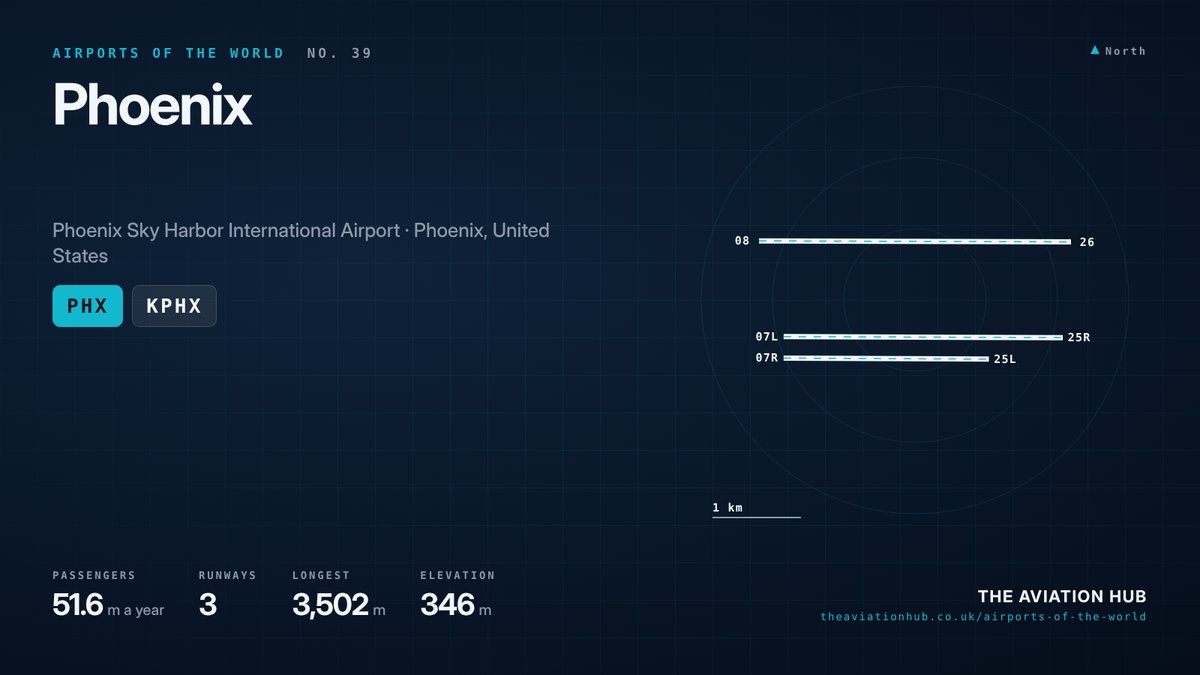
The airport carries the IATA code PHX and the ICAO code KPHX. It occupies a long east to west site beside the Salt River at an elevation of 1,135 ft (346 m), close enough to downtown that the skyline fills the windows of Terminal 4. Three parallel runways serve two terminals, numbered 3 and 4, with 119 active gates between them. The City of Phoenix owns and operates the airport through its Aviation Department.
Traffic in 2025 was around 51.6 million passengers, slightly down on the record 52.3 million of 2024, placing Phoenix Airport among the dozen busiest in the United States. American carried roughly 40 per cent of passengers and Southwest about a third. Frontier also keeps a base here, and the Arizona Air National Guard flies Boeing KC-135R tankers from an enclave on the south side. Flight information and parking rates are on the airport’s official website.
How Sky Harbor Came to Be
The name predates the city’s involvement. J. Parker Van Zandt, owner of Scenic Airways, bought 278 acres of farmland east of Phoenix in November 1928 as a winter base for his sightseeing flights and called the field Sky Harbor. Maddux Air Lines started the first scheduled passenger service in February 1929. The city bought the airport from its then owners in 1935 for 100,000 dollars.
Growth after the war brought a proper terminal in 1952, which became Terminal 1 and has long since gone. Terminal 2 opened in 1962, Terminal 3 in 1979 and the vast Terminal 4 in 1990, named for Senator Barry Goldwater. When Goldwater died in 1998 the mayor proposed renaming the whole airport after him, but public attachment to the Sky Harbor name proved overwhelming and the idea was dropped.
America West built its hub here in the 1980s and 1990s, merged with US Airways in 2005 and then with American in 2013, which is how American inherited the operation. Terminal 2 closed in February 2020 and was demolished the following year. Terminal 3 was renamed for Senator John McCain in January 2021 after a renovation, and the third control tower, 326 ft tall, opened in 2007.
Runways at Phoenix Airport
Three parallel runways run east to west across the site, all of grooved concrete and all 46 m wide. The northern runway, 8/26, is the longest at 3,502 m (11,489 ft). The southern pair are closer together. Runway 7L/25R measures 3,139 m (10,300 ft) and 7R/25L is 2,377 m (7,800 ft). All three are rated for aircraft of 900,000 lb and more, so the Boeing 777s and 787s on the London and Taipei routes have no trouble.
Operations normally run with arrivals on the outer runways and departures from the centre, with the direction set by the wind. Easterly operations on the 7s and 8 are typical in the morning, and the field usually turns to westerly flow on the 25s and 26 around midday. Heat is the real operational quirk at Phoenix Airport. On the hottest days, when temperatures pass 118F (48C), the thin air cuts aircraft performance and in June 2017 American cancelled dozens of regional jet flights because their performance charts stopped at 118F. A haboob dust storm in August 2025 briefly cut visibility to zero.
Terminals and Airlines
Terminal 4 is where almost everything happens. It has eight concourses lettered A to D on the north and south sides, with American occupying the A and B gates and Southwest in the C and D concourses, including the S2 pier added in 2004. The final concourse, with gates D11 to D18, was added to the south side in a project that began in 2019. International arrivals clear customs here, and British Airways, Starlux, China Airlines, Volaris and WestJet all use the building.
Terminal 3, the John McCain terminal, serves Delta, United, Alaska, Frontier, JetBlue, Air Canada and the smaller carriers. It was fully modernised in a programme that finished in January 2020 and has a quieter, more modern feel than its neighbour. The PHX Sky Train links the two terminals and the car parks, so a transfer between airlines takes about ten minutes. The site of the old Terminal 2 at the western end now holds bus served remote stands.
Routes and Destinations
Denver is the busiest route with almost 1.2 million passengers in 2025, followed by Seattle, Chicago O’Hare, Dallas Fort Worth and Los Angeles. American’s hub schedule reaches across the country and into Mexico, while Southwest’s point to point network blankets the west. Phoenix Airport also feeds the winter resort trade, with heavy traffic from the Midwest and Canada between November and April.
San Jose del Cabo in Mexico is the largest international market, then London Heathrow, which British Airways and American both serve, and Calgary. The longest route by distance is Taipei, launched by China Airlines in December 2025 with Starlux following in 2026, the first nonstop links between Phoenix and Asia at around 7,000 miles (11,300 km). Summer brings the quietest months as the heat drives tourists away. Cargo is modest and dominated by the integrators.
Getting to and from Phoenix Airport
The PHX Sky Train is the key. It runs from the 44th Street and Washington light rail station through the East Economy car park to Terminals 4 and 3, and since December 2022 it continues west to the Rental Car Center. The Valley Metro light rail connects to the Sky Train by a moving walkway bridge over Washington Street. Downtown is about 15 minutes away by train for a few dollars, which makes it the cheapest sensible option.
East Sky Harbor Boulevard links the terminals to Interstate 10, State Route 143 and the Loop 202, and the drive downtown takes ten minutes outside the rush hour. Taxis and ride hailing pick up at designated kerbs and cost around 20 to 30 dollars to central Phoenix or 40 dollars to Scottsdale. Valley Metro buses on Routes 44 and 13 serve the Sky Train stations. Parking ranges from cheap economy lots on the Sky Train to covered garages beside the terminals, which matter in July.
Spotting and Photography
Phoenix Airport is one of the easiest big hubs in America to photograph. The Terminal 3 Sky Train station looks over the centre and south runways, the guideway bridges an active taxiway, and the top levels of the Terminal 3 and Terminal 4 garages are official public viewing areas. Outside the fence, the East Economy garage roof catches 26 arrivals on short final, and the Salt River area to the south offers the approach to 25L.
Spots that look north, such as the Salt River, have good light for most of the day, although summer evenings are backlit. The Papago Buttes and Camelback Mountain make a fine backdrop on westerly days. Summer temperatures make midday spotting dangerous, so carry water and work the early morning. Stay on public roads, do not stop on Sky Harbor Boulevard, and keep away from the Air National Guard ramp on the south side where photography is unwelcome.
What Comes Next
The next big project is a new terminal on the western end of the site where Terminal 2 stood. Announced in April 2024, it will include a customs facility and is designed for net zero emissions, with ground breaking planned for 2029 and opening around 2033. A 36 million dollar overhaul of the Terminal 4 cooling plant is under way, which says a lot about the local climate.
Growth is capped by the runways rather than the terminals, and there is no space for a fourth. The city has studied a second airport at Mesa Gateway for decades, and Allegiant and a few others already fly from there. Phoenix Airport is heading towards 55 million passengers with new Asian routes and a steadily rising international share. Compare it with the rest of the American hubs on the Airports of the World map.
Continue to follow The Aviation Hub for more analysis and insight.
Advertise with us Your brand, in front of an aviation audience Home page and in-article placements, sold directly, one advertiser per slot. From £250 a year. See the rates