
Phuket Airport Guide: Thailand’s Island Holiday Gateway
Phuket Airport is Thailand's busiest international gateway outside Bangkok, a single runway field beside Mai Khao beach. Terminals, routes and spotting.
 By The Aviation Hub
7 min read
Updated October 20, 2026
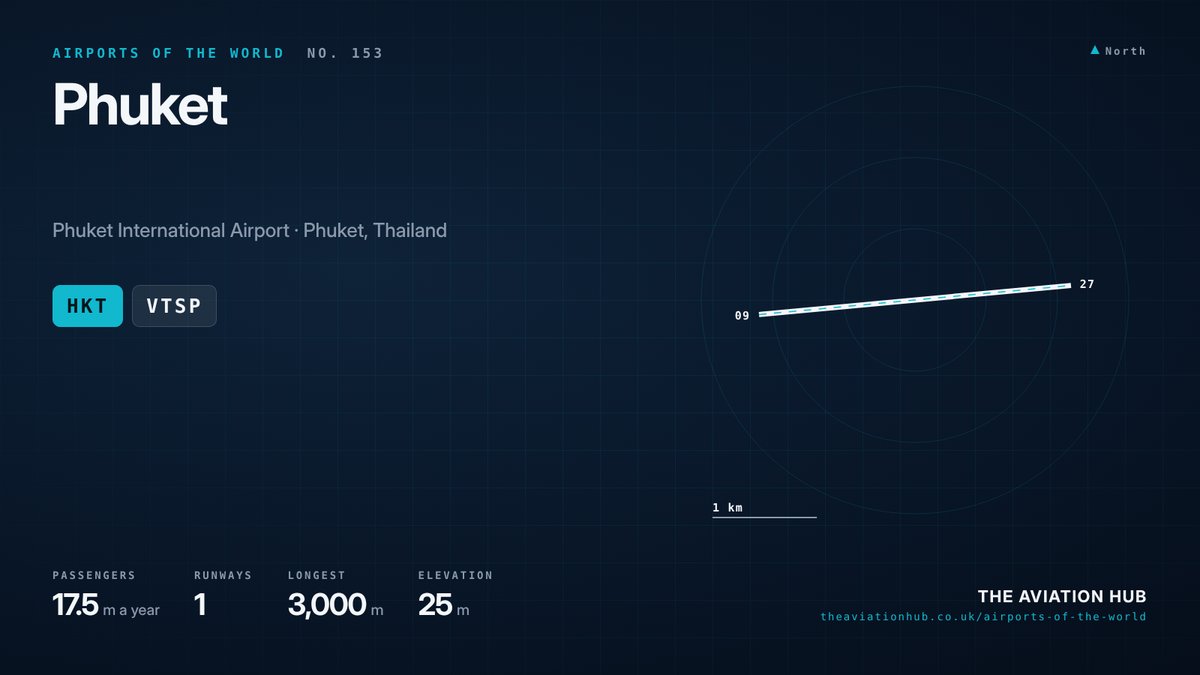
Phuket Airport sits at the northern tip of Thailand’s largest island, in the Mai Khao subdistrict of Thalang, about 20 miles (32 km) north of Phuket town. It is the main gateway to the Andaman coast and the busiest international airport in Thailand outside Bangkok. More than 17 million passengers a year pass through a single runway and three terminals, with the beach so close that departing jets pass directly over sunbathers. Its traffic mirrors the global tourism trade, from Chinese tour groups to Russian winter escapes and Australian surfers.
Phuket Airport at a Glance
The IATA code is HKT and the ICAO code is VTSP. The field lies at the north of the island, roughly 20 miles (32 km) from Phuket town and about 25 miles (40 km) from Patong, the main resort strip. Elevation is a modest 25 m (82 ft). There is one runway and three terminals: Terminal 2 for international flights, Terminal 3 for domestic services and the small Terminal X for charters.
Phuket Airport handled roughly 17.2 million passengers in 2024, with around 10.6 million international and 6.6 million domestic, an increase of close to a fifth on the year before. Aircraft movements were around 104,000. Thai Airways International treats it as a focus city, while Bangkok Airways, Thai AirAsia and Thai Lion Air all keep operating bases here. Airports of Thailand, the state controlled company that also runs Bangkok’s two airports, is the operator, and live flight details are on the airport’s official website.
A Short History of Phuket’s Airfield
The airfield began as a modest provincial strip serving a tin mining and rubber island, long before mass tourism arrived. Thai Airways domestic flights from Bangkok were its bread and butter through the 1970s and 1980s. The island’s transformation into a resort destination from the 1980s onwards pushed international charter traffic through a terminal that was never designed for it.
Two accidents in the 1980s marked the airport’s early years. A Thai Airways Boeing 737-200 crashed in 1985 after the crew reported both engines flaming out, killing all 11 aboard, and the cause was never determined. In 1987 Thai Airways Flight 365 from Hat Yai went into the sea on approach, killing 83 people, with pilot error the primary cause. The 2004 Indian Ocean tsunami then devastated the coast, and the airport became a hub for the relief effort.
The worst accident came in September 2007, when One Two Go Flight 269 from Bangkok Don Mueang crashed while landing in heavy rain and wind shear, killing 89 of the 130 on board. The charter terminal, Terminal X, opened in February 2014 to ease pressure on the main buildings. A major expansion finished in 2016 at a cost of around 5.14 billion baht (roughly £120 million), raising capacity from 6.5 million to 20 million passengers a year, a figure the airport is already close to.
Runways at Phuket Airport
Phuket Airport has a single asphalt runway, 09/27, which is 3,000 m (9,843 ft) long and 45 m wide. The length comfortably takes the Boeing 777-300ER, Airbus A350-900 and Airbus A330-300 aircraft that work the long haul and Chinese charter markets, but a single strip means every disruption bites. The western threshold of runway 09 sits almost on Mai Khao beach, so arrivals from the west come in over the Andaman Sea and cross the sand at very low height.
Prevailing winds shift with the monsoon. Westerly winds in the rainy season, from roughly May to October, favour runway 27 approaches over the island, while the dry season north easterlies bring runway 09 into use with its spectacular beach approach. The single runway is stretched at peak times. A hard landing by an Air India Express Boeing 737 MAX 8 in 2026 burst both nose wheel tyres and shut the runway for around six hours, a reminder of how exposed a one runway island airport is.
Terminals and Airlines
Terminal 2 at Phuket Airport is the international building, enlarged and refurbished during the 2016 programme, and it is where the long haul and regional carriers congregate. Thai Airways International, Singapore Airlines, Cathay Pacific, Emirates, Qatar Airways, Turkish Airlines and Etihad Airways are the full service names, joined by a long roll of low cost operators including Scoot, AirAsia, Jetstar and VietJet Air. Russian carriers such as Aeroflot returned in strength after 2022.
Terminal 3 is the domestic building, dominated by Thai AirAsia, Thai Lion Air, Nok Air, Thai Vietjet and Bangkok Airways, which runs a steady shuttle to Samui and Bangkok. Terminal X handles charters, much of it Chinese and Russian group traffic in the winter peak. Star Alliance has the biggest presence through Thai Airways and Singapore Airlines, with oneworld represented by Cathay Pacific, Qatar Airways and Malaysia Airlines. The Thai Airways Royal Orchid lounge and the Coral lounges serve premium passengers.
Routes and Destinations
Bangkok dominates. In 2019, the last full pre pandemic year, Suvarnabhumi carried around 3.4 million passengers to and from Phuket and Don Mueang added about 3 million more, which makes the Bangkok air corridor one of the busiest in Thailand. Chiang Mai was the next domestic route at more than 400,000. Internationally, Singapore led with just over a million passengers, followed by Kuala Lumpur at nearly 900,000 and Shanghai Pudong at around 760,000.
The long haul map has grown since. Qatar Airways and Emirates provide the Gulf links to Europe, while Turkish Airlines connects Istanbul. Direct flights from Moscow and other Russian cities form a large winter market, and Australian cities are served by Jetstar. The longest routes now reach western Europe, with TUI’s seasonal Manchester flights and Virgin Atlantic’s Heathrow service, launched in October 2026, at around 6,200 miles (10,000 km). Traffic peaks from November to March, when Europeans and Russians flee winter, and dips in the monsoon months. Freight is modest at around 58,000 tonnes a year, mostly seafood and perishables.
Getting to and from Phuket Airport
There is no railway on the island, so Phuket Airport is reached by road. Route 402, the main north to south highway, runs past the airport entrance, and the drive to Phuket town takes around 45 minutes, with Patong and Kata closer to an hour in traffic. Metered taxis and the airport’s limousine counters charge fixed fares by zone, typically 600 to 1,000 baht (roughly £14 to £23) to the west coast beaches, and ride hailing apps such as Grab operate from a designated pick up area.
The cheapest sensible option is the Phuket Smart Bus, which runs along the west coast from the airport to Rawai via Patong, Karon and Kata for a flat fare of around 100 to 170 baht and takes about 90 minutes to the southern beaches. Airport buses also run to Phuket town bus terminal. Minivans sell shared seats to the resorts. Car hire desks are in both terminals, and parking is plentiful by Thai standards. A proposed rail link to Krabi has gone nowhere since it was floated in 2012.
Spotting and Photography
Mai Khao beach beside Phuket Airport is one of the most famous spotting locations in the world. The sand lies directly beneath the approach to runway 09, and in the dry season aircraft cross the beach a few dozen feet up, with the sea as backdrop. Wide body arrivals from Europe and the Gulf, Thai Airways A350s and the Chinese charters give variety that few single runway airports can match. The beach belongs to Sirinat National Park, so access is open and free.
Light is best in the afternoon, when the sun is behind a photographer standing on the beach looking east towards the threshold. During the monsoon, runway 27 operations mean departures climb out over the beach instead, which still gives good shots of heavy jets at low level. The airport authority has posted signs warning against standing directly under the approach and has threatened prosecution in the past, so stay back from the fence line, keep off the restricted strip near the threshold and never attempt to touch or be blown by passing aircraft.
What Comes Next
Capacity is the constraint. The 2016 works lifted the ceiling to 20 million passengers, and traffic in 2025 was approaching that figure, so Airports of Thailand is looking at further expansion. The bigger idea is a second airport, Andaman International, on the mainland in Phang Nga province, planned to serve Phuket, Krabi and Phang Nga together. Its first phase was pencilled in for 2025 before the project was paused in 2022, and it remains under review.
Phuket Airport is heading for continued growth hemmed in by a single runway, beach front geography and a tourism boom that shows no sign of slowing. See how it compares with other resort gateways on our Airports of the World map.
Continue to follow The Aviation Hub for more analysis and insight.
Advertise with us Your brand, in front of an aviation audience Home page and in-article placements, sold directly, one advertiser per slot. From £250 a year. See the rates

