
Pisa Airport, officially Galileo Galilei International Airport, is the main air gateway to Tuscany and a favourite with British holidaymakers heading for Florence, Lucca and the Chianti hills. It lies about a mile (2 km) south of Pisa city centre, so close that the Pisa Mover shuttle reaches the main railway station in around five minutes. Ryanair dominates a busy low cost network, and the Italian Air Force shares the runways. Around 5.5 million passengers passed through in 2024.
Pisa Airport at a Glance
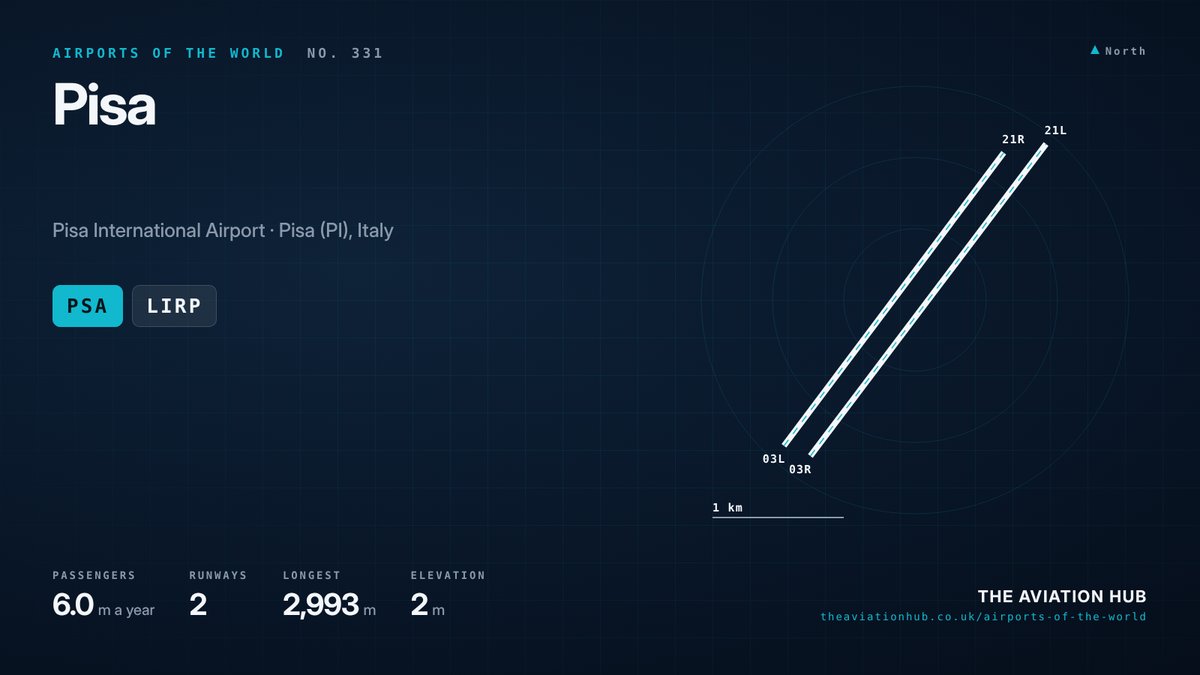
The airport uses the IATA code PSA and the ICAO code LIRP. It sits just 2 m (6 ft) above sea level on the flat coastal plain of the Arno, a few miles inland from the Ligurian Sea. Two parallel asphalt runways and a single passenger terminal serve the field. Toscana Aeroporti runs it alongside Florence Peretola, while the Aeronautica Militare operates a large base on site.
Pisa Airport handled 5,547,008 passengers in 2024, up 8.6 per cent on the year, with 41,819 aircraft movements and almost 13,000 tonnes of cargo. That ranks it tenth in Italy by passengers. Ryanair is the largest airline by a distance, with easyJet, Wizz Air, Jet2.com, British Airways, Volotea, Aeroitalia and Eurowings also prominent. Timetables and parking details are on the airport’s official website.
How Pisa’s Airport Came to Be
The airfield began life as a military base in the 1930s. In the final stages of the Second World War it hosted units of the US Army Air Forces’ Fifteenth Air Force. Civil flying grew after the war, though the military never left. On 27 January 1952 a Seaboard and Western Douglas DC-4 carrying cattle overshot the runway and burned, an odd footnote in the field’s early civil story.
The airport takes its name from Galileo Galilei, the astronomer and physicist born in Pisa in 1564. Low cost airlines transformed its fortunes in the 2000s. Traffic rose 30 per cent in 2006 and 24 per cent in 2007, the fastest growth among Italy’s 15 largest airports at the time. Delta even flew to New York JFK from June 2007 until 2016.
The Pisa Mover, an automated people mover to Pisa Centrale, opened in 2017 and replaced the old rail link into the terminal. The Pisa and Florence airport companies merged in 2015 to form Toscana Aeroporti, bringing both under one operator. Traffic dipped in the pandemic and then recovered strongly, moving past its pre pandemic level by 2024.
Runways at Pisa Airport
Two parallel asphalt runways serve Pisa Airport. Runway 03R/21L is 2,993 m (9,820 ft) long and 45 m wide, and runway 03L/21R is 2,792 m (9,160 ft) by 45 m. Both comfortably take the Boeing 737-800 and Airbus A321neo that make up most civil traffic, as well as the military transports. The runways run northeast to southwest across the flat plain.
The Italian Air Force’s 46th Air Brigade flies the Lockheed C-130J Hercules and Leonardo C-27J Spartan from the base. Military and civil movements are sequenced together, which can add a few minutes at busy times. Arrivals come in from the southwest over open countryside or from the northeast over the city outskirts, depending on the wind. On 23 November 2009 an Air Force KC-130J crashed just after take off, killing all five crew.
Terminals and Airlines
A single terminal at Pisa Airport handles all passengers, split into two zones. Gates 1 to 11 on the ground floor serve Schengen flights and rely on buses to reach aircraft. Gates 21 to 25 on the first floor handle non Schengen services, including UK flights, with walk out boarding, buses or a single jet bridge at gate 23. The building gets busy in summer but is compact enough to cross in minutes.
Ryanair uses Pisa as a focus city and has the largest network, with dozens of year round and seasonal routes flown by Boeing 737-800 and 737-8200 jets. easyJet, Wizz Air and Jet2.com add more low cost capacity, while British Airways flies from London. Volotea, Aeroitalia, Eurowings and Norwegian fill out the European picture. flydubai has provided the main link beyond Europe, though its Dubai service has been suspended for periods.
Routes and Destinations
The UK is a core market for Pisa Airport. London is served from several airports by Ryanair, easyJet, British Airways and others, and Jet2.com flies from Birmingham, Leeds Bradford and Manchester. Scandinavian, German, Spanish and Eastern European routes follow. Domestic flights reach Sicily, Sardinia and southern Italy, with Wizz Air adding Palermo from 25 October 2026.
Summer is the peak by a wide margin, as beach and villa traffic floods into Tuscany. Winter schedules thin out but keep the main city links, and Wizz Air adds Madrid from 3 November 2026 while Volotea resumes Toulouse on 6 November. Dubai, around 2,800 miles (4,500 km) away, is the longest route when flydubai operates. North African and Middle Eastern routes add variety, and cargo stays modest at about 13,000 tonnes.
Getting to and from Pisa Airport
The Pisa Mover is the obvious first step. The automated shuttle links the terminal with Pisa Centrale station in about five minutes for a fare of a few euros. From Pisa Centrale, regional trains reach Florence Santa Maria Novella in around an hour, Lucca in under 30 minutes and La Spezia for the Cinque Terre in about an hour. The Mover and train combination is the cheapest sensible option for most journeys.
Flibco runs coaches from outside the terminal to Florence city centre several times a day, taking a little over an hour. Taxis to the Leaning Tower take around ten minutes. Drivers reach Pisa Airport from the dual carriageway to Florence and the A12 motorway along the coast. Five car parks cover short and long stays, and car hire desks are grouped close to the terminal.
Spotting and Photography
Pisa is a mixed bag for spotters. Civil movements are heavy with Ryanair, but the military side adds C-130Js and C-27Js that make a visit worthwhile. Public roads around the perimeter give views of arrivals and departures over the flat Tuscan countryside. The car parks close to the terminal offer glimpses of the civil apron.
Summer haze softens long lens shots, so early morning and evening give the best results. The flat terrain means runway approaches are easy to frame against open sky. Italy takes military security seriously. Stay on public land, avoid lingering near the Air Force side, never climb fences and comply at once with the Carabinieri or base personnel.
What Comes Next
Toscana Aeroporti manages Pisa and Florence as a pair. Florence’s short runway limits growth there, and a long planned new runway at Peretola has faced repeated legal and political challenges. That keeps Pisa as the region’s main low cost and leisure airport. Terminal expansion is part of the operator’s plans, and new routes from Wizz Air and Volotea point to further growth.
Constraints remain. The shared military base, the nearby city and noise concerns limit how far the airfield can grow. Pisa Airport looks set to keep climbing gently towards 6 million passengers, with summer peaks driving the numbers. Compare it with other Italian gateways on the Airports of the World map.
Continue to follow The Aviation Hub for more analysis and insight.
Advertise with us Your brand, in front of an aviation audience Home page and in-article placements, sold directly, one advertiser per slot. From £250 a year. See the rates

