
Pittsburgh Airport Guide: From US Airways Hub to New Terminal
Pittsburgh Airport lost its US Airways hub, kept four runways and opened a new terminal in 2025. Airlines, routes, transport and spotting advice in one guide.
 By The Aviation Hub
7 min read
Updated October 20, 2026
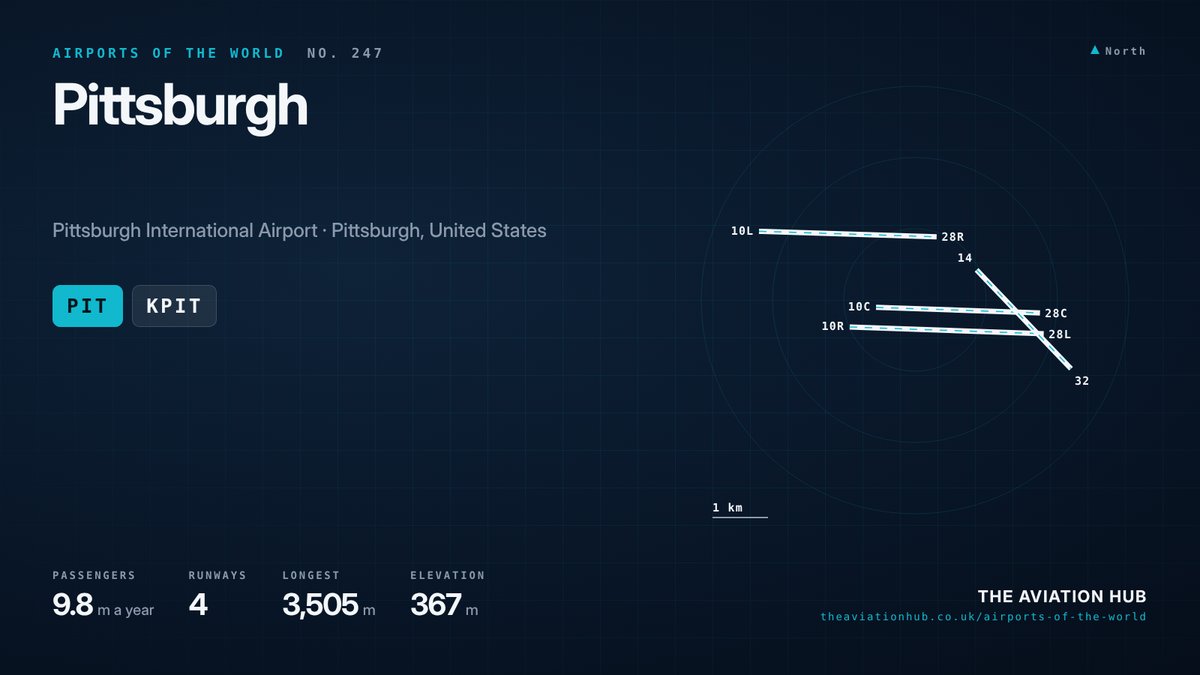
Pittsburgh International Airport sits on a sprawling site in the hills of western Pennsylvania, about 17 miles (27 km) west of downtown. Pittsburgh Airport was once a fortress hub for US Airways with about 20 million passengers a year at its peak, and the four runway airfield and X shaped airside terminal were built for that role. The hub is long gone, but the airport has rebuilt itself as a Southwest Airlines stronghold with close to 10 million passengers, a London link and a brand new landside terminal that opened in November 2025.
Pittsburgh Airport at a Glance
The IATA code is PIT and the ICAO code is KPIT. The airport lies in Findlay and Moon townships, roughly 17 miles (27 km) west of the city centre, at an elevation of 367 metres (1,203 feet). There are four runways, three of them parallel, and a terminal complex split between a landside building for check in and security and an airside building with 61 gates on four concourses.
Passenger traffic was around 9.8 million in 2025, roughly level with the previous year. Southwest is the largest carrier with about a quarter of passengers, and Allegiant Air has an operating base here. American Airlines and Republic Airways both run maintenance bases on the field. The Allegheny County Airport Authority operates the airport, and up to date terminal and parking details are on the airport’s official website.
How Pittsburgh’s Airport Came to Be
Federal planners began building the field in 1942 as a military airport on farmland bought by Allegheny County. After the war the county added a commercial terminal to relieve the older Allegheny County Airport, and Greater Pittsburgh Airport opened on 31 May 1952. An international arrivals building in 1972 brought the word International into the name.
The decisive moment came in 1992 with the opening of the Midfield Terminal, a landside and airside complex connected by an underground people mover. The New York Times called it the airport of the future, and it was designed around the US Airways hub, which at its peak in the late 1990s pushed traffic to about 20 million passengers. The 1994 crash of USAir Flight 427, a Boeing 737-300 that rolled out of control on approach and killed all 132 on board, led to changes to the rudder system on every 737.
US Airways dismantled the hub after its bankruptcies in the early 2000s, and traffic fell by more than half. The airport spent a decade courting low cost carriers and has succeeded, with Southwest, Frontier, Allegiant and Breeze all growing. In 2021 the field became the first in the world to run entirely on its own microgrid, powered mainly by natural gas with a solar farm alongside.
Runways at Pittsburgh Airport
Pittsburgh Airport has four runways, a legacy of its hub era that gives it enormous spare capacity. The main runway, 10R/28L, is 3,505 metres (11,500 feet) long and 61 metres wide with a concrete surface. Parallel to it are 10C/28C at 3,284 metres (10,775 feet) and 10L/28R at 3,201 metres (10,502 feet), both 46 metres wide. The crosswind runway, 14/32, is 2,469 metres (8,101 feet) of concrete.
Three parallel east west runways allow simultaneous arrivals and departures, and the airport can run independent approaches on the outer pair. In westerly winds runway 28L is the main arrival runway and 28R handles most departures. In easterly winds 10L takes most arrivals, 10R is the second arrival runway and 10C handles departures. Runway 32 is the main arrival runway for general aviation.
The runways are long enough for any aircraft, and British Airways operates the Boeing 787 to Heathrow without restriction. The surplus capacity and location make the field a favourite diversion airport for the northeast, with a record 463 diversions in 2018 when storms closed hubs along the coast.
Terminals and Airlines
The new landside terminal opened on 18 November 2025 and replaced the 1992 building, which had required a people mover ride to reach the gates. At Pittsburgh Airport the new structure sits next to the airside building, so passengers walk directly from security to the concourses. The project cost around US$1.7 billion, up from a planned US$1.1 billion, and includes a 3,300 space garage and a 2,800 space surface car park.
The airside terminal is shaped like an X, with Concourse A holding 23 gates, Concourse B 25, Concourse C 6 gates for international arrivals and Concourse D 7. Southwest dominates with Boeing 737-700, 737-800 and 737 MAX 8 services. American, Delta and United fly to their hubs with a mix of mainline Airbus A320 family jets and regional Embraer E175 and CRJ-900 aircraft. Frontier, JetBlue, Allegiant and Breeze add low cost options.
Routes and Destinations
Atlanta was the busiest route in 2025 with around 370,000 passengers, followed by Chicago O’Hare, Orlando, Charlotte and Denver. The pattern reflects an airport that feeds the big hubs and sends Pittsburghers south for the winter. Florida leisure routes with Southwest and Allegiant fill the schedule from December to April.
International service is modest but real. British Airways flies to London Heathrow with the 787, the longest route from Pittsburgh Airport. Icelandair serves Reykjavik in summer, and Aer Lingus has flown to Dublin since May 2026. Air Canada links Toronto, and there are seasonal flights to Cancun and the Caribbean. Cargo is handled mainly by FedEx, UPS and Amazon Air.
Getting to and from Pittsburgh Airport
There is no rail link. The light rail system does not reach the airport, and proposals for an extension have never found funding. Pittsburgh Regional Transit’s 28X Airport Flyer bus runs from the terminal to downtown and Oakland roughly every 30 minutes, taking 40 to 60 minutes and costing a couple of dollars, which makes it the cheapest sensible option by a wide margin.
By road the airport sits at the end of the Airport Parkway, exit 53 of Interstate 376, with the Southern Beltway (Route 576) joining from the south. Downtown is 25 to 40 minutes away depending on traffic through the Fort Pitt Tunnel. Taxis and app cars with Uber and Lyft cost around US$40 to US$55 (roughly £30 to £45) to the centre.
The new terminal garage and surface lot sit right outside the building, with cheaper extended parking lots served by shuttle buses. Mountain Line Transit’s Grey Line connects communities south of the city and parts of West Virginia. Car hire desks are in the terminal, and a large consolidated rental car facility stands nearby.
Spotting and Photography
The hills around Pittsburgh Airport provide several vantage points. The sidewalk on Ewing Road is a popular choice for arrivals on runway 28L, and the Montour Trail on the northwest side of the field looks at runway 10L arrivals and 28R departures. The mix of Southwest 737s, regional jets and the British Airways 787 gives variety.
The far end of Concourse A, around gates A19 to A25, gives good airside views of the taxiways. Since 2017 the airport has allowed people without tickets to pass through security under its myPITpass scheme, the first US airport to do so since 2001, which means spotters can get airside views on quieter days.
Local police patrol the perimeter roads and the cargo area. Stay on public verges, do not stop on the Parkway and avoid the fence line near the cargo and military ramps. The Air National Guard and Air Force Reserve share the field, so photographing the military side is unwise.
What Comes Next
With the landside terminal open, attention turns to the airside building. The authority plans to renovate the gate areas, restrooms and concessions over the coming years, and to decide what to do with the old landside terminal and people mover. Keeping airline costs in check after the construction matters for an airport that depends on price sensitive carriers.
The four runways give Pittsburgh Airport room to grow for decades, and the Dublin and Heathrow links show that transatlantic demand exists. The likely path is steady growth with Southwest and the low cost carriers rather than any return to hub status. Compare it with other US airports on the Airports of the World map.
Continue to follow The Aviation Hub for more analysis and insight.
Advertise with us Your brand, in front of an aviation audience Home page and in-article placements, sold directly, one advertiser per slot. From £250 a year. See the rates

