
Porto Alegre Airport Guide: Flood, Recovery and Routes
Porto Alegre Airport is the gateway to southern Brazil. Its history, longer runway, airlines, routes, metro link and recovery from the 2024 flood.
 By The Aviation Hub
6 min read
Updated October 20, 2026
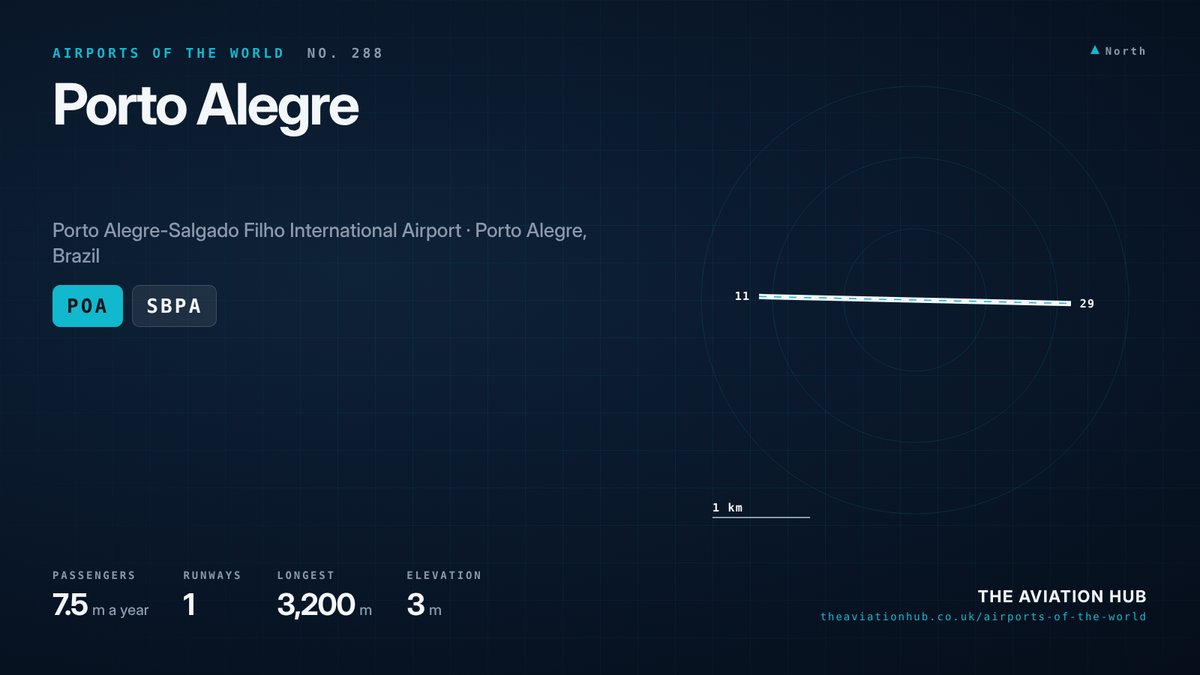
Salgado Filho International Airport is the main gateway to Rio Grande do Sul, the southernmost state of Brazil. Porto Alegre Airport handled about 7.5 million passengers in 2025, a remarkable figure for a field that spent much of 2024 under water. It sits on low ground beside the city’s northern districts, close to the rivers that feed the Guaíba. A longer runway, a metro link and a German operator have reshaped it over the past decade.
Porto Alegre Airport at a Glance
The IATA code is POA and the ICAO code is SBPA. The airport lies about 6 miles (9 km) north east of downtown, at an elevation of just 3 metres (11 ft). It has a single runway and one passenger terminal, Terminal 1. The older Terminal 2 now houses offices.
Traffic in 2025 was roughly 7.5 million passengers, with about 67,000 aircraft movements and close to 34,000 tonnes of cargo. LATAM, Gol and Azul, the three Brazilian majors, carry the bulk of the traffic. Fraport Brasil has run the airport since January 2018 under a 25 year concession, taking over from the state company Infraero. Flight information and parking details are on the airport’s official website.
How Porto Alegre’s Airport Came to Be
Aviation arrived on the site on 31 May 1923, when the first aircraft landed at what was then an air club. The field became São João Federal Airport, named after its neighbourhood. Varig, founded in Porto Alegre in 1927, made it an operating base from 1932, and the first passenger terminal opened in 1940. The airline remained a powerful local presence for decades.
The current name dates from 12 October 1951. It honours Senator Joaquim Pedro Salgado Filho, the first minister of the Brazilian Air Force, who died in an air crash in 1950. A new terminal followed in 1953 and was renovated in 2010. Today’s Terminal 1 opened on 11 September 2001. Terminal 2 closed to passengers on 15 September 2019, when Fraport moved all airlines into one building.
Runways at Porto Alegre Airport
Porto Alegre Airport has one asphalt runway, 11/29, which is 3,200 metres (10,499 ft) long and 45 metres wide. For most of its life it measured only 2,280 metres. The extension opened in May 2022 after years of delay, partly caused by the resettlement of the Vila Nazaré community that lay in its path. The extra length allows aircraft such as the Boeing 777-300 and Airbus A330-900 to fly to Europe and North America without heavy payload limits.
Easterly winds are common in Porto Alegre, so runway 11 sees regular use, with 29 taking over when the wind turns west. The airport has no crosswind runway. The low elevation, so close to river level, proved the field’s weakness in 2024. When the floods came there was nowhere for the water to go.
Terminals and Airlines
Terminal 1 at Porto Alegre Airport covers about 37,600 square metres and has 16 gates with jet bridges. It was designed with a shopping mall built in, an unusual feature in the region when it opened. LATAM, Gol and Azul run the domestic network with Airbus A320 family jets, Boeing 737s and Embraer E195s. Azul also flies ATR turboprops to smaller cities in the state.
International carriers include Aerolíneas Argentinas, Copa Airlines, TAP Air Portugal and Sky, which link the city to Buenos Aires, Panama City, Lisbon and Santiago. LATAM adds flights to neighbouring countries. Copa and TAP bring Star Alliance connections, while Aerolíneas Argentinas belongs to SkyTeam.
Routes and Destinations
From Porto Alegre Airport, São Paulo is the dominant market, served at both Guarulhos and Congonhas, with Campinas for Azul connections. Rio de Janeiro and Brasília follow, along with Curitiba, Florianópolis and the cities of the north east in the holiday season. International flights reach Buenos Aires, Santiago and Panama City. TAP flies to Lisbon four times a week, the only link to Europe, and Azul added a seasonal service to Bariloche in July 2026.
Getting to and from Porto Alegre Airport
Rail is the cheapest sensible option. Since August 2013 the Aeromóvel, an air propelled people mover, has linked Terminal 1 with Aeroporto station on the Trensurb metro. From there trains reach Mercado station in the city centre in around 10 minutes, and the whole trip costs a few reais. Bus routes T5, T11 and B09 also stop at the terminal.
By road, the centre is about 20 minutes away outside the rush hours, and around 40 minutes when traffic is heavy. Taxis and ride hailing services pick up outside arrivals. The car park has around 1,440 spaces, which can fill at peak times. Avenida dos Estados and the BR 290 motorway connect Porto Alegre Airport with the coast road and the wider state.
Spotting and Photography
Porto Alegre Airport has no public viewing terrace, but the elevated Aeromóvel offers a raised view during its short ride, and the metro platform overlooks parts of the airport. Public roads along the perimeter give glimpses of the runway. Traffic is mostly narrow bodies from the three domestic airlines, with occasional wide bodies on international and charter flights.
This far south the sun sits to the north for most of the day, so the northern side of the field generally gives the better light. Brazilian airports are security conscious. Stay on public land, avoid photographing military aircraft at Canoas and move on if police ask you to.
Flood Recovery and What Comes Next
Torrential rain swamped Rio Grande do Sul in late April and May 2024. Porto Alegre Airport suspended operations on 3 May, and no flights ran from 4 to 26 May. Water covered the runway, aprons and the ground floor of the terminal, and 47 aircraft were trapped until they could be flown out as levels fell.
A limited service ran from Canoas Air Force Base, north of the city, from 27 May. From 15 July passengers checked in at the terminal and were bussed to Canoas. Phase one of the reopening began on 21 October, using the least damaged 1,730 metre stretch of runway for up to 128 flights a day. Full operations returned on 16 December 2024.
Resilience now comes first. After the flood, Fraport and the authorities focused on protecting the airport from a repeat, with better drainage and renewed flood defences for the city. The longer runway has opened the door to long haul flights, and the operator is keen to attract European and North American carriers to fill it.
Porto Alegre Airport has proved it can recover from disaster, and traffic in 2025 was back above seven million. The next step is turning that runway length into a wider intercontinental network beyond Lisbon. See how it compares with other South American gateways on the Airports of the World map.
Continue to follow The Aviation Hub for more analysis and insight.
Advertise with us Your brand, in front of an aviation audience Home page and in-article placements, sold directly, one advertiser per slot. From £250 a year. See the rates

