New international rules limit passengers to two power banks and ban charging them on board, and some airlines have gone further. Here is what you need to know before taking a power bank on a plane this Christmas, from where to pack it to how big it can be.
Taking a power bank on a plane is no longer as simple as throwing it in your bag. Since 27 March 2026, new international rules adopted by the UK Civil Aviation Authority have limited passengers to two power banks each and banned recharging them on board, according to the CAA.
With many people taking new gadgets away over Christmas, it is worth checking the rules before you pack.
The Key Rules
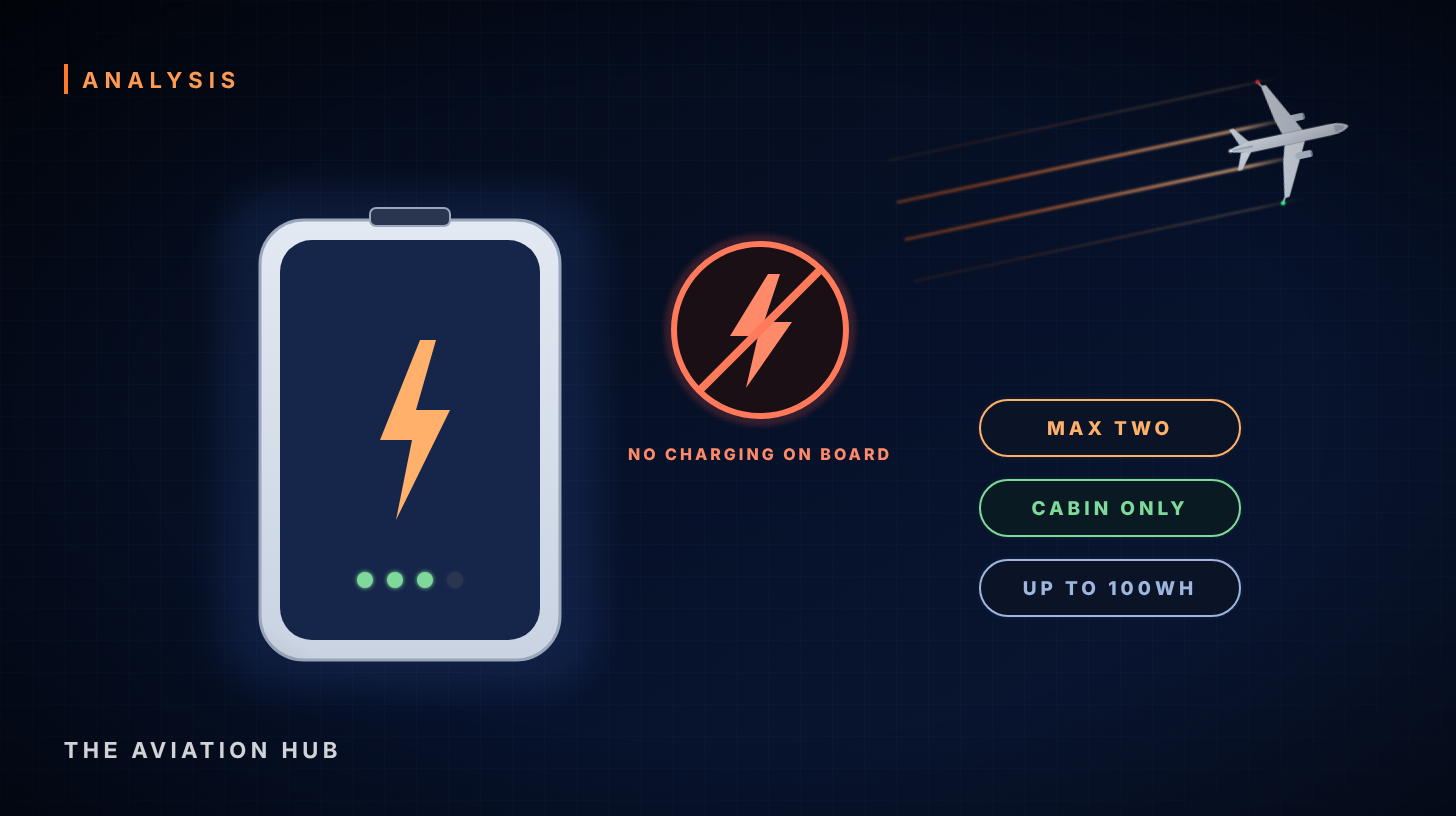
Power banks must be carried in your hand luggage, never in checked baggage. You can take a maximum of two per person.
They must not be recharged on board the aircraft, and the CAA says they should not be used to charge other devices during the flight. Each one must also be protected from short circuits when not in use, for example by keeping it in its original packaging, taping over the terminals or using a separate pouch.
How Big Can a Power Bank Be?
Most everyday power banks are fine. Those rated up to 100 watt hours can be carried without the airline’s approval, the CAA says.
Larger power banks, between 100 and 160 watt hours, need approval from the airline before you fly. The rating is usually printed on the device. If it only shows milliamp hours, a typical 20,000mAh power bank is around 74 watt hours, within the standard limit.
Why the Rules Have Tightened
Lithium battery incidents on aircraft are rising. The CAA says they now happen at a rate of around two a week, and reports of passenger devices overheating or malfunctioning nearly doubled between 2024 and 2025, according to the CAA.
The risk is a fire known as thermal runaway, which can spread quickly and is hard to put out. In the cabin, crew can see and deal with it. In the hold, it could go unnoticed.
Many Travellers Still Get It Wrong
The CAA found that 36% of travellers are unaware of the dangers of packing batteries in checked baggage. Cases of lithium battery devices found in checked luggage rose by 91% in 2025.
“Pack right for a safe flight, and that means don’t put your batteries in your checked bag,” said the CAA’s director of aviation safety.
Some Airlines Go Further
Several airlines have introduced stricter rules of their own. The Lufthansa Group, which includes Lufthansa, Swiss, Austrian, Brussels Airlines and Eurowings, has banned the use and charging of power banks on board since 15 January 2026, and does not allow them in overhead lockers, according to Brick.
Qantas, Jetstar and Virgin Australia have similar bans. Rules vary by airline, so check your carrier’s website before you fly, especially if you have connecting flights with different airlines.
Practical Tips
Pack your power bank somewhere you can reach it, such as a coat pocket or the bag under the seat in front, rather than the overhead locker. If it becomes hot, swells or starts to smoke, tell the crew immediately.
Charge your devices fully before you travel, and bring a charging cable for the seat power socket if your aircraft has one. Leave damaged or recalled power banks at home.
The Bottom Line
The rules on taking a power bank on a plane are now clear: keep it in your hand luggage, carry no more than two, and do not charge it on board. Some airlines, including the Lufthansa Group, also ban using one at all during the flight.
For most travellers, a standard power bank will be fine. The key is to pack it correctly and check your airline’s rules before you go.
Continue to follow The Aviation Hub for more analysis and insight.
Advertise with us Your brand, in front of an aviation audience Home page and in-article placements, sold directly, one advertiser per slot. From £250 a year. See the rates