Power Banks on Flights 2026: The Rules for UK Passengers
 By The Aviation Hub
6 min read
Updated October 11, 2026
By The Aviation Hub
6 min read
Updated October 11, 2026 
Power banks must travel in your cabin bag, you can carry two at most, and since 27 March 2026 they cannot be recharged on board, with several airlines banning their use in flight altogether.
A power bank belongs in your hand luggage and never in a checked bag. The Civil Aviation Authority says you can take two power banks per person, that batteries from 100 watt hours (Wh) to 160Wh need airline approval, and that anything over 160Wh is prohibited in passenger baggage.
These details were checked in October 2026. New international rules took effect on 27 March 2026, and a growing list of airlines now goes further by banning any use of a power bank during the flight. The safest choice is a clearly labelled power bank of under 100Wh.
The Baseline Rules in the UK for Power Banks
The CAA’s packing advice tells passengers to keep power banks and vapes with them in the cabin because they can overheat and cause a fire in the hold. It adds that power banks should never be recharged on the aircraft, and that crew may ask you to keep one in the seat back pocket rather than an overhead locker.
Gate check is where many passengers slip up. If your cabin bag is taken from you at the gate to go in the hold, the CAA says to remove any batteries or lithium powered devices first. British Airways makes the same point: spare batteries and power banks must stay with you in the cabin.
Airline industry guidance is stricter on size. IATA’s passenger guidance, dated 31 March 2026, limits passengers to a maximum of two lithium ion power banks not exceeding 100Wh and lists larger power banks as forbidden. It also notes that airlines may impose more stringent conditions.
What Changed for Power Banks on Flights in March 2026
The CAA’s summary of the rule change says an International Civil Aviation Organization addendum became effective on 27 March 2026. It separates power banks from other spare batteries and sets a maximum of two power banks per person.
Under those rules a power bank must be carried in carry on baggage, must be individually protected against short circuit and must not be recharged on board. The text adds that a power bank should not be used to charge other devices on board, which is advice rather than an outright ban.
More tightening is coming. IATA’s guidance to airlines says the changes will be written into the next edition of its Dangerous Goods Regulations, which takes effect on 1 January 2027, and indicates that the approval route for power banks above 100Wh will not carry over.
How to Work Out Watt Hours
Airlines measure battery size in watt hours, while most power banks are sold by milliamp hours (mAh). The CAA says that if the Wh rating is not printed on the battery, you multiply the volts by the amp hours, and for a figure in mAh you divide the result by 1,000.
So a power bank labelled 20,000mAh and 3.7 volts works out as 20,000 multiplied by 3.7, divided by 1,000, which is 74Wh. A 10,000mAh unit at the same voltage is 37Wh. On the same 3.7 volt label, the 100Wh threshold falls at about 27,000mAh.
The label matters as much as the sum. Jet2 forbids lithium batteries and power banks that have no clearly stated watt hour rating, and British Airways requires each power bank to show its capacity rating.
What UK Airlines Say
British Airways allows up to two power banks per person, each no more than 100Wh. They must be stored in the seat pocket or in a bag under the seat in front, and the aircraft seat power supply is for charging personal devices, not power banks.
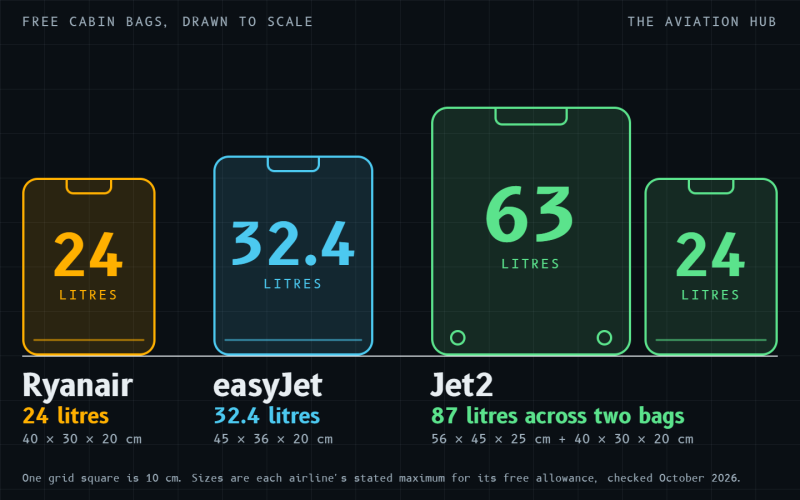
Jet2’s restricted items page allows no more than two power banks per person, each not exceeding 160Wh, and grants automatic approval for those between 100Wh and 160Wh. It says power banks must not be charged on board and must not be used to charge or power any device on board. See our Jet2 baggage guide for cabin bag sizes.
easyJet’s dangerous goods page allows a maximum of two power banks per person, in your cabin bag only, and says they must not be recharged or used to charge other devices on board. Its restricted items page sets the limit at 160Wh and asks you to keep them somewhere they can be easily monitored. Smart luggage going in the hold must have its battery or power bank removed at Bag Drop.
Ryanair’s Help Centre limits power banks to two per passenger and bans any over 100Wh from both cabin and hold. They must stay on your person or in the bag under the seat in front, never in the overhead lockers. Ryanair is the exception on use: a power bank may charge personal devices except during taxi, take off and landing, unless crew say otherwise, but must never be recharged on board.
TUI’s luggage guidelines do not mention power banks and point to a separate list of items allowed on board. Its drone guidance gives a guide to its approach to lithium batteries: spare batteries travel in carry on baggage only, a drone with batteries above 100Wh and up to 160Wh needs TUI’s prior approval, and anything over 160Wh is forbidden. Read that list before you fly and treat the CAA baseline as the minimum.
The Stricter Long Haul Airlines
Emirates has been among the strictest since 1 October 2025. Customers may carry one power bank under 100Wh, it may not be used in the cabin or charged from the aircraft, and it must sit in the seat pocket or a bag under the seat in front.
Singapore Airlines set a maximum of two power banks from 15 April 2026, with prior approval needed between 100Wh and 160Wh. They cannot be charged through in seat outlets or USB ports, or used to charge personal devices in flight.
Qantas allows up to two, which cannot be used or charged during the flight. Cathay Pacific also allows two, bans use and recharging at any time, and requires them to stay under the seat in front rather than in overhead compartments.
In South Korea, Korean Air’s newsroom says Korean Air, Asiana Airlines, Jin Air, Air Busan and Air Seoul banned the use and charging of power banks on board from 26 January 2026. Overhead bin storage is not allowed.
The Bottom Line
Carry no more than two power banks, or one on Emirates, and keep each under 100Wh with the rating printed on the case. Pack them in the bag that goes under the seat in front of you, and take them out if that bag is sent to the hold at the gate.
Do not plan to use a power bank in the air. Ryanair still permits it outside taxi, take off and landing, but most airlines covered here do not. Charge your phone before boarding, use the seat power where the airline provides it, and check your own airline’s page before a long haul trip because these rules have changed several times since late 2025.
Continue to follow The Aviation Hub for more analysis and insight.
Advertise with us Your brand, in front of an aviation audience Home page and in-article placements, sold directly, one advertiser per slot. From £250 a year. See the rates