
Prague Airport Guide: Vaclav Havel’s Gateway to Bohemia
Prague Airport, named after Vaclav Havel, is the Czech Republic's main gateway. Runways, terminals, Ryanair and Smartwings routes and access explained.
 By The Aviation Hub
6 min read
Updated October 20, 2026
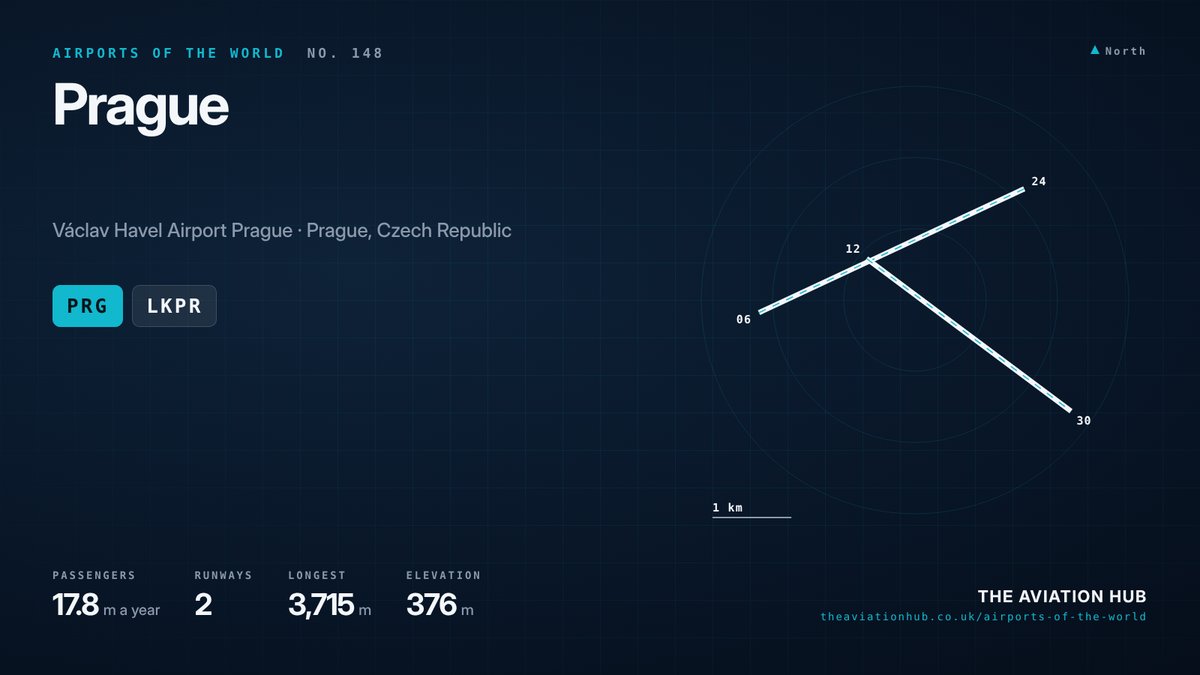
Vaclav Havel Airport Prague is the main gateway to the Czech Republic and one of the busiest airports in central Europe. It sits on a plateau at Ruzyne on the western edge of the city, above the Vltava valley. Prague Airport handled close to 18 million passengers in 2025, almost matching its pre pandemic record despite the collapse of its long time flag carrier Czech Airlines. Low cost airlines and a booming tourist trade now fill the gap.
Prague Airport at a Glance
The IATA code is PRG and the ICAO code is LKPR. The airport lies about 7 miles (12 km) west of the old town, at an elevation of 376 m (1,234 ft). There are two usable runways and two passenger terminals, Terminal 1 for non Schengen flights and Terminal 2 for the Schengen area, plus a private aviation Terminal 3 and a VIP Terminal 4 used for state visits.
Prague Airport handled roughly 17.75 million passengers in 2025, up about 8.5 per cent, and just short of the 2019 record. Cargo reached around 96,000 tonnes. Smartwings, the Czech leisure airline, operates its hub here, and Ryanair and Eurowings have bases. Letiste Praha, a company wholly owned by the Czech state, runs the airport and publishes timetables and transport details on the airport’s official website.
How Prague’s Airport Came to Be
Czechoslovak civil aviation began at Kbely, a military field on the north east side of the city, shortly after the republic was founded in 1918. Kbely was cramped by the 1930s, so a new airport opened at Ruzyne on 5 April 1937. Its functionalist check in building won a gold medal at the Paris international exhibition that year and survives as Terminal 4.
The airport played a grim role in August 1968, when Soviet paratroopers seized it in the opening hours of the Warsaw Pact invasion so transport aircraft could land troops. That same year the first modern terminal, now Terminal 1, opened. An Aeroflot Tupolev Tu-154 crashed short of the runway in 1973, killing 66 people, and an Inex Adria DC-9 hit high ground in fog in 1975 with 75 dead.
Terminal 1 was rebuilt in 1997, and Terminal 2 opened in 2006 to handle Schengen traffic. Runway 06/24 was fully reconstructed in 2012 and 2013. In October 2012, after an online petition gathered more than 65,000 signatures in a week, the airport was renamed after Vaclav Havel on what would have been his 76th birthday. Czech Airlines ceased operations in late 2024 after 101 years.
Runways at Prague Airport
Prague Airport has two concrete runways. The main one is 06/24, which is 3,715 m (12,189 ft) long and 45 m wide, and it carries the overwhelming majority of traffic. Prevailing westerly winds mean runway 24 is in use most of the time, with arrivals approaching from the north east over the suburbs. The crossing runway, 12/30, measures 3,250 m (10,663 ft) and has only a Category I instrument landing system.
Runway 12/30 is used when crosswinds dictate or during maintenance, and its approach passes over the Prague 6 district and the town of Kladno, which keeps its use politically sensitive. A third strip, 04/22, is permanently closed to take offs and landings and serves as a taxiway and parking area. A parallel runway, 06R/24L, has been planned for two decades to relieve the main strip but remains tangled in environmental approvals.
Terminals and Airlines
Terminal 1 opened in 1968 and was rebuilt in 1997, and it now handles all flights to destinations outside the Schengen zone, through concourses A and B. That means the United Kingdom, Ireland, Turkey, the Gulf, North America and Asia. British Airways, easyJet’s UK flights, Turkish Airlines, Emirates, Qatar Airways, Delta and Korean Air all operate here. Border control sits between the check in hall and the gates.
Terminal 2 opened in 2006 and handles Schengen flights through concourses C and D. Ryanair, Wizz Air, Eurowings, Lufthansa, Air France, KLM, Swiss, Vueling and the Schengen sectors of Smartwings all use it. The two terminals at Prague Airport are joined by a walkway and sit side by side. Alliance wise, Lufthansa, Austrian, Swiss and Turkish fly Star Alliance colours, Air France, KLM and Delta cover SkyTeam, and British Airways, Qatar Airways and Finnair represent Oneworld. Terminal 3 handles private jets and charters, while Terminal 4 is reserved for government flights.
Routes and Destinations
London was the biggest destination city in 2024, followed by Paris, Amsterdam, Milan and Rome. By country, the United Kingdom led, ahead of Italy, Spain, France and Turkey. Around 70 airlines served more than 170 destinations in 2024. Ryanair and Wizz Air blanket Europe with Boeing 737-800 and Airbus A321neo services, and Smartwings operates its 737 MAX 8 fleet to the Mediterranean, Canaries and Egypt from spring to autumn.
Long haul remains thin. Emirates and Qatar Airways connect through the Gulf, Korean Air and Asiana fly to Seoul, Hainan Airlines to Beijing, Delta operates seasonal New York flights and Air Canada serves Toronto in summer. The longest regular routes are the China Airlines and Starlux services to Taipei at roughly 5,600 miles (9,000 km). Winter is the quiet season, with Christmas markets providing a December bump, and summer peaks from June to September. Cargo moves through two terminals operated by Menzies and Skyport.
Getting to and from Prague Airport
There is no railway to Prague Airport yet. The cheapest sensible option is trolleybus 59, which since 2024 links both terminals to Nadrazi Veleslavin on metro line A in about 15 minutes, with the metro reaching the centre in another 15. A single public transport ticket covers both legs for around CZK 40 (about £1.40). Bus 100 serves metro line B at Zlicin for passengers heading south west.
The Airport Express coach runs from Terminal 1 to the main railway station, Praha hlavni nadrazi, in about 35 minutes. Taxis to the old town take 25 to 40 minutes and cost roughly CZK 600 to 800 (about £21 to £28) with the official operators, and ride hailing apps are widely used. The airport sits beside the D7 motorway and the Prague ring road. Parking ranges from short stay garages opposite the terminals to cheaper long stay lots served by shuttle buses.
Spotting and Photography
Prague Airport is one of the easier European capital airports for spotting. It maintains an official viewing hill beside runway 06/24 at the village of Knezeves, which covers arrivals and departures on runway 24 in the usual westerly flow. Fields near Dobroviz and Jenec cover arrivals on runway 06 on easterly days. The public viewing terrace on the second floor of Terminal 2 looks across the apron to the Smartwings and Ryanair stands.
Light suits the terminal area in the morning and the Knezeves hill from late afternoon in summer. Traffic is a mix of Ryanair, Wizz, Smartwings and the Lufthansa group, with Emirates Boeing 777-300ER and Qatar Boeing 787 flights adding wide body interest. The airport doubled as Miami in the Bond film Casino Royale. Stay off farm tracks that are marked private, do not climb fences, and keep clear of the military area at Kbely if you venture across the city.
What Comes Next
Letiste Praha plans a new concourse for Terminal 2 with eight jet bridge gates and ten non Schengen bus gates, an extended check in hall in Terminal 1 and reworked concourses A and B. Construction is due to begin in 2027 or 2028 with completion by around 2033. The rail link, a branch from the Prague to Kladno line with an underground station beneath the terminals, is the country’s first public private railway partnership at around CZK 28 billion and should open near 2030, cutting the trip to the centre to about 25 minutes.
Prague Airport is heading for 20 million passengers on a low cost model, with a parallel runway still the great unanswered question. Compare it with its neighbours on our Airports of the World map.
Continue to follow The Aviation Hub for more analysis and insight.
Advertise with us Your brand, in front of an aviation audience Home page and in-article placements, sold directly, one advertiser per slot. From £250 a year. See the rates

