
Rhode Island T. F. Green International Airport sits in Warwick, a short train ride south of the state capital. Providence Airport handled about 4.3 million passengers in 2025, and many of them came from Massachusetts rather than Rhode Island. Its pitch is simple: short queues, cheap parking and an easy run up Interstate 95, all within reach of Boston. That formula has kept it busy since Southwest Airlines arrived in the 1990s.
Providence Airport at a Glance
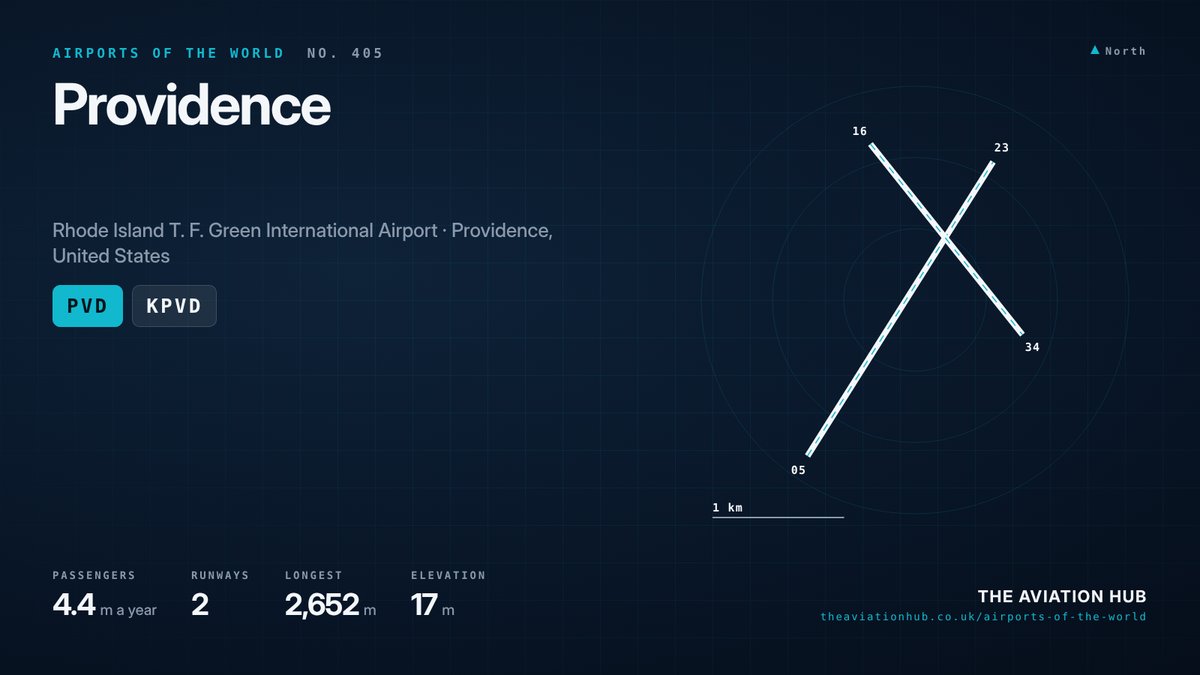
The IATA code is PVD and the ICAO code is KPVD. The airport lies roughly 6 miles (10 km) south of downtown Providence, at an elevation of 17 metres (55 feet). It has two runways and a single terminal with two concourses. Providence Airport recorded around 4.28 million passengers in 2025, up from about 4 million the year before.
Southwest Airlines is the largest carrier, and Breeze Airways runs a crew base here. The Rhode Island Airport Corporation, a quasi public subsidiary of the state’s Commerce Corporation, operates the site across about 1,111 acres. Flight times, parking rates and live updates are on the airport’s official website.
A Short History of T. F. Green
The field opened on 27 September 1931 as Hillsgrove State Airport, the first state owned and operated airport in the United States. In 1938 it took the name of Theodore Francis Green, a former governor elected to the Senate two years earlier. During the Second World War the Army Air Forces used it for flight training between 1942 and 1945.
Growth arrived much later. The terminal was rebuilt in 1996 and named after former governor Bruce Sundlun. Southwest’s arrival the same decade turned the airport into a regional alternative to Boston Logan. Traffic peaked at about 5.7 million passengers in 2005, then slipped as airlines consolidated.
Recent years brought ambition and frustration in equal measure. Norwegian based transatlantic flights at Providence Airport from 2017 to 2019, linking Rhode Island with Ireland, Scotland and Norway. The 737 MAX grounding and weak loads ended the experiment. In June 2021 the state formally renamed the field Rhode Island T. F. Green International Airport.
Runways at Providence Airport
Runway 05/23 is the main strip. It measures 2,652 metres (8,700 feet) long and 46 metres wide, with an asphalt surface. The crosswind Runway 16/34 measures 1,853 metres (6,081 feet), also 46 metres wide and surfaced in asphalt. Most airline traffic uses 05/23, with 16/34 taking over when strong northwesterly or southeasterly winds blow.
The main runway reached its current length only on 1 October 2017. The extension took decades to plan and required demolishing homes, relocating a city park and rerouting Main Avenue, despite local opposition. Officials argued it would allow longer nonstop flights and improve safety in poor weather. A former parallel runway, 5L/23R, closed after a 1999 incursion and now serves as Taxiway V at Providence Airport.
Terminals and Airlines
All flights use the Bruce Sundlun Terminal, a compact building designed by HNTB. The North Concourse holds 14 gates and the South Concourse has eight. Gates 7 and 8 handle international arrivals, with a direct link to customs on the lower level. Walking distances are short, and security rarely backs up for long.
Southwest operates the largest schedule with Boeing 737 jets. American, Delta and United connect the airport to their hubs, while Breeze Airways flies Airbus A220 aircraft to a growing list of leisure cities. Spirit, which shut down in May 2026, and other low cost carriers have come and gone over the years. With every alliance represented through its hub partners, Providence Airport works well for one stop connections almost anywhere.
Routes and Destinations
Florida dominates the leisure market. Orlando was the busiest route of all in 2025, and Tampa and Fort Lauderdale are popular too, especially in winter. Hub routes to Charlotte, Philadelphia, Atlanta, Detroit, Chicago and Washington feed connections across the network. Southwest adds point to point flights to cities such as Baltimore and Chicago Midway. Breeze focuses on secondary destinations that rarely have a direct link to New England.
International flying has been patchy. Norwegian’s 737 MAX routes once reached Dublin, Edinburgh, Belfast, Shannon, Cork and Bergen. Azores Airlines has also flown to the Azores for the region’s large Portuguese community. Cabo Verde Airlines returned in May 2026 with a weekly 737 MAX to Praia, and Breeze added Cancun in February 2026. Even so, the schedule is mainly domestic, with summer peaks to coastal and holiday destinations. Cargo is modest after Amazon Air moved its operation to Hartford’s Bradley in 2018.
Getting to and from Providence Airport
Rail is the standout feature. T. F. Green Airport station, opened in December 2010, sits on the MBTA Providence/Stoughton Line and links to the terminal by an elevated walkway. Trains reach Providence in about 15 minutes and Boston South Station in roughly 85 minutes. Amtrak does not stop here, though the state is studying a future stop.
A 1.1 mile (1.8 km) connector road leads directly onto Interstate 95. RIPTA buses run to Kennedy Plaza in downtown Providence and to Newport, the cheapest sensible option for most visitors. Taxis, ride hailing and rental cars wait outside, with the car rental centre beside the station. Garage and surface parking at Providence Airport cost far less than at Logan.
Spotting and Photography
The airport sits among residential streets, so viewing is informal rather than organised. Roads near the southwestern end of Runway 05/23, along the relocated Main Avenue, give close views of arrivals on Runway 05 and departures on Runway 23. The parking garages also offer elevated glimpses of the apron. Southwest 737s, Breeze A220s and regional jets make up the daily mix.
Southwesterly winds in summer usually bring arrivals onto Runway 23, while other wind directions can switch the flow. Viewpoints south of the main runway keep the sun behind you for much of the day. Respect private property, stay on public roads and never stop on the connector or Interstate 95 to take pictures. Keep well clear of the perimeter fence at Providence Airport and cooperate with any police check.
What Comes Next
The longer runway gives the airport the ability to handle longer nonstop flights, and the state continues to court transatlantic carriers. An Amtrak stop at the airport station remains under engineering study. Terminal upgrades since 2001 have expanded checkpoints, baggage screening and ticket counters, and further modernisation is ongoing.
Traffic is still below its 2005 peak, but the trend is upward again, helped by Breeze and steady Southwest flying. Logan’s congestion remains the airport’s biggest advantage. Expect a steady regional gateway that wins on convenience rather than scale. Compare it with other New England fields on our Airports of the World map.
Continue to follow The Aviation Hub for more analysis and insight.
Advertise with us Your brand, in front of an aviation audience Home page and in-article placements, sold directly, one advertiser per slot. From £250 a year. See the rates

